
From Jack & Jill to Baby Shark
The time has been when the most participative session of a school morning was the recitation of nursery rhymes, passed down through the generations. Learning by rote, often mispronounced, perfected for performance at family gatherings, a marker of accomplishment: the nursery rhyme has been the bedrock of an oral tradition passed down through the generations. It has created a comfortable nonsense-world where the focus is on sound, expression, action, rhythm and rhyme – the simplest form of poetic expression. This has cut across languages, encouraging translation and a change of linguistic register, with ease.
The nursery rhyme has, from time to time, been embroiled in controversy. The most recent controversy was sparked by Mr Sandeep Singh, the Minister of State for Basic Education, Government of Uttar Pradesh. In a public speech in an academic setting, he chose two nursery rhymes on which to vent his ire. The mischief-filled ‘Johnny, Johnny, “Yes Papa”’ and the playful ‘Rain, rain, go away’. Little ones, it seems, were not to be influenced into an unhealthy consumption of sugar and telling lies to elders about putting their hand in the sugar jar. Neither were they to be encouraged to be environmentally uncompassionate by wishing the rain to go away in a tropical country whose economy is dependent on agriculture, where rain is celebrated and welcomed.
The core of the argument used was that many popular English rhymes are culturally irrelevant to Indian children and carry hidden negative meanings or historical baggage from the British era. It was seen as the criticism of the colonial mindset or Gulami ki Mansikt, imbibed by children.
While these spins on the political correctness of what was seen as a part of the age of innocence is troublesome, there is no doubt that what are considered harmless, lilting melodies and rhymes, hide darker secrets, whose origins – genuine or imagined – have been camouflaged by time. Admittedly, the fact remains that what is learnt by rote and in tandem with a class-load of peers is rarely forgotten. However, the charge that the insidious corrupting influence of subliminal themes influences an adult’s response to life, is questionable.
JACK AND JILL
Does the simple Jack and Jill, the staple of all nursery rhymes weave a story about a climbing expedition gone horribly wrong? Will the Greta Thunberg brigade promote it as a doggerel regarding the terrible hardships and potential injuries sustainable in the obtaining of water; it’s scarcity and the dangers of its procurement?
Consider a version of the age-old English rhyme when rendered in Hindi:
Jack and Jill went up the hill,
जैक और जिल गए पहाड़ी पर,
(Jack aur Jill gaye pahadi par)
To fetch a pail of water,
लाने पानी की एक बाल्टी भर।
(Laane paani ki ek baalti bhar)
Jack fell down and broke his crown,
जैक गिरा और सिर फूटा उसका,
(Jack gira aur sir phoota uska)
And Jill came tumbling after.
और जिल भी लुढ़कती आई नीचे गिरकर।
(Aur Jill bhi ludhakti aayi neeche girkar)
Interestingly, due to the emphasis on Indian-centric alternatives, many schools in India wipe out ‘Jack and Jill’ entirely for traditional Hindi rhymes about water or nature, such as ‘मछली जल की रानी है’ (Machli Jal Ki Rani Hai) or ‘चंदा मामा दूर के’ (Chanda Mama Door Ke), which carry a similar rhythmic appeal but with familiar local themes!
INCY-WINCY SPIDER
Another popular rhyme, non-controversial till now, is ‘Incy-Wincy Spider’ (in India, corrupted to Inky-Minky Spider). This is generally viewed as one of the ‘safer’ rhymes because it teaches perseverance. The spider does not give up, despite the rain. This nursery rhyme too is now bi-lingual:
Inky-Minky spider climbed up on the wall
इन्की-मिन्की मकड़ी, दीवार पर चढ़ गई,
(Inky-Minky makdi, deewaar par chadh gayi)
Down came the rain and drowned the spider all
ज़ोर की आई बारिश, मकड़ी डूब गई।
(Zor ki aayi baarish, makdi doob gayi)
Up came the sun and dried the water up
सूरज ऊपर आया, सारा पानी सुखा दिया,
(Sooraj oopar aaya, saara paani sukha diya)
Inky-Minky spider climbed the wall again
इन्की-मिन्की मकड़ी ने, दीवार पे फिर कदम रख दिया!
(Inky-Minky makdi ne, deewaar pe phir kadam rakh diya!)
HISTORICAL OCCULTISM?
While many nursery rhymes seem like innocent nonsense, several have dark origins or contain language and themes that are viewed through a critical lens today. The furore began with nursery rhymes like ‘Ten Little Indian Boys’. This nursery rhyme was even more popular earlier, before with the offensive ‘n’-word was replaced by a reference to ‘Indians’ instead.
While many children who grew up in the late 20th century remember it as a harmless counting game, its origins and original lyrics are deeply rooted in racism, minstrel shows, and violence. Today, it is considered highly inappropriate. The rhyme was adapted in 1868 by the American songwriter Septimus Winner for a racist minstrel show. This included white actors in blackface, performing caricatures that mocked black people.
The British adaptation replaced the racial slur by the word ‘Indians’ Over the decades, the two versions were used interchangeably in various countries, but both retained the exact same dark, violent structure.
This is not an innocent counting rhyme, but a countdown to death in which every child is systematically killed in gruesome ways. The countdown relies on dark, troubling ‘tropes’, which is a literary device using a recognizable, recurring elements in a story.
Starting out with ten, each of the boys in the countdown are victims:
‘Ten little Indian boys going out to dine;
One choked his little self and then there were nine.’
‘Four little Indian boys going out to sea;
A red herring swallowed one and then there were three.’
‘Two little Indian boys sitting in the sun;
One got frizzled up and then there was one.’
The rhyme concludes with the last boy hanging himself (or getting married!), effectively wiping out the entire group. Hardly a catchy joke for toddlers through the systematic elimination of minority children.
Today, this nursery rhyme is no longer taught to toddlers. Counting rhymes, following the same tune, include “Ten Little Teddy Bears”, or simply counting fingers – ‘One little, two little, three little fingers …’
Salient Criticism Against Traditional Nursery Rhymes
The controversy surrounding traditional nursery rhymes has divided opinion. Some believe it is time to decolonize the nursery and provide children with content that reflects their own reality. On the other hand, others believe that these rhymes are a harmless part of global children’s literature. The government and its ministers would be better advised to focus more on improving school infrastructure and teacher quality rather than policing what toddlers sing.
The woke generation searches through the literary stimulation for children to find elements that are politically incorrect, racially insensitive, morally dark or downright violent.
There is no doubt that in tracing the history of some rhymes, it is evident that they were composed to include racial slurs or used to mock specific ethnic groups. Over time, many have been sanitized, but their history remains controversial. Rhymes that children find catchy actually describe gruesome events, punishment or even death. Innocent-sounding childhood rhymes may carry dark and politically charged backstories.
BAA, BAA, BLACK SHEEP (Racism?)
Baa, baa, black sheep,
Have you any wool?
Yes, sir, yes, sir,
Three bags full;
One for the master,
And one for the dame,
And one for the little boy
Who lives down the lane.
While commonly associated with the medieval wool tax, some modern interpretations have critiqued the rhyme for potential racial undertones. A more detailed historical analysis suggests a historical echo of the heavy economic control and inequality triggered by the medieval wool trade. The lyrics represent how the wool was divided up by authority figures:
“One for the master” The King / The Crown (taking his custom duty)
“One for the dame” The Church / Monasteries (who controlled much of the wool production)
“And one for the little boy who lives down the lane” The poor farmer, (left with the smallest, least profitable portion of his own labour).
GOOSEY GOOSEY GANDER (Religious Persecution?)
Goosey goosey gander,
Whither shall I wander?
Upstairs and downstairs
And in my lady’s chamber.
There I met an old man
Who wouldn’t say his prayers,
So I took him by the left leg
And threw him down the stairs.
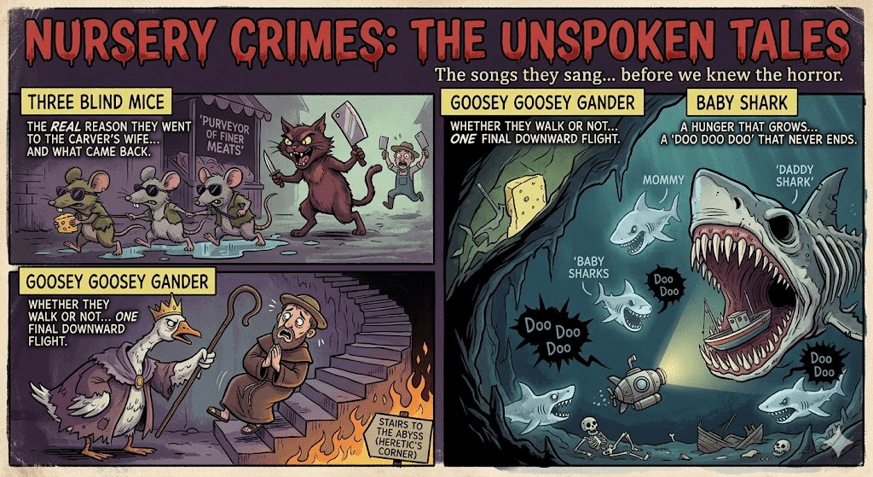
Though the nursery rhyme sounds like a story about a wandering bird, it most probably refers to the persecution of Catholic priests found saying prayers in secret, in the 16th century. Practicing Catholicism had been made illegal and was highly dangerous during the Protestant Reformation during the reigns of King Henry VIII and his successors.
The lines include ‘In my lady’s chamber’ which could refer to Catholic families who wanted to continue practicing their faith in secret building ‘priest holes’— tiny, hidden architectural spaces tucked away inside the walls, under floorboards, or upstairs in private chambers to hide fleeing Catholic priests. Similarly, the ‘Old Man who wouldn’t say his prayers’: may refer to a Catholic priest who refused to recite the newly mandated Protestant prayers. The punishment for such apostacy being that they ‘Threw him down the stairs’ – a grim metaphor for being captured, persecuted, or executed.
The interesting ‘Goose’ of the nursery rhyme is likely the slang of the era. ‘Goose’ or ‘gander’ was sometimes used as a coding mechanism to mock traveling officials. Open political dissent could result in execution for treason, therefore, using animal-centric nursery rhymes allowed people to gossip about royal crackdowns and religious warfare right under the authorities’ noses.
ROCK-A-BYE-BABY (Pretender to the Throne?)
Rock-a-bye baby, on the treetop,
When the wind blows, the cradle will rock,
When the bough breaks, the cradle will fall,
And down will come baby, cradle, and all.
On the surface, the nursery rhyme seems a gentle lullaby meant to soothe an infant to sleep. In reality, the lyrics describe an absolute nightmare scenario: a cradle balancing precariously on a high tree branch, a howling wind, and a catastrophic plunge to the ground. Theories range from it being a warning about pride, to a reference to rituals practiced by indigenous people or even a story about a royal usurper.
Historians generally point to two main theories for how this grim imagery came to be.
- The American Version
The native American Custom of how mothers in certain tribes would suspend their infants in birch-bark cradles from the branches of trees. This is said to have kept the babies safe from ground predators and allowed the wind to gently rock them to sleep while the mothers worked. To European observers, it seemed incredibly precarious — inspiring the cautionary rhyme about the branch breaking.
- The Royal Pretender
The simple rhyme is sometimes interpreted as a piece of fierce political satire aimed at King James II of England during the Glorious Revolution of 1688. James II was Catholic, and the Protestant establishment was desperate to restrain him from establishing a Catholic dynasty. When his son James Stuart was born, rumours were floated the baby wasn’t sired by the king. It was claimed that the royal baby had died, and that a newborn had been smuggled into the Queen’s bed inside a metal warming pan.
In this political reading, the ‘tree top’ represents the highest echelons of the royal court, the ‘wind’ represents the incoming Protestant revolution led by William of Orange, and the ‘cradle will fall’ was a joyful prediction that the Stuart dynasty was about to crash to the ground.
Significantly, the earliest printed version of the rhyme from 1765 (Mother Goose’s Melody) included a dark footnote that warned children about the dangers of pride:
“This may serve as a Warning to the Proud and Ambitious, who climb so high that they generally fall at last.”
THREE BLIND MICE (Bloody Mary?)
Three blind mice, three blind mice,
See how they run, see how they run!
They all ran after the farmer’s wife,
Who cut off their tails with a carving knife,
Did you ever see such a sight in your life,
As three blind mice?
While it sounds like a silly, fast-paced chase between a farmer’s wife and some unlucky rodents, historians widely believe it is a thinly veiled piece of political and religious commentary about one of the most ruthless monarchs in British history: Queen Mary I or ‘Bloody Mary’.
When the staunchly Catholic Queen Mary I ascended to the English throne in 1553, she was determined to reverse the English Reformation and bring the country back under papal authority. Anyone who opposed her faced brutal consequences.
‘The Farmer’s Wife’ represents Queen Mary I. The ‘farmer’ reference itself is likely to stem from the vast estates and agricultural wealth owned by the Crown and Catholic Church at the time.
The ‘Three Blind Mice’are believed to represent three prominent Protestant churchmen — Archbishop Thomas Cranmer, Bishop Nicholas Ridley, and Bishop Hugh Latimer (collectively known as the Oxford Martyrs).
They were described as ‘blind’ for failing to see the ‘true light’ of the Catholic faith, blindly sticking to their Protestant beliefs despite the immense danger.
In the rhyme, the farmer’s wife simply cuts off their tails. This is believed to refer to Queen Mary I. The ‘cutting off of tails’ is a metaphor for their execution.
Unsuitable Social or Historical Contexts
GEORGIE PORGIE
Georgie Porgie, pudding and pie,
Kissed the girls and made them cry.
When the boys came out to play,
Georgie Porgie ran away.
In the modern context, this rhyme is often criticized for depicting non-consensual behaviour and bullying as a cheeky childhood anecdote, secretly loaded with high-society gossip and political scandal.
While it sounds like a simple rhyme about a playground bully who kisses girls and runs away crying, historians generally point to a scandalous 17th century royal affair, before the English Civil War, involving King Charles I or the court of his father, James I.
The most widely accepted theory is that ‘Georgie Porgie’ was a mocking caricature of George Villiers, a handsome, arrogant nobleman who rose from obscurity to become the favourite of King James I, and later a dominant advisor to King Charles I.
‘Pudding and pie’ is a jab at his immense wealth, weight and luxurious lifestyle, which was entirely funded by royal favours.
‘Kissed the girls and made them cry’ Villiers was a notorious womanizer. He used his high status to seduce numerous noblewomen, leaving a trail of ruined reputations and broken marriages.
‘When the boys came out to play, Georgie Porgie ran away’ is said to be a criticism of his political and military cowardice. Villiers routinely used his influence to start international conflicts (such as disastrous military campaigns against Spain and France), but lacked the tactical skill to back them up. When the actual military commanders (‘the boys’) stepped up to hold him accountable or fight, Villiers would use his royal protection to evade confrontation and flee.
The real-life story ended disastrously. Villiers became among the most hated men in England. In 1628, a disgruntled army officer named John Felton stabbed him to death. The public was so relieved by his death that the satirical rhyme stuck around for centuries, transforming a hated 17th century politician into a timeless cautionary tale for children.
PETER PETER PUMPKIN EATER (Infidelity & Chastity?)
Peter, Peter, pumpkin eater,
Had a wife and couldn’t keep her;
He put her in a pumpkin shell,
And there he kept her very well.
This rhyme is often interpreted as a story about a man who couldn’t control his unfaithful wife. It is a dark commentary on domestic control and marital infidelity.
While it sounds like a bizarre story about a man who loves pumpkin and hates his wife’s wandering habits, historians usually point to two main theories: a grim American folk story about infidelity, or an ancient, brutal European punishment.
- The Tale of Infidelity:
The most common interpretation traces the rhyme to 18th century America, where pumpkins were a staple crop.
‘Couldn’t keep her’: In the slang of that time, this meant he could not keep her faithful.
‘Pumpkin Shell’: Frustrated, humiliated, and desperate to control her Peter locked her up in a metaphorical prison. In darker, more literal versions of the old folk story, Peter actually murdered his unfaithful wife and hid her body inside a giant pumpkin carcass to conceal his crime.
- The Medieval Chastity Frame:
Another interpretation uses the ‘pumpkin shell’ as a euphemism for a chastity belt or a literal wooden isolation cell. In medieval times, unfaithful women were sometimes locked away in tiny, cramped wooden structures or bricked up in small rooms within the house. The phrase ‘and there he kept her very well’ becomes a chillingly sarcastic nod to domestic captivity and total isolation.
RING A RING OF ROSES (The London Plague?)
Ring-a-ring-of-roses,
A pocket full of posies,
Hush-a, bush-a,
We all fall down.
The popular belief is that the rhyme refers to the Great Plague of London (1655). This is more likely to be an urban legend as the rhyme appeared hundreds of years after the plague. In the event of the rhyme being associated with the plague, it would be the most direct description of agonizing, historical mass death.
‘Ring-a-ring-of-roses’is said to describe the very first symptom of the bubonic plague — a painful, red, circular rash that resembled a ring of rose-coloured spots.
‘A pocket full of posies’: It was the common belief that diseases were spread through bad odours (miasma). To protect themselves, people would fill their pockets with ‘posies’ of sweet-smelling herbs and flowers and hold them to their noses to ward off the foul stench of the sick and dying.
‘Hush-a, bush-a’ mimics the sound of a sudden, violent sneeze, which signalled that the respiratory system had been infected.
‘We all fall down!’ wasn’t just falling down on the playground; it signified the sudden, ultimate collapse of death.
Controversies Related to Modern Nursery Rhymes
Several other 21st century nursery rhymes and songs have faced backlash from parents, educators, and child psychologists.
Unlike the old classics, which are criticized for their dark historical roots, modern rhymes are usually highlighted for their psychological impact, overstimulation, or questionable values.
- BABY SHARK (Violent Dismemberment?)
‘Baby Shark’ began as a campfire tune, before the Pinkfong phenomenon sanitized it as an introduction to kinship names. The original versions of the song were dark, with the swimmer losing limbs or being eaten by the shark. The more violent lyrics were accompanied by the singers making a swimming motion with their arms, until the moment of the attack:
‘Shark attack, doo doo doo doo doo doo
Shark attack, doo doo doo doo doo doo
Shark attack, doo doo doo doo doo doo
Shark attack!’
‘Lost an arm, doo doo doo doo doo doo
Lost an arm, doo doo doo doo doo doo
Lost an arm, doo doo doo doo doo doo
Lost an arm!
‘Lost a leg, doo doo doo doo doo doo …’ (Optional): ‘Lost my head, doo doo doo doo doo doo…’
It ended with the grim finale where the singers put their hands together in prayer and looked at the sky:
‘Went to heaven, doo doo doo doo doo doo
Went to heaven, doo doo doo doo doo doo
Went to heaven, doo doo doo doo doo doo
Went to heaven!’
The entire vicious cycle could be repeated ad infinitum, with the alternative ending:
‘Reincarnated, doo doo doo doo doo doo …
As a baby shark! doo doo doo doo doo doo …’
- THE WHEELS ON THE BUS (Gender Roles?)
The wheels on the bus go round and round,
Round and round,
Round and round.
The wheels on the bus go round and round,
All through the town.
Standard subsequent verses included the action of the wipers, the horn, the doors, the baby and finally the parents.
A major talking point among parenting communities centre around the specific modern lyrics chosen for the song. In the traditional rhyme, the actions of ‘the people’ or ‘the wipers’ are innocuous. In the modern version CoComelon introduces verses that assign gender roles, which include mothers being disciplinary and fathers being affectionate.
‘The mommies on the bus go ‘Shh, shh, shh’…’
‘The daddies on the bus go ‘I love you, I love you, I love you’…’
- SKIBIDI TOILET (The New Nursery Rhyme?)
While not a traditional rhyme, the ‘Skibidi’ song/meme has become the nursery rhyme of Gen Alpha (children born after 2010). It is viewed as ‘brain rot’ by many parents due to its nonsensical, grotesque imagery, such as heads popping out of toilets, etc. paired with an addictive, repetitive beat. It ignites a moral concern representing a shift where nursery rhymes are no longer curated by educators but by viral algorithms, often lacking any educational or prosocial value.
‘Skibidi Toilet’ began as a brief, surreal YouTube Short featuring a human head popping out of a toilet, singing a mashup of songs. What began as a bizarre joke quickly evolved into a massive, wordless, dystopian action series detailing a brutal war between Skibidi Toilets where disembodied human heads, trapped inside toilets, try to take over the world. Thereafter, an alliance is formed by cyborg humanoids with electronic hardware for heads! These include cameramen, speakermen, and TV men.
Unlike the traditional nursery rhymes featuring sheep or old men who wouldn’t say their prayers, ‘Skibidi’ features explosions, dark themes, and sci-fi violence. It has now assumed the same cultural space as traditional nursery rhymes. Added to this is the repetitive audio anchor – the hypnotic, inescapable theme song loop (‘Skibidi dop dop dop yes yes…’). Psychologists have inferred that such repetition as the Skibidi song acts as an instant dopamine trigger for young brains. Because there is no spoken dialogue, a three-year-old anywhere in the world can understand exactly what is happening.
All in all, nursery rhymes will continue to be contentious. Themes and topics range from taxes, religious execution, royal bastards, political assassinations, marital captivity, the plague— leading all the way to disembodied heads bobbing from toilets. All this through the lens of early nursery rhymes!


Leave a comment