Macky's Mart

All about the history of La Martiniere on readers' demand.

By

Carlyle Andre McFarland

1979 (Cornwallis); Day-Scholar

Personal No. 5887

Erstwhile Principal, La Martiniere College, Lucknow (2011 – 2024)

  • From Jack & Jill to Baby Shark

    The time has been when the most participative session of a school morning was the recitation of nursery rhymes, passed down through the generations. Learning by rote, often mispronounced, perfected for performance at family gatherings, a marker of accomplishment: the nursery rhyme has been the bedrock of an oral tradition passed down through the generations. It has created a comfortable nonsense-world where the focus is on sound, expression, action, rhythm and rhyme – the simplest form of poetic expression. This has cut across languages, encouraging translation and a change of linguistic register, with ease.

    The nursery rhyme has, from time to time, been embroiled in controversy. The most recent controversy was sparked by Mr Sandeep Singh, the Minister of State for Basic Education, Government of Uttar Pradesh. In a public speech in an academic setting, he chose two nursery rhymes on which to vent his ire. The mischief-filled ‘Johnny, Johnny, “Yes Papa”’ and the playful ‘Rain, rain, go away’. Little ones, it seems, were not to be influenced into an unhealthy consumption of sugar and telling lies to elders about putting their hand in the sugar jar. Neither were they to be encouraged to be environmentally uncompassionate by wishing the rain to go away in a tropical country whose economy is dependent on agriculture, where rain is celebrated and welcomed.

    The core of the argument used was that many popular English rhymes are culturally irrelevant to Indian children and carry hidden negative meanings or historical baggage from the British era. It was seen as the criticism of the colonial mindset or Gulami ki Mansikt, imbibed by children.

    While these spins on the political correctness of what was seen as a part of the age of innocence is troublesome, there is no doubt that what are considered harmless, lilting melodies and rhymes, hide darker secrets, whose origins – genuine or imagined – have been camouflaged by time. Admittedly, the fact remains that what is learnt by rote and in tandem with a class-load of peers is rarely forgotten. However, the charge that the insidious corrupting influence of subliminal themes influences an adult’s response to life, is questionable.

    JACK AND JILL

    Does the simple Jack and Jill, the staple of all nursery rhymes weave a story about a climbing expedition gone horribly wrong? Will the Greta Thunberg brigade promote it as a doggerel regarding the terrible hardships and potential injuries sustainable in the obtaining of water; it’s scarcity and the dangers of its procurement?

    Consider a version of the age-old English rhyme when rendered in Hindi:

    Jack and Jill went up the hill,

    जैक और जिल गए पहाड़ी पर,

    (Jack aur Jill gaye pahadi par)

    To fetch a pail of water,

    लाने पानी की एक बाल्टी भर।

    (Laane paani ki ek baalti bhar)

    Jack fell down and broke his crown,

    जैक गिरा और सिर फूटा उसका,

    (Jack gira aur sir phoota uska)

    And Jill came tumbling after.

    और जिल भी लुढ़कती आई नीचे गिरकर।

    (Aur Jill bhi ludhakti aayi neeche girkar)

    Interestingly, due to the emphasis on Indian-centric alternatives, many schools in India wipe out ‘Jack and Jill’ entirely for traditional Hindi rhymes about water or nature, such as ‘मछली जल की रानी है’ (Machli Jal Ki Rani Hai) or ‘चंदा मामा दूर के’ (Chanda Mama Door Ke), which carry a similar rhythmic appeal but with familiar local themes!

    INCY-WINCY SPIDER

    Another popular rhyme, non-controversial till now, is ‘Incy-Wincy Spider’ (in India, corrupted to Inky-Minky Spider). This is generally viewed as one of the ‘safer’ rhymes because it teaches perseverance. The spider does not give up, despite the rain. This nursery rhyme too is now bi-lingual:

    Inky-Minky spider climbed up on the wall

    इन्की-मिन्की मकड़ी, दीवार पर चढ़ गई,

    (Inky-Minky makdi, deewaar par chadh gayi)

    Down came the rain and drowned the spider all

    ज़ोर की आई बारिश, मकड़ी डूब गई।

    (Zor ki aayi baarish, makdi doob gayi)

    Up came the sun and dried the water up

    सूरज ऊपर आया, सारा पानी सुखा दिया,

    (Sooraj oopar aaya, saara paani sukha diya)

    Inky-Minky spider climbed the wall again

    इन्की-मिन्की मकड़ी ने, दीवार पे फिर कदम रख दिया!

    (Inky-Minky makdi ne, deewaar pe phir kadam rakh diya!)

    HISTORICAL OCCULTISM?

    While many nursery rhymes seem like innocent nonsense, several have dark origins or contain language and themes that are viewed through a critical lens today. The furore began with nursery rhymes like ‘Ten Little Indian Boys’. This nursery rhyme was even more popular earlier, before with the offensive ‘n’-word was replaced by a reference to ‘Indians’ instead.

    While many children who grew up in the late 20th century remember it as a harmless counting game, its origins and original lyrics are deeply rooted in racism, minstrel shows, and violence. Today, it is considered highly inappropriate. The rhyme was adapted in 1868 by the American songwriter Septimus Winner for a racist minstrel show. This included white actors in blackface, performing caricatures that mocked black people.

    The British adaptation replaced the racial slur by the word ‘Indians’ Over the decades, the two versions were used interchangeably in various countries, but both retained the exact same dark, violent structure.

    This is not an innocent counting rhyme, but a countdown to death in which every child is systematically killed in gruesome ways. The countdown relies on dark, troubling ‘tropes’, which is a literary device using a recognizable, recurring elements in a story.

    Starting out with ten, each of the boys in the countdown are victims:

    ‘Ten little Indian boys going out to dine;

    One choked his little self and then there were nine.’

    ‘Four little Indian boys going out to sea;

    A red herring swallowed one and then there were three.’

    ‘Two little Indian boys sitting in the sun;

    One got frizzled up and then there was one.’

    The rhyme concludes with the last boy hanging himself (or getting married!), effectively wiping out the entire group. Hardly a catchy joke for toddlers through the systematic elimination of minority children.

    Today, this nursery rhyme is no longer taught to toddlers. Counting rhymes, following the same tune, include “Ten Little Teddy Bears”, or simply counting fingers – ‘One little, two little, three little fingers …’

    Salient Criticism Against Traditional Nursery Rhymes

    The controversy surrounding traditional nursery rhymes has divided opinion. Some believe it is time to decolonize the nursery and provide children with content that reflects their own reality. On the other hand, others believe that these rhymes are a harmless part of global children’s literature. The government and its ministers would be better advised to focus more on improving school infrastructure and teacher quality rather than policing what toddlers sing.

    The woke generation searches through the literary stimulation for children to find elements that are politically incorrect, racially insensitive, morally dark or downright violent.

    There is no doubt that in tracing the history of some rhymes, it is evident that they were composed to include racial slurs or used to mock specific ethnic groups. Over time, many have been sanitized, but their history remains controversial. Rhymes that children find catchy actually describe gruesome events, punishment or even death. Innocent-sounding childhood rhymes may carry dark and politically charged backstories.

    BAA, BAA, BLACK SHEEP (Racism?)

    Baa, baa, black sheep,

    Have you any wool?

    Yes, sir, yes, sir,

    Three bags full;

    One for the master,

    And one for the dame,

    And one for the little boy

    Who lives down the lane.

    While commonly associated with the medieval wool tax, some modern interpretations have critiqued the rhyme for potential racial undertones. A more detailed historical analysis suggests a historical echo of the heavy economic control and inequality triggered by the medieval wool trade. The lyrics represent how the wool was divided up by authority figures:

    One for the master The King / The Crown (taking his custom duty)

    One for the dame The Church / Monasteries (who controlled much of the wool production)

    And one for the little boy who lives down the lane The poor farmer, (left with the smallest, least profitable portion of his own labour).  

    GOOSEY GOOSEY GANDER (Religious Persecution?)

    Goosey goosey gander,

    Whither shall I wander?

    Upstairs and downstairs

    And in my lady’s chamber.

    There I met an old man

    Who wouldn’t say his prayers,

    So I took him by the left leg

    And threw him down the stairs.

    Though the nursery rhyme sounds like a story about a wandering bird, it most probably refers to the persecution of Catholic priests found saying prayers in secret, in the 16th century. Practicing Catholicism had been made illegal and was highly dangerous during the Protestant Reformation during the reigns of King Henry VIII and his successors.

    The lines include ‘In my lady’s chamber’ which could refer to Catholic families who wanted to continue practicing their faith in secret building ‘priest holes’— tiny, hidden architectural spaces tucked away inside the walls, under floorboards, or upstairs in private chambers to hide fleeing Catholic priests. Similarly, the ‘Old Man who wouldn’t say his prayers’: may refer to a Catholic priest who refused to recite the newly mandated Protestant prayers. The punishment for such apostacy being that they ‘Threw him down the stairs’ – a grim metaphor for being captured, persecuted, or executed.

    The interesting ‘Goose’ of the nursery rhyme is likely the slang of the era. ‘Goose’ or ‘gander’ was sometimes used as a coding mechanism to mock traveling officials. Open political dissent could result in execution for treason, therefore, using animal-centric nursery rhymes allowed people to gossip about royal crackdowns and religious warfare right under the authorities’ noses.

    ROCK-A-BYE-BABY (Pretender to the Throne?)

    Rock-a-bye baby, on the treetop,

    When the wind blows, the cradle will rock,

    When the bough breaks, the cradle will fall,

    And down will come baby, cradle, and all.

    On the surface, the nursery rhyme seems a gentle lullaby meant to soothe an infant to sleep. In reality, the lyrics describe an absolute nightmare scenario: a cradle balancing precariously on a high tree branch, a howling wind, and a catastrophic plunge to the ground. Theories range from it being a warning about pride, to a reference to rituals practiced by indigenous people or even a story about a royal usurper.

    Historians generally point to two main theories for how this grim imagery came to be.

    • The American Version

    The native American Custom of how mothers in certain tribes would suspend their infants in birch-bark cradles from the branches of trees. This is said to have kept the babies safe from ground predators and allowed the wind to gently rock them to sleep while the mothers worked. To European observers, it seemed incredibly precarious — inspiring the cautionary rhyme about the branch breaking.

    • The Royal Pretender

    The simple rhyme is sometimes interpreted as a piece of fierce political satire aimed at King James II of England during the Glorious Revolution of 1688. James II was Catholic, and the Protestant establishment was desperate to restrain him from establishing a Catholic dynasty. When his son James Stuart was born, rumours were floated the baby wasn’t sired by the king. It was claimed that the royal baby had died, and that a newborn had been smuggled into the Queen’s bed inside a metal warming pan.

    In this political reading, the ‘tree top’ represents the highest echelons of the royal court, the ‘wind’ represents the incoming Protestant revolution led by William of Orange, and the ‘cradle will fall’ was a joyful prediction that the Stuart dynasty was about to crash to the ground.

    Significantly, the earliest printed version of the rhyme from 1765 (Mother Goose’s Melody) included a dark footnote that warned children about the dangers of pride:

    “This may serve as a Warning to the Proud and Ambitious, who climb so high that they generally fall at last.”

    THREE BLIND MICE (Bloody Mary?)

    Three blind mice, three blind mice,

    See how they run, see how they run!

    They all ran after the farmer’s wife,

    Who cut off their tails with a carving knife,

    Did you ever see such a sight in your life,

    As three blind mice?

    While it sounds like a silly, fast-paced chase between a farmer’s wife and some unlucky rodents, historians widely believe it is a thinly veiled piece of political and religious commentary about one of the most ruthless monarchs in British history: Queen Mary I or ‘Bloody Mary’.

    When the staunchly Catholic Queen Mary I ascended to the English throne in 1553, she was determined to reverse the English Reformation and bring the country back under papal authority. Anyone who opposed her faced brutal consequences.

    ‘The Farmer’s Wife’ represents Queen Mary I. The ‘farmer’ reference itself is likely to stem from the vast estates and agricultural wealth owned by the Crown and Catholic Church at the time.

    The ‘Three Blind Mice’are believed to represent three prominent Protestant churchmen — Archbishop Thomas Cranmer, Bishop Nicholas Ridley, and Bishop Hugh Latimer (collectively known as the Oxford Martyrs).

    They were described as ‘blind’ for failing to see the ‘true light’ of the Catholic faith, blindly sticking to their Protestant beliefs despite the immense danger.

    In the rhyme, the farmer’s wife simply cuts off their tails. This is believed to refer to Queen Mary I. The ‘cutting off of tails’ is a metaphor for their execution.

    Unsuitable Social or Historical Contexts

    GEORGIE PORGIE

    Georgie Porgie, pudding and pie,

    Kissed the girls and made them cry.

    When the boys came out to play,

    Georgie Porgie ran away.

    In the modern context, this rhyme is often criticized for depicting non-consensual behaviour and bullying as a cheeky childhood anecdote, secretly loaded with high-society gossip and political scandal.

    While it sounds like a simple rhyme about a playground bully who kisses girls and runs away crying, historians generally point to a scandalous 17th century royal affair, before the English Civil War, involving King Charles I or the court of his father, James I.

    The most widely accepted theory is that ‘Georgie Porgie’ was a mocking caricature of George Villiers, a handsome, arrogant nobleman who rose from obscurity to become the favourite of King James I, and later a dominant advisor to King Charles I.

    ‘Pudding and pie’ is a jab at his immense wealth, weight and luxurious lifestyle, which was entirely funded by royal favours.

    ‘Kissed the girls and made them cry’ Villiers was a notorious womanizer. He used his high status to seduce numerous noblewomen, leaving a trail of ruined reputations and broken marriages.

    ‘When the boys came out to play, Georgie Porgie ran away’ is said to be a criticism of his political and military cowardice. Villiers routinely used his influence to start international conflicts (such as disastrous military campaigns against Spain and France), but lacked the tactical skill to back them up. When the actual military commanders (‘the boys’) stepped up to hold him accountable or fight, Villiers would use his royal protection to evade confrontation and flee.

    The real-life story ended disastrously. Villiers became among the most hated men in England. In 1628, a disgruntled army officer named John Felton stabbed him to death. The public was so relieved by his death that the satirical rhyme stuck around for centuries, transforming a hated 17th century politician into a timeless cautionary tale for children.

    PETER PETER PUMPKIN EATER (Infidelity & Chastity?)

    Peter, Peter, pumpkin eater,

    Had a wife and couldn’t keep her;

    He put her in a pumpkin shell,

    And there he kept her very well.

    This rhyme is often interpreted as a story about a man who couldn’t control his unfaithful wife. It is a dark commentary on domestic control and marital infidelity.

    While it sounds like a bizarre story about a man who loves pumpkin and hates his wife’s wandering habits, historians usually point to two main theories: a grim American folk story about infidelity, or an ancient, brutal European punishment.

    • The Tale of Infidelity:

    The most common interpretation traces the rhyme to 18th century America, where pumpkins were a staple crop.

    ‘Couldn’t keep her: In the slang of that time, this meant he could not keep her faithful.

    Pumpkin Shell: Frustrated, humiliated, and desperate to control her Peter locked her up in a metaphorical prison. In darker, more literal versions of the old folk story, Peter actually murdered his unfaithful wife and hid her body inside a giant pumpkin carcass to conceal his crime.

    • The Medieval Chastity Frame:

    Another interpretation uses the ‘pumpkin shell’ as a euphemism for a chastity belt or a literal wooden isolation cell. In medieval times, unfaithful women were sometimes locked away in tiny, cramped wooden structures or bricked up in small rooms within the house. The phrase and there he kept her very well becomes a chillingly sarcastic nod to domestic captivity and total isolation.

    RING A RING OF ROSES (The London Plague?)

    Ring-a-ring-of-roses,

    A pocket full of posies,

    Hush-a, bush-a,

    We all fall down.

    The popular belief is that the rhyme refers to the Great Plague of London (1655). This is more likely to be an urban legend as the rhyme appeared hundreds of years after the plague. In the event of the rhyme being associated with the plague, it would be the most direct description of agonizing, historical mass death.

    Ring-a-ring-of-roses’is said to describe the very first symptom of the bubonic plague — a painful, red, circular rash that resembled a ring of rose-coloured spots.

    A pocket full of posies’: It was the common belief that diseases were spread through bad odours (miasma). To protect themselves, people would fill their pockets with ‘posies’ of sweet-smelling herbs and flowers and hold them to their noses to ward off the foul stench of the sick and dying.

    Hush-a, bush-a’ mimics the sound of a sudden, violent sneeze, which signalled that the respiratory system had been infected.

    We all fall down!’ wasn’t just falling down on the playground; it signified the sudden, ultimate collapse of death.

    Controversies Related to Modern Nursery Rhymes

    Several other 21st century nursery rhymes and songs have faced backlash from parents, educators, and child psychologists.

    Unlike the old classics, which are criticized for their dark historical roots, modern rhymes are usually highlighted for their psychological impact, overstimulation, or questionable values.

    • BABY SHARK (Violent Dismemberment?)

    ‘Baby Shark’ began as a campfire tune, before the Pinkfong phenomenon sanitized it as an introduction to kinship names. The original versions of the song were dark, with the swimmer losing limbs or being eaten by the shark.  The more violent lyrics were accompanied by the singers making a swimming motion with their arms, until the moment of the attack:

    ‘Shark attack, doo doo doo doo doo doo

    Shark attack, doo doo doo doo doo doo

    Shark attack, doo doo doo doo doo doo

    Shark attack!’

    ‘Lost an arm, doo doo doo doo doo doo

    Lost an arm, doo doo doo doo doo doo

    Lost an arm, doo doo doo doo doo doo

    Lost an arm!

    ‘Lost a leg, doo doo doo doo doo doo …’ (Optional): ‘Lost my head, doo doo doo doo doo doo…’

    It ended with the grim finale where the singers put their hands together in prayer and looked at the sky:

    ‘Went to heaven, doo doo doo doo doo doo

    Went to heaven, doo doo doo doo doo doo

    Went to heaven, doo doo doo doo doo doo

    Went to heaven!’

    The entire vicious cycle could be repeated ad infinitum, with the alternative ending:

    ‘Reincarnated, doo doo doo doo doo doo …

    As a baby shark! doo doo doo doo doo doo …’

    • THE WHEELS ON THE BUS (Gender Roles?)

    The wheels on the bus go round and round,

    Round and round,

    Round and round.

    The wheels on the bus go round and round,

    All through the town.

    Standard subsequent verses included the action of the wipers, the horn, the doors, the baby and finally the parents.

    A major talking point among parenting communities centre around the specific modern lyrics chosen for the song. In the traditional rhyme, the actions of ‘the people’ or ‘the wipers’ are innocuous. In the modern version CoComelon introduces verses that assign gender roles, which include mothers being disciplinary and fathers being affectionate.

    ‘The mommies on the bus go ‘Shh, shh, shh’…’

    ‘The daddies on the bus go ‘I love you, I love you, I love you’…’

    • SKIBIDI TOILET (The New Nursery Rhyme?)

    While not a traditional rhyme, the ‘Skibidi’ song/meme has become the nursery rhyme of Gen Alpha (children born after 2010). It is viewed as ‘brain rot’ by many parents due to its nonsensical, grotesque imagery, such as heads popping out of toilets, etc. paired with an addictive, repetitive beat. It ignites a moral concern representing a shift where nursery rhymes are no longer curated by educators but by viral algorithms, often lacking any educational or prosocial value.

    ‘Skibidi Toilet’ began as a brief, surreal YouTube Short featuring a human head popping out of a toilet, singing a mashup of songs. What began as a bizarre joke quickly evolved into a massive, wordless, dystopian action series detailing a brutal war between Skibidi Toilets where disembodied human heads, trapped inside toilets, try to take over the world. Thereafter, an alliance is formed by cyborg humanoids with electronic hardware for heads! These include cameramen, speakermen, and TV men.

    Unlike the traditional nursery rhymes featuring sheep or old men who wouldn’t say their prayers, ‘Skibidi’ features explosions, dark themes, and sci-fi violence. It has now assumed the same cultural space as traditional nursery rhymes. Added to this is the repetitive audio anchor – the  hypnotic, inescapable theme song loop (‘Skibidi dop dop dop yes yes…’). Psychologists have inferred that such repetition as the Skibidi song acts as an instant dopamine trigger for young brains. Because there is no spoken dialogue, a three-year-old anywhere in the world can understand exactly what is happening.

    All in all, nursery rhymes will continue to be contentious. Themes and topics range from taxes, religious execution, royal bastards, political assassinations, marital captivity, the plague— leading all the way to disembodied heads bobbing from toilets. All this through the lens of early nursery rhymes!

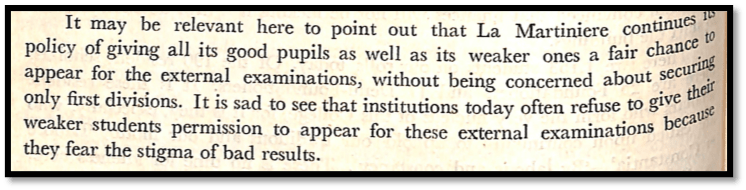
  • The annual examination results conducted by prominent boards across the nation have been announced. There is jubilation and amazement everywhere. I know no one, across all boards, who has ‘failed’, though some who were incapacitated or dreadfully unwell and unable to write the examinations. For such candidates, the result was recorded as PCNR, or Pass Certificate Not Awarded.

    In the meantime, the circus is in full swing. Full-page newspaper advertisements announce the success of institutions; flexible vinyl hoardings with mug-shots of the centum achievers dot the city landscape; parents are literally weighed in fruits and sweets in some schools; teachers of examination classes receive significant cash awards; social media is abuzz with the success – good wishes and blessings pour forth.

    In the midst of this euphoria, it might seem churlish to prick the bubble of individual and institutional conceit and ask the question … How much do our children really know?

    If you are not a parent or actively involved in this national celebration, there are questions to be asked. At the moment, everyone seems happy: the advertising industry is happy, schools and teachers are happy, parents are happy, students are happy. But at the back of the minds of other stakeholders, such as institutions of higher learning and potential employers, the question still arises … How much do our children really know?

    To be fair, many are already questioning the validity of the figures presented. The interpretation of the results is arcane – mysterious, secret and understood by only a few. It requires specialized knowledge that seems hidden or encoded to the average observer. The figures themselves are interchangeably described as scores, marks and grades, even though the terms are not synonyms. Each term carries a system of assessment or evaluation of its own.

    It appears to be a national fraud, and definitely not in the national interest, that the inflation of numbers is studiously justified by the jargon of statistics. However, the amalgam of scores, marks and grades into a cocktail of achievement leaves the perspicacious doubting the verity of the system. This bubble must burst. Until then, everybody is happy.

    More and more, analytical systems for competitive examinations have rejected the veracity of board examination results as markers of achievement. The meritocracy of numbers does not ensure admission into institutes of higher learning. The competitive examination season begins the moment board examination results are announced. There are cities, such as Kota, where the local economy thrives on promises of success through ‘coaching’ or cramming classes. In its extreme, this has led to a loss of life by suicide by young people, who could not withstand the pressure. Central Universities have their own entrance tests, while popular streams of education such as engineering, medicine and accountancy follow the same route of devising systems to actually test … How much do our children really know?

    The numbers speak for themselves. Consider the published numbers of three examination boards with which we are familiar: The Central Board of Secondary Education (CBSE), the Council for the Indian School Certificate Examinations (CISCE); and the Uttar Pradesh Madhyamik Shiksha Parishad (U.P. Board). The results for 2026 are as follows:

    BoardClass 10 (Secondary)Class 12 (Senior Secondary)
    CISCE (ICSE/ISC)99.18% pass rate 258,721 appeared; 2,131 PCNR*99.13% pass rate 103,316 appeared; 902 PCNR*
    CBSEPass percentage ~95% (millions appeared)Class 12 results pending (over 18 lakh candidates)
    UP Board (UPMSP)90.42% pass rate 27.5 lakh appeared; ~2.6 lakh failed80.38% pass rate 24.8 lakh appeared; ~4.9 lakh failed

    *Pass Certificate Not Awarded

    To analyse the results of a chosen examination board (using the CISCE as an example), consider the following:

    In the ISC (Class 12) Examinations 2026, out of 103,316 candidates who wrote the examination, a mere 902 candidates failed to receive a Pass Certificate. This does not indicate that they ‘failed’ the examination, but rather that, for various reasons a Pass Certificate Not Awarded (PCNR) was recorded against their names. The overall pass percentage was 99.13%.

    In the ICSE (Class 10) Examinations 2026, out of 258,721 who appeared a total of 2,131 candidates failed to receive a Pass Certificate (PCNR). The overall pass percentage was 99.18%.

    For all three examination boards, examiners evaluate answer scripts according to detailed rubrics set by a Moderator for each subject. This is vetted during a coordination meeting with team leaders of examiners.

    Significantly, all three boards emphasize that the numbers recorded on certifications are percentages. Regrettably, there is no transparency in the manner in which these results are calculated. A percentage implies how much of the examination material was mastered. It is further implied that every candidate is evaluated uniformly, against the same maximum marks, making results comparable across years and schools.

    Examination boards often shield themselves from criticism of inflated marks by claiming that the purpose of the boards is merely to certify completion of schooling. The emphasis is on whether a student has met minimum standards and thresholds (e.g. 33% or 40%), not on their relative standing or ranking. The blanket explanation given is that the marks have undergone a process of ‘moderation and standardisation’. Moderation and scaling are applied, ostensibly to ensure fairness across different examination papers and correction centres.

    This veers sharply in the direction of a percentile system, which changes the dynamics of what the results are expected to reflect. Percentile ranks are seen by some as redundant and misleading. Yet, when moderation and scaling – using the formulae for the calculation of percentile – are passed off as a percentage, it is potentially misleading. This undermines clarity.

    This abnormally high success raises questions about grade inflation. It also begs the question – Is such reportage academically ethical?

    ‘Standardisation’ or Academic Charlatanism?

    Technically, a percentile could be presented as one of the other metrics described because they all often exist on a 0–100 scale. However, doing so is a fundamental misrepresentation of data and is considered academically dishonest. This is problematic and has serious ethical implications.

    We are reminded that numbers often look the same. Without a clear key or legend – much like a map – the necessary context is lacking for interpretation.

    If you score in the 90th percentile on a very difficult examination, but your actual percentage was only 62%, you might be tempted to tell someone you got a “90.” To the untrained eye, “90” looks like an A, whereas “62” looks like a D. However, both figures represent two completely different realities.

    Centum Achievers

    A common misreading of results is seen in the large number of examinees being awarded a centum in multiple papers of the examination. While achieving a perfect score of 100 marks in purely objective papers (such as mathematics, computer applications, sciences) is potentially possible, it once again begs the question as to how a centum can awarded be awarded for expressive, creative and subjective papers, such as Languages, Literature and Social Sciences where higher-order thinking questions are the norm.

    Classifications in Evaluation

    For the uninitiated, a quick study of the different terms used in evaluation (which are often used synonymously), is helpful:

    1. A Raw Score

    A Raw Score (or simply, score) is a direct measurement of a candidate’s performance based on set criteria, such as a Marking Scheme or ‘Key’. A score is objective. It is usually expressed as a number or a percentage of the total possible points. The raw score measures an individual’s accuracy or achievement.

    For example: If a candidate answers 62 out of 100 questions correctly on a test, the candidates score is recorded as 62%. This does not change, regardless of how other candidates may have performed.

    2. A Mark

    A Mark is similar to a score, with the difference being that a mark may involve professional judgment. A teacher may decide that a piece of writing deserves an “A” even if the raw score is not perfect, because it meets qualitative standards of creativity or clarity. This is often subjective, especially for subjects where objective responses cannot be quantified, such as in languages and literature.

    3. A Grade

    A grade is a standardized symbol or letter used to represent a level of achievement within a specific system. It is a qualitative descriptor (like A, B, C or 1–10) based on a predefined scale.

    For example: A score of 92% might be assigned a grade of “A”. This provides a quick, easy-to-understand summary of a student’s performance level. It does not reflect the candidate’s actual raw achievement.

    4. A Percentage

    A percentage is a way of expressing a score as a fraction of 100. It is an indicator of absolute performance.

    For example: a candidate who scores 40 out of 50 has a percentage achievement of 80%. This helps to normalize scores so that performance can be compared across different tests (e.g., comparing a 10-point class test to a 100-point exam).

    5. A Percentile Rank

    A percentile rank (or simply, percentile) is a comparative statistic. It indicates the percentage of people in a group that the candidate performed better than.

    It establishes the candidate’s rank relative to the total number of examinees. This is especially relevant in tests where the difficulty level might change every year. It is a statistical indicator of relative performance.

    For example: If the candidate is placed in the 90th percentile, it indicates that the candidate scored HIGHER than 90% of the people who wrote the test. The candidate is placed in the bracket of the top 3% of the total number of examinees. It does NOT mean that the examinee answered 90% of the questions correctly.

    The Ethical Perspective

    In an academic or professional setting, misrepresenting a percentile as a score or percentage is unethical. There seems to be an underlying intention to deceive. Scores/Marks/Percentages measure competency (what you know), while percentiles measure competitiveness (how you compare). Falsifying the distinction is a deliberate attempt to hide the candidate’s actual level of mastery. While it is true that percentile calculations with very large numbers of examinees provide more reliable rankings, they also mask individual performance differences.

    Academic integrity is at stake when percentiles are passed off as percentages and ranks as marks. This might be seen as wilful misrepresentation of academic records. In short, academic fraud. When a candidate seeking admission to an institution of higher learning is asked for their ‘score’ and a ‘percentile’ is provided instead, an incorrect data point is being provided that skews the evaluation process.

    The candidates for the school-leaving examination are not to blame as there is no legend or key explaining the method of calculation of the figure provided. An observer is wilfully led to believe that the figure given is actually a percentage because the marksheet says so. How this ‘percentage’ was calculated cannot be verified!
    Perceivable Danger

    The danger of swapping the percentile rank for a percentage is evident by taking an example of extremes:

    In the case of an ‘easy test’, a candidate might appear to be a genius, when their performance is actually average. The actual score achieved might be 97, though the percentile might only place the candidate at the 50th rank if many others did better.

    In the case of a ‘difficult test’, a candidate might actually be at the top of the class even if they achieved an actual score of 39, which in many cases reflects failure. Nevertheless, the percentile rank could place the candidate at the 95th percentile.

    In casual parlance, passing off a rank as a score is common. When formally recorded on a valid academic document, it is an ethical breach.

    Suggested Solution

    The solution to this lies in requiring explicit statements on official documents that combine individual achievement with comparative positioning. The honest way to present this is to list both:

    “Scored 75% in the examination, placing the candidate in the 99th percentile.”

    This will indicate both the candidate’s absolute performance and their standing without being deceptive. Until then, there will be generations of examinees for whom their marksheet will be a simple certification of having written an examination, without the crucial information of individual achievement. A wag once claimed that the Grade 10 certificate is only useful to legally record a candidate’s date of birth!

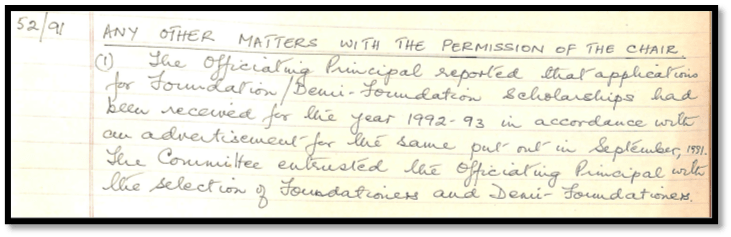
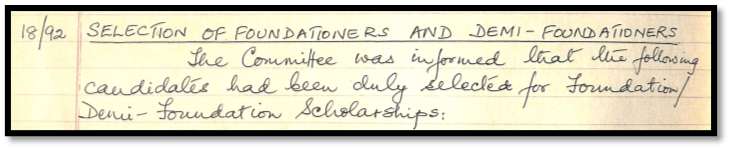
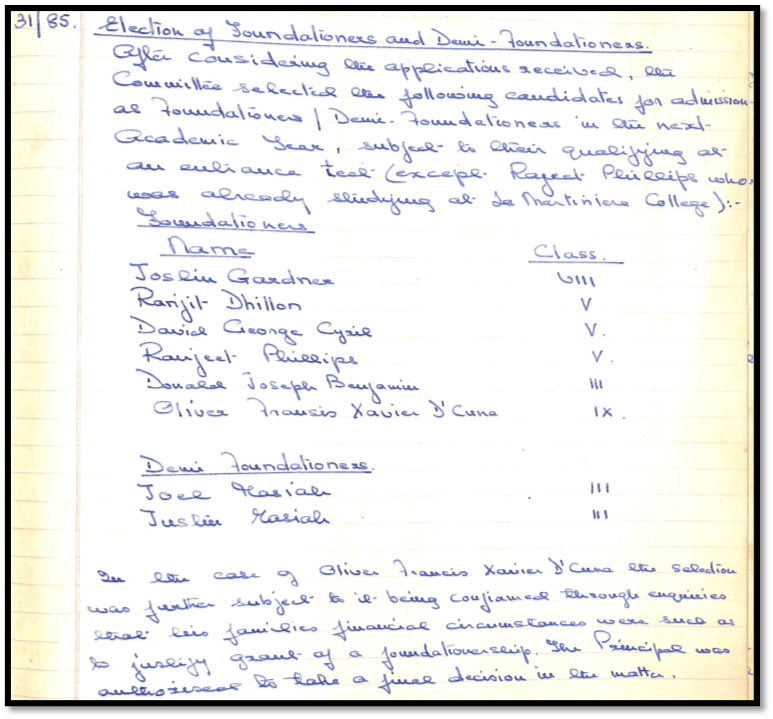
  • The New Foundationer
    Claude Martin’s Boys

    As the College moved towards 175 years of its establishment, the philanthropic component of the Founder’s Will was re-examined in accordance with the exigencies of contemporary times. Through nearly two centuries, Trustees, Governors and Administrators have tweaked the tenets of the Will and the Scheme of Administration while still staying on the right side of the law. It is well known that legal rules can produce unjust outcomes. La Martiniere College, Lucknow has been burdened with this reality.

    Perhaps ironically, the phrase, “the law is an ass” was popularized by Charles Dickens in Oliver Twist, a novel based upon the appalling conditions of orphans and abandoned children in Victorian England. Published in 1838, two years before the Court Decree by which the College was founded, the idiom is often used to describe situations where following the letter of the law defies logic or fairness, often leading to ridiculous outcomes. The way Maj. Gen. Claude Martin’s bequest has been toyed with may be seen in this context. This is apparent in the way the charitable, gratuitous and philanthropic spirit of his Will has been circumscribed over the decades by the harness of the law. It is seen that the law is not always synonymous with justice or common sense. Decisions, especially those related to charity, seem morally wrong when they are blindly influenced by the literal text of a statute. A literal or inflexible application of the law has led to an absurd or unjust outcome.

    This non-application of the spirit of altruism and generosity, while scrupulously following the letter of the law through convenient interpretation has done great disservice to the memory of the Founder and prospective beneficiaries of his largesse.

    1. The College was established as an institution that would be sustained on the investment made by the capital left by the Founder.
    2. The majority of boys, or some might interpret it as all pupils, were to taken care of by the Foundation.
    3. The College was established with the best of intentions, utilizing the best financial minds in British India and later, the Republic of India. This was to secure the capital of the institution and make safe, judicious investments.
    4. The Founder Will and the Scheme of Administration envisaged a school for boys, irrespective of race and religion.
    5. The letter of the law was applied by two departments being established – a European and Anglo-Indian section and an Oriental or Native section.
    6. Following the events of 1857, the native department was relocated and gradually ground to the dust.
    7. Provision was made for lodging, boarding and domestic arrangements for at least 25% of the total pupil strength. Residence in the College was compulsory for Foundation pupils.
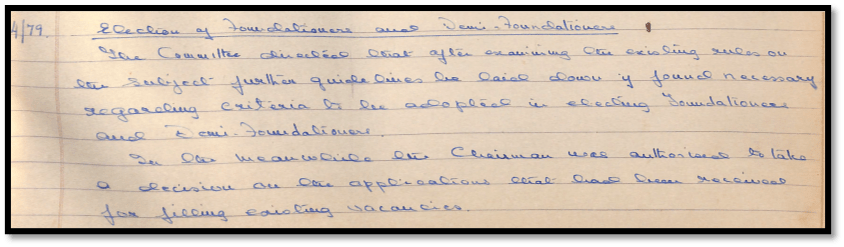
    8. Parents who could afford fees and desired to have their sons educated at the College were granted admission for their sons as resident scholars.
    9. The absolute number of Foundation pupils was never set. Governors from time to time set an arbitrary number. By practice this seemed to stabilize at 100.
    10. Interpretations of the letter of the law began with the introduction of supernumerary Foundationers, from whose parents, concessional fees were received.
    11. The nomenclature for supernumerary resident-scholars was converted to demi-Foundationer.
    12. Resident Scholars, whose parents could pay for boarding and lodging facilities became to first Boarders.
    13. Day-scholar pupils were reluctantly permitted to seek admission on the payment of appropriate fees.
    14. The College was seen as primarily a residential institution.
    15. Segregation by race was the norm. After much struggle, Indian pupils were admitted, but only as day-scholars.
    16. With the withdrawal of the British and Anglo-Indians from India following Independence, it was expedient to admit Indian boys as day scholars. Later Indian boys shared facilities for boarding and lodging when admitted as resident scholars.
    17. To keep the economy afloat, day scholar pupils were admitted in large numbers. India was moving towards the goal of mass education.
    18. The Foundation pupils were relegated to the lowest priority: numbers were retained to fulfil the letter of the law.
    19. Skewered fee policy and self-imposed restrictions, not envisaged by the Founder, required that numbers admitted had to be multiplied to make ends meet. This could only be done by admitting day scholars whose numbers soon overtook the resident scholars. This rapidly changed the tone of the institution.
    20. Junior classes were sanctioned. Multiple sections were sanctioned. Pre-school groups were introduced. Class strength burgeoned. The western character was replaced largely by non-westernised staff and Hindi speaking pupils.

    The Spirit vs the Letter of the Law

    The legal foundation for the continuance of the system of Foundation pupils is the Will of Major General Claude Martin. The College exists because a court decree ordered that his charitable intentions be carried out, after prolonged litigation that culminated in binding judicial schemes in 1839 and 1841. The College is therefore not merely a school, but a charitable trust created by testamentary direction. Claude Martin expressly set aside a substantial portion of his estate for education. His belief was that access to education should be made easier for the young, particularly those without means.

    Under the scheme created to implement the Will, “Foundationers” are students supported from the Founder’s endowment. They are provided tuition, boarding, lodging, clothing and education at free of cost. This support exists because of the Founder’s charitable bequest, not as a discretionary welfare measure.

    With the changes that have occurred that could not be envisaged by the Founder, the spirit of the law must take precedence over the formality of the letter of the law. This means giving effect to the underlying intention of the law giver rather than relying only on narrow technical wording. As applied to La Martiniere College, Lucknow, Maj. Gen. Claude Martin’s intentions were to make education accessible by a division of his estate. He intended the institutions to operate without discrimination of religion or background. He viewed education as a charitable obligation to society, not a commercial service.

    In this context, the spirit of the Will requires that Foundationer benefits be preserved as a charitable right, not reduced to a concession. The College is expected to prioritise educational charity over revenue maximisation. Also, decisions affecting Foundationers are to be judged by whether they advance or dilute the Founder’s charitable purpose.This interpretation is reinforced by the fact that courts intervened to enforce the Will, meaning that charitable intent is legally paramount, not optional.

    Charity at La Martiniere College is a continuing obligation, not a historical relic. It finds mention in the College song sung in all Martiniere institutions with the reference: “lasting still his charity” for which pupils are exhorted: “Faithful may we ever be, followers of his constancy”.

    Legally and morally, this means that Charity is structural, not ceremonial; Foundationers are central to the Founder’s vision, not peripheral; any interpretation that treats Foundationers as a financial burden contradicts the object of the trust.

    Equality does not negate charity. The College admits pupils of all background with equal opportunity. The Will and subsequent Scheme emphasise that all scholars share equally in the benefits of the College without preference in respect of religion or economic status. Foundationers are not “lesser” students; they are direct beneficiaries of the trust. The charitable character lies in lifting disadvantage, not erasing it by uniform fees or treatment.

    Seen in the modern context, the spirit of the law governing the Foundationer system at La Martiniere College, Lucknow is this: The College exists to convert private wealth into public educational benefit, with Foundationers being the clearest and most direct expression of Claude Martin’s charitable intent.

    The Foundationer System in the 21st Century

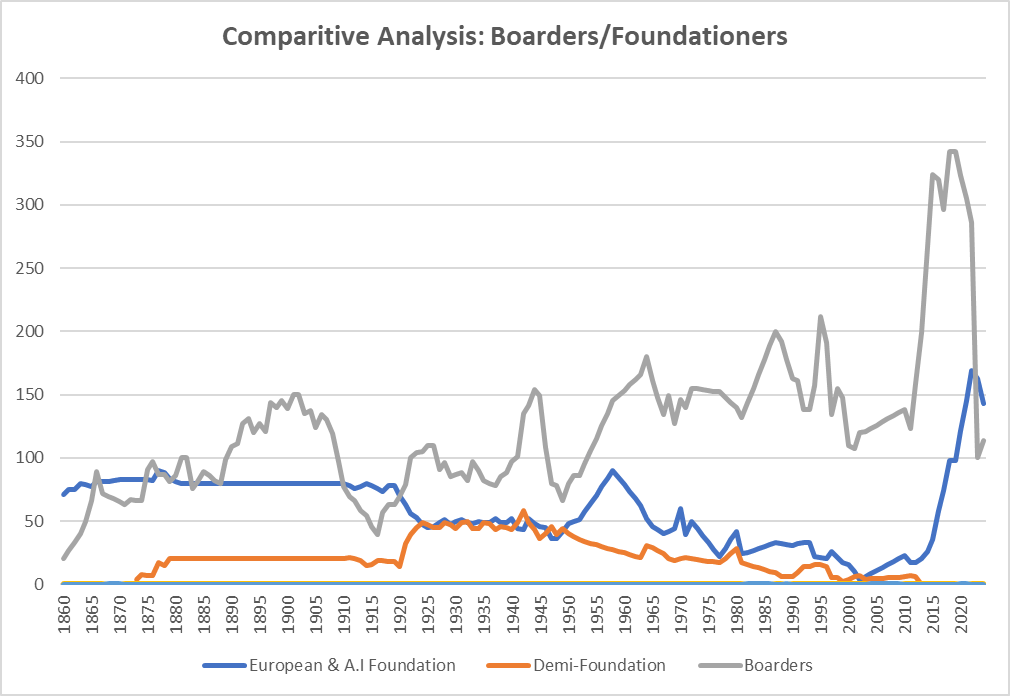
    The commencement of the 21st century saw these multiple factors congregate to exhibit a College, offering 14 years of learning to boys, with abysmal regard to charity and first values. Consider the reported strength at the commencement of the new century:

    YearTotal StrengthDay-ScholarsBoardersFoundationersDemi-Foundationers
    2001-2002229821751071006
    2002-2003238622551200407
    2003-2004256924381210604

    The numbers of Foundation pupils were nowhere near the arbitrary absolute number of 100, set more than a century ago. The number of paying Boarders could not inflate the expected number of resident scholars, nor establish any ratio or proportion in the context of day scholar strength.

    From the time of Independence, now nearly 80 years ago, the reasons for ignoring or consigning the Founder’s ‘lasting charity’ vis a vis the Foundation pupils, have been numerous and excusatory. The tendency, promoted over a century has been to find cogent arguments to maintain a bare minimum number in a quaint display of tradition that was gradually converting to folklore. Among the number of excuses presented were:

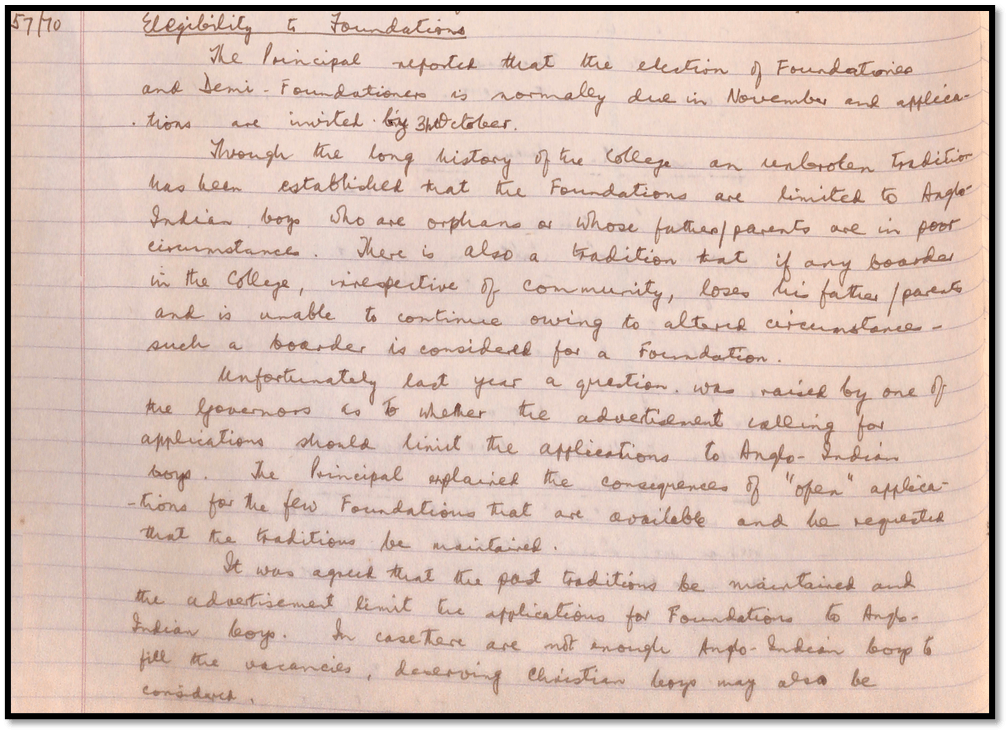
    • The Founder’s Will and Scheme of Administration required Foundationers to be of European origin or Anglo-Indian ancestry.

      The Founder’s Will, supported by the Scheme of Administration, placed no restriction on race.

      • In modern India, the Anglo-Indian community has dwindled in numbers and not many Anglo-Indians candidates apply for the privilege of the Foundation.

      The dwindling numbers, created by the European and Anglo-Indian diaspora, has been built up again by Anglo-Indians continuing to make the multi-community India their home. The number of boys who can be admitted must come from pan-India. The opportunity for a quality education must be offered to and enjoyed by them.

      • Foundationers are freeloaders.

      The provisions for free education were provided by the Founder and supported by the Scheme of Administration. Individual, subjective opinion should not interfere with the foundational principles of charity as espoused by the Founder.

      • Foundationers are ungrateful.

      Gratitude is not a condition for charity. The distinction between the ‘deserving poor’ and the ‘undeserving poor’ has no place in dispensing charity. Also, ‘gratitude’ – genuine or otherwise, is not a condition for service and charity even in the modern socialist state.

      • Foundationers are tardy in their academic work. They don’t apply themselves to academic challenges. They get everything too easily. They do not respect the value of the privileges they enjoy … and so on, with grumbling in the same vein.

      The Founder set aside his bequest for precisely such unfortunate boys. Many come from backgrounds that are severely financially limited. Most are admitted as children or pre-adolescent boys; affection rather than power and authority can provide a sterling change in attitude. The general malaise, inertia, torpor, apathy, indolence, languor and laissez-faire attitude is often an inherited social factor. It is the responsibility of care-providers in the College to encourage individual change. The state of discouragement into which children are born can be transfigured through accessible education.

      • Foundation pupils are only fit for the sports field and not for the classroom.

      The genuine credit for physical fitness and all the virtues with which sports and games are associated contribute an equal, if not a greater effect on the all-round education of a child. The best features of popular sport, unarguably promote those characteristics that education encourages. For the academically disinclined pupil, it is a meaningful educational tool rather than mere recreation. Perseverance, consistent effort, and self‑regulation are qualities that reinforce the value of sustained labour and determination in academic and professional pursuits. These cannot be imbibed by academic pursuits alone.

      • Funding for the Foundationers is an unnecessary burden.

      Foundationer benefits are a charitable right and not a concession. Educational charity is to be prioritised over revenue maximisation. Decisions regarding Foundationers are to be judged by whether they advance or dilute the Founder’s charitable purpose.Charity at La Martiniere College is a continuing obligation, not a historical relic. Any interpretation that treats Foundationers as a financial burden contradicts the object of the trust.

      Permanent Resident Scholars

      We are reminded of the apocryphal story that led to Maj. Gen. Claude Martin leaving the majority of his vast estate for the education of ‘young men and boys’. It is the story of Zulpheekar, an abandoned Georgian boy for whom the Founder paid a certain sum of money to his father. The condition of European children left destitute in a foreign land by death, desertion, abandonment and so on it may be said inspired Claude Martin to establish an institution where the ‘bazaar trash’ would have an opportunity to escape from destitution by means of a sponsored education. Zulpheekar, given the Name ‘James’ and the ‘patronym ‘Martin’ was educated in Calcutta. The scheme that Claude Martin suggested for his school for boys in Lucknow followed the trajectory of James (Zulpheekar) Martin’s own education and development.

      More than 200 years later, in 2014, Mrs Kamini Rattan Chauhan, Secretary, Women Welfare and Child Development initiated a project in which she proposed that abandoned children who were being taken care of in child shelters and homes could be integrated with the wider society and enjoy benefits denied to them by the circumstances of their birth. She approached La Martiniere College, Lucknow to enquire whether the College would be able to accommodate, under this scheme, certain boys in the Boarding House. This would be in the nature of an experiment, which she hoped would be popularised by other institutions, especially those with residential facilities.

      The timing was opportune. The College had already decided that there was to a resurgence of Foundation pupils. Considering the Will of the Founder, its legal implications, the carte blanche authority to take in children irrespective of religion and caste and such socially divisive considerations, it was agreed in principle, that the ‘experiment’ would be implemented in La Martiniere College, Lucknow, with certain riders.

      From Zulpheekar to Shubham

      In 2015, La Martiniere College had opened its doors to the first such Permanent Resident Scholar. Shubham was received on 8 October, 2015. He follows in the footsteps of Zulpheekar, the first abandoned child to be formally maintained by the generosity of the Founder, nearly 200 years ago. The Governors examined the action and recorded Resolutions in this regard:

      ADMISSION OF SHUBHAM TO LA MARTINERE COLLEGE

      The Principal informed the Committee that in October, 2015, the Child Welfare Department had approached the College to consider integrating abandoned children in the mainstream system of education. This was to be conducted on an experimental basis. After considerable discussion and determination of legal implications, a boy named Shubham had been admitted to the College as a Resident Scholar. Safeguards for the welfare of the boy include the District Magistrate being appointed as his guardian by the Court of the 1st Class Judicial Magistrate, Bal Kalyan Samiti, Lucknow. He shall receive education in the College in the nature of a Foundationer. He shall be in the care of the College till he is 18 years of age. The Principal reported that despite the trauma that he has grown up with, the child was adjusting socially and academically. It would be further explored whether children in similar circumstances may be accommodated in keeping with the spirit of the Will of the Founder. The financial implications in this regard were also to be examined. With the Right to Education becoming a greater reality, it would be a significant contribution if abandoned boys could be taken care of with the safeguards required such as may be learnt from this pioneering case.

      The LCG decided that keeping in mind the financial implications involved, the issue was to be discussed at the proposed joint meeting of the Trustees and the LCG.

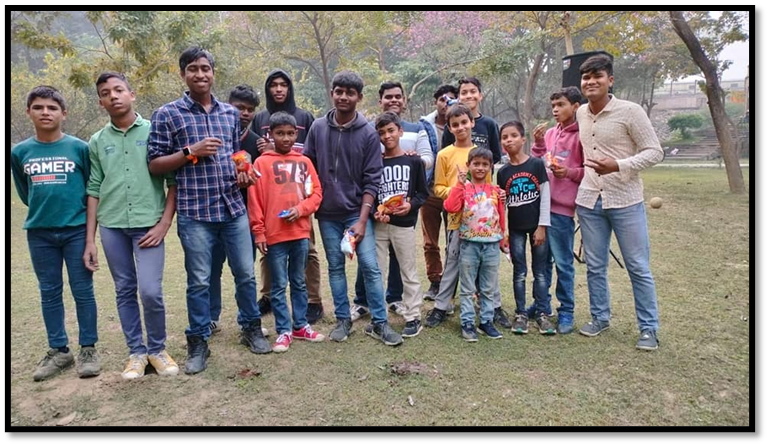
      With the approval of the Board of Governors the College subsequently, over the years received nearly 20 boys. The boys have over the years made the College their home with the security and emotional support from Staff and fellow students alike. Despite their academic delay and the social challenges they have faced, they have integrated with the wider student community and perform well in all spheres of College activity.

      Boys were placed in foster care with the College accompanied by a judicial order in each case by the Child Welfare Magistrate. The District Magistrate of Lucknow, by means of the same order, is ex-officio local guardian of the children. The boys, as per agreement, are to be educated at La Martiniere College, with full facilities including boarding, lodging, clothing, health, recreation, etc. The boys are to follow the academic scheme of the College until they completed the ISC or equivalent examination.

      The legal framework for this sensitive project was drawn up with the following safeguards:

      • The boy/boys recommended to the College would be placed in legal foster-care with the College.
      • The children would be received by the College with the Child Welfare Magistrate’s written order for each boy.
      • The College would include the boys under the provision for Foundation Scholars in the Will of the Founder Major, Gen. Claude Martin.
      • The District Magistrate who is also a member of the local Committee of Governors of the College, in an ex-officio capacity, would serve as the Local Guardian of each boy.
      • The boys/boys would be medically examined and the College Physician’s report attached.
        • The case history of each child would be presented to the College and maintained.
        • The CWC officials had the responsibility of making regular visits to check on the children’s welfare.
        • The children would be educated at La Martiniere College, with full facilities including boarding, lodging, clothing, health, recreation, enhancement of their particular talents.
        • The boys would follow the academic scheme of the College until they completed the ISC or equivalent examination.

      The scheme is now a well-established part of the College programme, providing inclusivity of less-advantaged children with boys from relatively privileged backgrounds. Above all, it is a natural progression in fulfilling the spirit of charity enshrined in the Will of the Founder. For the first time in the history of the College, a clear legal format has been provided for a new category of Foundation pupils. It is predicted that such children born into disadvantage, shall be the new Foundationers in the unlikely event of the source of the Foundationers from the Anglo-Indian community for any reason ever dries up. The ‘lasting charity’ of the Founder shall thus be sustained.

      The demographic change introduced has been well receive with alumni of privilege, mostly requesting anonymity, have made generous contributions for the welfare of the children, including clothes, sports goods, pocket-money, excursions, gifts etc, creating a bonding with the children.

      In addition, the College has provided legal protection to the children, as required, visits to parents separated by jail sentences, mental problems, visits to girl siblings and even reuniting with family after years of separation due to being lost in crowds.

      By 2018, the Governors were apprised of four more boys joining this category of scholars, whose number reached 10 by 2019 and continued to increase with a minimum of two boys being added to the community each year.

      Conclusion

      From a small colonial era institution dominated by European and Anglo Indian boys, La Martiniere College, Lucknow, has evolved into a predominantly Indian, socially diverse, and nationally respected school. The most significant demographic change has been the broadening of access, especially for Indian middle class families, while the most significant continuity has been the Foundationer system, which preserves economic diversity. The demographic evolution of La Martiniere mirrors India’s own historical journey—from colonial hierarchy to inclusive nationhood, while remaining anchored to the philanthropic vision of its founder.

      A single act of philanthropy can sustain generations. Claude Martin’s decision was remarkable for his times. The current mixed demography prevents the college from becoming socially homogeneous or insulated. A school composed exclusively of affluent students, risks narrowing perspectives and fostering social detachment. With fee contributing pupils and Foundationers sharing the same facilities together, the College actively dismantles social hierarchies within its campus. The student body reflects a broader cross‑section of society, enriching classroom discussions, friendships, and shared experiences. Especially significant is the Foundationer system. This is not an auxiliary welfare measure; it is foundational to the college’s existence. To discontinue or dilute this system would be to redefine La Martiniere as a purely fee‑driven institution, severing it from the very principles upon which it was established.

      In an age marked by widening economic inequality, educational institutions such as La Martiniere College play a critical role in bridging social divides, and La Martiniere’s long‑standing model offers a proven example of inclusive excellence. It continues to be not only an institution of privilege but also one of purpose, contributing meaningfully to society while retaining a balanced and representative demographic structure.

      La Martiniere College, Lucknow, stands as a permanent monument to the spirit of charity of Claude Martin. It is a reminder that true charity lies not merely in giving, but in creating opportunities that transform lives. Claude Martin’s vision lives on, not in stone and mortar of Constantia alone, but in the lives shaped by the education he so generously endowed.

    1. BACK TO BASICS

      Demography Influenced by Numbers

      A quick analysis of numbers in the second decade of the 21st century indicates the demographic changes that would affect La Martiniere College, Lucknow.

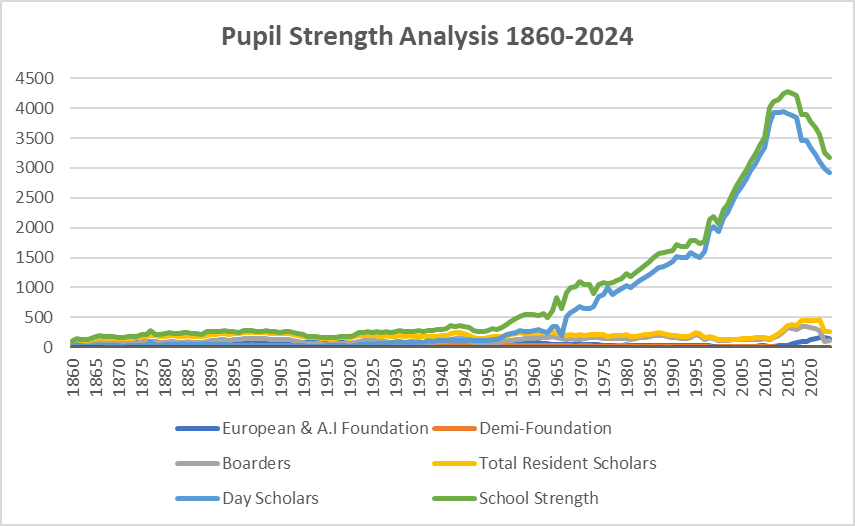
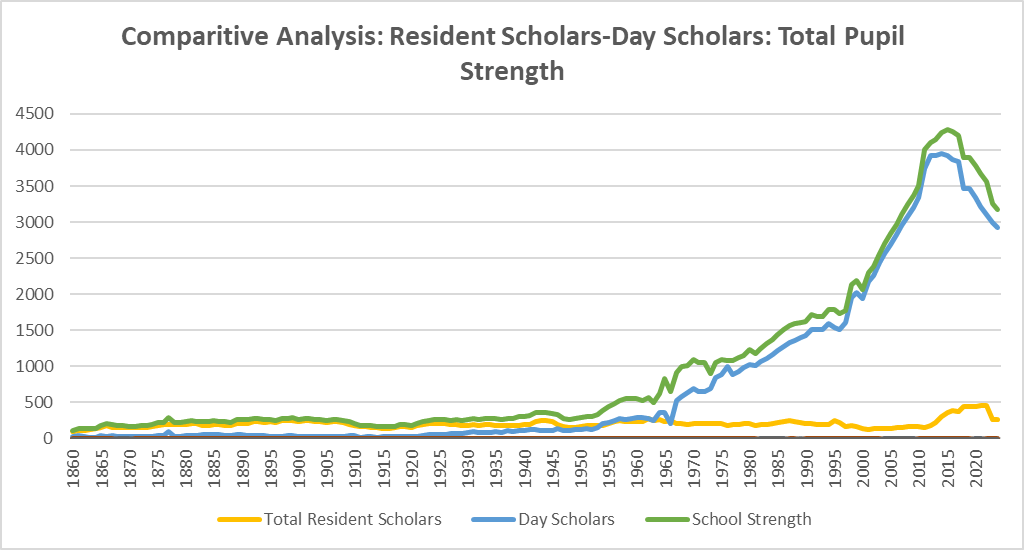
      YearDay ScholarsResident ScholarsFoundation ScholarsResident S. + Found.Staff ChildrenTotal Nos
      20103397138291673503
      2012374012324147994010
      20143790199222211114145
      20153794267282951224239
      20163326324353691104277
      20173274320583781524249
      20183222296743701744206
      20193459342984401433899
      202229693031524551313555
      202323071001632631583257
      202422321141432571883177

      A conscious endeavour was made to halt the pupil strength of the College from hurtling out of control. This could not be achieved overnight. It would not be possible to reduce the existing number of pupils on roll. This would only be possible by consciously limiting the intake of boys to the College. Especially in the College Nursery, the class of first intake.

      It would take about 14 years to reduce numbers by 1000 pupils. In 2014, the total number of pupils on roll was 4145. In 2024, the number was curtailed to 3177. This is despite new sections being opened to accommodate the new sections that had been introduced in a cyclic pattern in the early 2000s. The financial effects were stark. There was a deficit of fees for nearly 1000 pupils, which coincided with the number of Foundation pupils increasing to an all-time record of 163 in 2023. It was possible to accommodate Foundation pupils due to the rapid increase in numbers of Resident Scholars, the domestic expenses of whom were self-sustaining, leaving a lesser strain on finances to pay for overhead expenses, such as electricity, wages, boarding and lodging. A revamping of boarding house facilities and earlier comforts, now seen as necessities, ensured a larger number of boarders being admitted to the College. The all-time high number of 455 Resident Scholars was reached in 2022. This was despite the understandable concerns of parents regarding community living, following the Covid 19 pandemic.

      In this juggling of numbers, the demography of the College also underwent change.

      The gradual reduction of approximately 1000 students began the process of separating the wheat from the tares. The Martiniere boy was selected by observation of spark and individual thinking. Parents were advised to not admit their boys to the College, if they wished to encourage their sons to pursue traditional careers, based on parental pressure. As the profile of parents underwent change, boys were more at liberty to take up creative challenges for occupations. This was greatly encouraged by the College that provided facilities, which included modern subjects of study, such as law, hospitality, mass media, Artificial Intelligence and Robotics. Boys were provided with a fair degree of autonomy to ideate, plan, organize and be accountable for the conduct of programmes, alongside the standard academic requirements. A great amount of time was formally apportioned to co-curricular activities and play. La Martiniere College began to attract boys from families that were progressive. Fortunately, there was a boom in educational facilities in the city where parents with traditional ways of thinking, related to the upbringing of their sons, could send their sons to be educated.

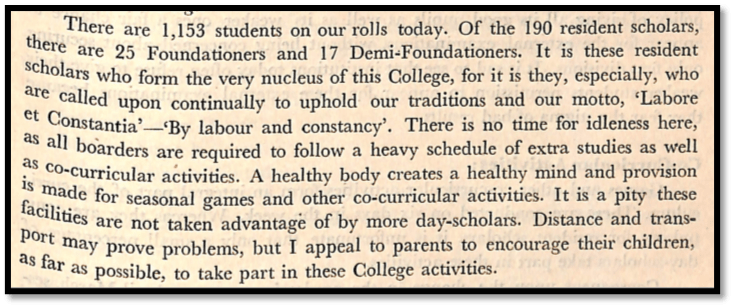
      The increase in number of Resident Scholars strengthened the observance of traditions and practices, passed down through the generations. With a large community of resident scholars, a monitoring of values, inculcation of worthy habits, respect for tradition and the joy of being part of a special legacy continued. The resident scholars could once again be described (as Principals Andrews, Daniells and Shaw had done), as “the backbone of the College”; the “nucleus” and the ‘transferers of tradition’.

      With the resurgence of Anglo-Indian and Christian boys as Foundation pupils, it was envisaged that the character of the institution would settle into the public-school mould where brawny, sports-loving, street-smart, survivors would set the tone, despite not maintaining a discernible proclivity for academics.

      Parents of boys from satellite towns of Lucknow made the College popular for boarding facilities, largely through word of mouth. Travel time from these satellite towns was now easier by road. Communications, the internet and the regulated use of mobile telephony helped this transition. These facilities and opportunities were not without their downside – constant monitoring of children by parents, imagined injustice, unreasonable demands and the inability to recognise the independence of boarding traditions as compared to family systems, caused conflict.

      All in all, the demography of the College settled into the middle-class, family-oriented tradition, with the College being seen as an extension of ‘home’. It was increasingly described as such.

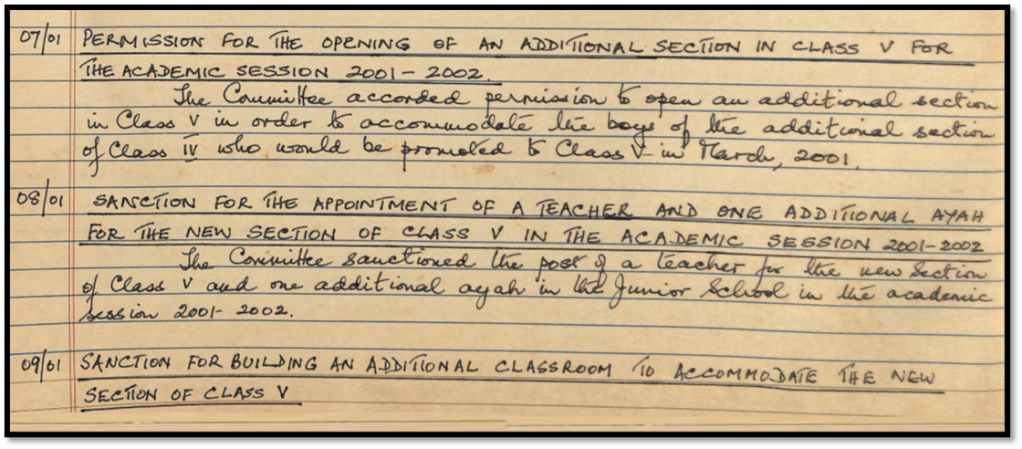
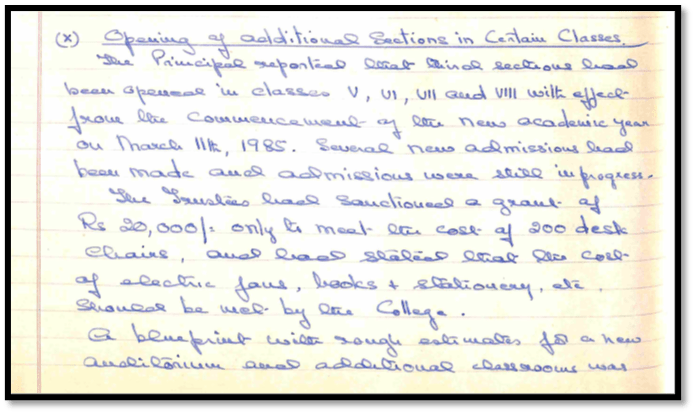
      The evolution of these markers had to be accompanied by hard-nosed adjustments in administrative policy. This began with the restructuring of academic sections and an adjustment for manageable numbers. There was an overflowing surge in the Junior School that accommodated seven classes and multiple sections, from Nursery, Preparatory and Classes 1 to 5. To provide more rooms for digital classrooms in the Junior School Campus, all sections of Class 5 were shifted to Constantia Campus. Classes 1 to 4 was now be designated as the Junior School; classes 5 to 8 made up the Middle School.

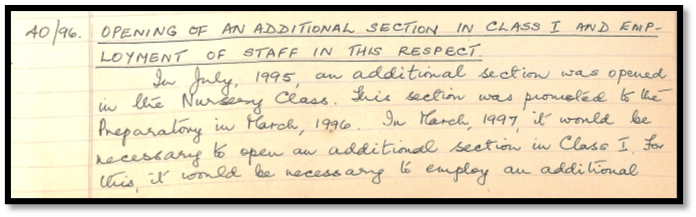
      To control numbers and to contribute to quality, a new section in all classes from Nursery to Class 9 was opened in July, 2011. Numbers in existing sections were reduced by at least 10 pupils to make up more manageable sections. This was made possible without appointing additional Staff. In a number of classes, sections had reached a total of seven each. To reduce numbers, the initial class – Nursery was reduced to six sections with an average of 40 pupils in each section.

      The Governors shared in this concern. In 2011, Resolution 27/11 was adopted to formally permit these changes:

      1.         “The Principal has reported that there are 60 pupils per section in most classes in the school. Owing to the large numbers per section, the quality of teaching and individual attention required for each pupil is being adversely affected.

                         The details are as follows:

                         Present Class Strength                                                     60

                         Optimum Class Strength target                                       45

                         Proposed average Class Strength in the current year    48

                         He has requested sanction of an additional section in each class from Nursery to Class 9.

                         He proposes to do this without any extra cost.

                         The details are as follows:

      • There will be no increase in the number of teachers.
        • There will be no increase in the existing infrastructure.
        • There will be the optimum utilization of the services of the teachers by a rationalization of work-load per teacher as per Government norms / CISCE recommendations.
        • There will be a discontinuation of environment studies as an independent subject as there is no longer a legal compulsion for the same.
        • Environmental awareness is to be included as a topic in General Science in Classes 1 to 8.
        • Teachers who are in charge of Houses in the Junior School will carry out their full academic work-load.
        • There will be need for renovations and repair of existing classrooms to accommodate the proposed new sections.
        • There will be a moratorium on all admissions from Nursery to Class 9 for the current year.

      Approval is sought to increase one section in each class from Nursery to Class 9, without extra financial burden on the College.”

      By 2021, some of the changes began to bear fruit. It was possible to abolition certain posts that had become redundant in a gradual manner, without any serving staff being retrenched. The Governors approved (vide Resolution 19/21) the abolition of redundant posts on the advice of the Principal. The Principal reported that over a period, due to the reduction of sections, certain posts had become redundant. Permission was sought for these posts to lapse. Reduction in numbers was accompanied by reduced expenditure on staff salaries.

      The Perennial Foundation Pupils

      Inspired by the objectives of the Founder, the number of Foundation pupils could be increased. Suppliers of books and clothing contacted publishers and manufacturers who deposited samples to provide for the Foundation pupils without the exchange of money.  Alumni provided with alacrity for niceties, excursions, pocket-money and the unquantifiable requirements for growing boys. Overhead expenses increased but were defrayed by the corresponding increase in revenue from boarding fees for resident scholars, without a drain on the resources of the College. This financial management was strongly assisted by financial consultants approved of by the Governors.

      This utilization of funds for the living conditions of the boys went hand in hand with the project of continued conservation of the buildings, begun efficiently during the sesqui-centenary celebrations in the College.

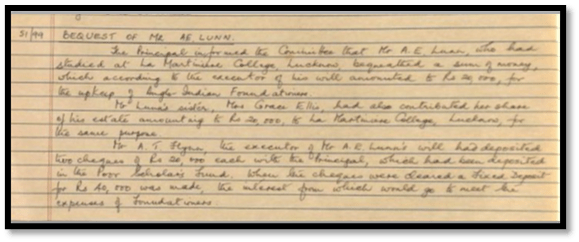
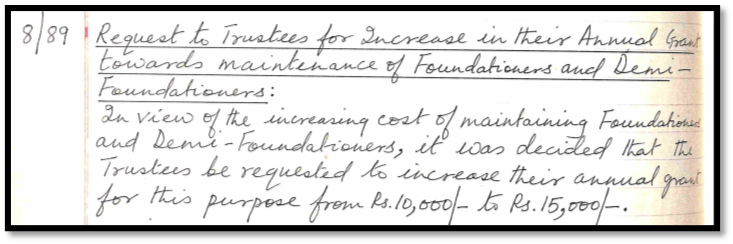
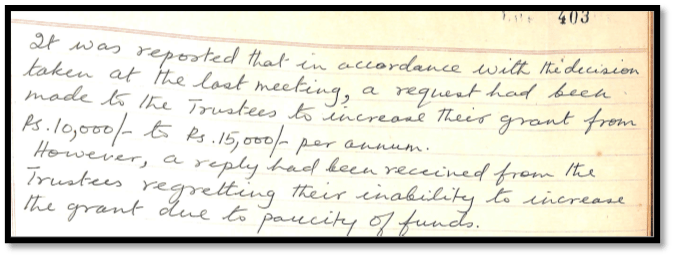
      Bureaucratic tangles, inadequate attention, lack of transparency and the general malaise of inertia on the part of the Martin Charities, prohibited the receipt of funds to cover costs for Foundation pupils at current rates. At the commencement of the decade, the College received an annuity of Rs 10,000/-, of which a portion was to be remitted for the upkeep of Foundation pupils in La Martiniere Girls’ College, Lucknow. This token amount ceased to be remitted by 2016, leaving the College with no other scheme, than to underwrite the expenses incurred for Claude Martin’s boys. The issue of requiring funds from the Martin Charities was brought up time and again. It was included in the formal minutes of the Governors’ meetings.

      49/11   INTENTION TO LIAISE WITH THE TRUSTEES OF THE LUCKNOW MARTIN CHARITIES FOR PAYMENT OF ACTUAL COSTS INCURRED IN THE EDUCATION AND MAINTENANCE OF ‘FOUNDATIONERS’ AS SPECIFIED IN THE WILL OF THE FOUNDER

      The Will of the Founder specified that a certain number of boys be educated and maintained from the funds accruing from the estate of the late Maj. Gen. Claude Martin. Such monies are controlled by the Trustees of the Lucknow Martin Charities. The College bears a heavy burden for the education and maintenance of these pupils, which is not subsidized by an enhancement of fee-paying pupils. An amount of Rs 10,000/- per year is forwarded to the College by the Trustees for this expenditure.

      The Principal intends to follow up this matter and seek funding for ‘Foundationers from the Trustees at actual costs.

      The Committee approved the idea.

      The Martin Charities was reminded repeatedly that adequate lease rents from the Golf Club, the Lucknow Zoo and the UPPCL could be used to bank roll this commitment of Trust. A sacred trust in the Government of the day had been envisaged by Claude Martin to execute his Will. This was largely ignored. The College, guided by the spirit of the Will of the Founder adjusted financial resources to make his unique philanthropic purpose a reality. An historic 163 boys were accommodated as Foundation pupils, far exceeding the artificial cap of absolute numbers of 100 that had been followed for more than a century and a half. The Founder’s Will, supported by the tenets of the Scheme of Administration called for at least one quarter of the boys admitted being supported by the Foundation. The number of Foundationers at 163, just following the Covid 19 pandemic was an indicator of how many boys could be accommodated at the Founder’s behest. The ability to take care of those boys for whom the school was established recalls Noam Chomsky’s dictum as applied to institutions – “There are no poor countries, only failed systems of resource management.”

      The Demography of the Alumni

      Every progressive educational institution is tasked with the role of changing lives on the individual level and contributing to the needs of society at the macro-level. To evaluate the manner in which the profile of pupils exiting La Martiniere College, Lucknow after having completed their academic tenure in the institution, it is a fulfilling and genuine exercise to contrast the demographic background and professions of parents of applicants for admission to the College, with the professional preferences and choices followed by pupils who have graduated from the College.

      The record of the social and professional backgrounds of parents is available through the admission records maintained by the College. It is these records that help analyse how families of applicants have changed from the establishment of the institution till the present. The typical European, service class, English-speaking and financially challenged families have over the centuries changed to Indian, service professionals, multiple linguistic speakers, often first-generation learners of English from middle class families. It is the record of alumni, independent of family background that provide an angle to the assessment of professional achievement on the demographic scale.

      While La Martiniere College, Lucknow studiously avoids profiling, nevertheless, inferences can be drawn from the existing records as to the categories of pupils admitted to the College. This can be compared and contrasted with the independent occupations of alumni who willingly present their achievements and credentials prepared in the typical social melting pot of quality education. The maintenance of this record is one of the several reasons for the existence of an association of alumni. Few return to traditional family ventures, some take up traditional or current socially attractive professions, while most are absorbed by professions that did not exist a generation ago or set out in pioneering enterprises with the boldness and confidence that a Martiniere education provides. La Martiniere Alumni Associations have been in existence from the beginning of the 20th century. They have been loosely operative, with a hiatus from time to time. Official recognition and institutional support were provided in 2011, when La Martiniere Alumni (LMA) was registered as a Society with the condition that the incumbent Principal would serve as the ex officio Patron of the Association. This was duly reported to the Governors:

      50/11   ESTABLISHMENT OF LA MARTINIERE ALUMNI ASSOCIATION

      The Principal wishes to inform the Committee that La Martiniere Alumni, (LMA) an association of Old Boys of the College has been registered. The Principal, La Martiniere College, Lucknow is the ex officio Patron and all former Principals are Honorary Life members. The LMA has expressed its desire to contribute towards the development of physical facilities in the College under the advice of the Principal.

      Minority Status Influence on Demography

      The Principal in the Annual Report of 2016-17 reported the reaffirmation of the Minority Status of the College that had been challenged in a matter of denial of automatic admission to Class 11 to an applicant. The matter had been argued before a single-judge Bench, followed by a division Bench in the High Court (Lucknow Bench). In 2017, the matter, by a Special Leave Petition came before the Supreme Court of India that ruled in favour of the College, setting aside the Order of the High Court and observing that La Martiniere College is “an unaided, minority, private institution”. The linguistic minority status of the College was reaffirmed. The effect on demographics maintained the prerogative of the Principal to select candidates for admission, thereby maintaining a prudent control on the cross-section of applications.

      Adjuncts to Monitoring Demography

      The 21st century has seen the engagement of Government, administration, educational authority and social movements in the commitment to education. This engagement has been incremental. It has sometimes been dictated by law or introduced due to greater awareness. Together, these factors have had an influence on the demographic composition of the College.

      Education is now projected as being inclusive. For this reason, the College initiated certain projects and movements that contributed to a change in the dynamics of education, moving towards a state where no child is left behind. This included Counselling Services for overall adjustment of the individual in the school-setting;

      Special Education for children who are academically different; and the establishment of a parallel system of testing and evaluation, recognised by law for those boys who may not be able to maintain the pace of the traditional system:

      Counselling Services

      In April 2015, the College faced an unmatched tragedy with death by suicide of a Class 9 pupil, Rahul Sridhar, on the first day in his new class. It was the first time such an event had happened on the school campus. The College were seized of the need for counselling services, which were immediately introduced. This began with personal counselling followed by the establishment of a Counselling Cell, which included services of psychological testing and career counselling. The diversity in challenges for boys in the modern world necessitated this development The Principal reported, “from the junior-most classes, boys with difficulties – emotional, psychological, relationships, etc. – may be referred to the Counsellor or may seek assistance individually. Parents are advised to meet the Counsellor in the event of any issue regarding the well-being of their son. This shall be dealt with confidentially and with professionalism.” The unintegrated composition of the student body required that this service be introduced to promote harmony.

      Special Education

      In 2017, a formal fillip was provided for Special Education, the foundation of which was reported in the Annual Report of the Principal.

      SPECIAL EDUCATION

      During the course of the academic programme, it is sometimes noticed that boys display signs of difficulty in learning due to inherent weaknesses. La Martiniere College has established a Cell for Special Education, wherein boys are screened for the particular type of disability noticed. If necessary, formal documentation after tests may be required from the approved professionals. For this, adjustments are made in the process of teaching / learning, the curriculum is modified and assessments made comfortable for the benefit of the pupil. Parents are encouraged to use the services of this Special Education Cell.

      In the same year, permission for introduction of National Institute of Open Schooling (NIOS) stream was introduced to serve the diverse and special children in the College. Due to the stark demographic differences visible, it was noticed that boys who were extremely proficient in all areas of their education and training, lagged behind due to an inability to cope up with the pressures of traditional forms of academic assessment and examination. Counsellors, Special Educators and Career Directors in the College reflected upon the need to train a boy for his best potential, while ensuring that the minimum academic requirements be maintained. Traditional Boards of education maintain a high standard with high expectations without flexibility for children with special needs. It was proposed to start a stream of study leading to school leaving examinations conducted by the National Institute for Open Schooling (NIOS). The system provides flexibility and pacing according to the individual’s requirement. Students, who were identified as being in need of this facility, could continue to receive education at La Martiniere College. They might choose to opt for school leaving examinations conducted by the NIOS. The NIOS is the only Board of education that is permitted to run concurrently in an institution affiliated to major National Boards such as CISCE or CBSE.

      Checks and balances were also be put in place so that provision was not misused on behalf of those children who are academically capable but did not use their potential to the fullest. The requirement for registration in the NIOS stream at La Martiniere had specific requirements, overseen by recognized professionals. This included a report of an RCI registered Psychologist indicating learning disabilities and the extent of this. The Governors approved of the decision.

      Dermatoglyphics Multiple Intelligence Testing

      A survey of the demographic differences in pupils was conducted and it was decided, with the approval of the Governors, that the assistance of technological aptitude testing based on Howard Gardner’s theory of Multiple Intelligences would be introduced in the College. This was a compulsory teat for all new admissions from 2013 and optional for boys who were already entrenched in the school system. Dermatoglyphics Multiple Intelligence Testing, to assess a pupil’s innate strengths and weaknesses was conducted on each new admission. Based on finger-printing of the candidate, the report generated was shared with the parents for information and record. The report was valid life-long.

      Following this development, boys with similar learning patterns were be grouped together in sections to ensure maximum benefit from the classroom teaching.

      Modern Influences on Demography

      In keeping with statutory requirements, La Martiniere College, Lucknow has introduced Bodies / Committees for the security of its members and redressal of complaints. This included the cross section of Staff and pupils.

      Guidelines, Norms and Complaint Mechanism for Sexual Harassment at the Workplace: In accordance with the directives of the Honourable Supreme Court of India, a complaint mechanism was established in accordance with The Vishaka Guidelines and Norms against sexual harassment at the workplace.

      Anti-Ragging Committee: In accordance with The Uttar Pradesh Prohibition of Ragging in Educational Institutions Act, 2010, a Standing Committee was set up to receive complaints and act in this regard, following due process.

      Committee for Protection of Children from Sexual Offences (POCSO): In accordance with The Protection of Children from Sexual Offences Act, 2012, a Standing Committee was set up to receive complaints and act, following due process.

      The Demography of the Student Body

      The professional requirements of education in the 21st century consciously focussed on the well-being of the pupil. Nevertheless, much of this was unfamiliar territory, where good intentions alone would not suffice. Keeping this in mind, Principal Carlyle McFarland appended a formal note on the demography of the student body and arising challenges, in the Annual Report of 2017-2018. This was also included in the Minutes of the meeting of the Governors in that year.

      OBSERVATIONS ON THE STUDENT BODY

      The Principal finds it necessary to place on record the difficulties being currently faced in matters related to discipline of pupils and the attitude of parents in the current scenario. Despite all well-recognized psychological practices being employed, indiscipline of various kinds that this generation of teachers is also not familiar with, is vitiating the academic atmosphere. The use of the internet, cyber-bullying, misuse of electronic communication devices, etc. are unfamiliar and uncharted territory. The College finds it necessary to be abreast with these developments and to mould its academic programme accordingly.

      Significantly, systems of negative reinforcement and punishment have to be changed in keeping with modern requirements and the rights of children. Moreover, there is need for preparation so that the new difficulties of adolescence can be dealt with.

      There is a certain militancy and a tendency to misuse democratic procedures like the law and the Press by a small section of parents. This is an unfortunate development in the sphere of education, which is likely to backfire. There has been an increase in negative publicity related to the College by a fraction of aggrieved parents. Significantly, this has not affected the enrolment of the College or the demand for admission to La Martiniere College.

      The Dynamics of Charity and Funding

      Funding continues to be an issue for the sustenance, progress, development and upkeep of Foundation pupils at La Martiniere College, Lucknow. There is no doubt that the College has, through nearly two centuries, served as a ‘not for profit’ entity. For over a century, fee-paying pupils were charged based on a sliding scale, determined by proven parental income. A cross-section of society was encouraged to educate their sons in the College, due to this. More than a hundred years after the establishment of the College, the sliding scale was abolished, and a common fee was introduced. This affected the demographics of the College, where those of limited financial means could not afford to send their sons to the institution. To the credit of the Governors, the increment in fees was maintained at bare minimum. The downside of this policy was that maintenance, upkeep, staff benefits and freeships were constantly affected. The involvement of the State in regulation of emoluments for staff, through Pay Commissions, whose recommendations were adopted by the College, made it necessary for fees to be increased in proportion. With the largest head of the annual budget being set aside for salary and wages, the system lost sight of the philanthropic basis on which the College was established. Foundationers were side-lined and became difficult to sustain, thereby eroding the very purpose for which the institution was established.

      In addition, recognising that there were exploiters of the policy for mass education, the mushrooming of private schools, unregulated and substandard, the Government introduced, in 2018, Guidelines of the Uttar Pradesh Self-Financed Independent Schools (Fee Regulation) Act. While the matter was challenged in the Courts, the College nevertheless adjusted its fee structure, in keeping with the provisions of the regulations. This was approved by the Governors and uploaded on the College website. There was no separate provision made for the maintenance of Foundation pupils as this was a unique social contribution made by the College from its inception, unmatched by any similar charitable Trust. Moreover, this practice did not fit in with the format of the fee regulations.

      The reality that struck the charitable work for which the College was founded, was a deficit in funds to maintain the Foundation pupils. The source for funding for these boys should have been funds received from the Trustees, through interest accrued on the investment of the endowments made by the Founder and added to by benefactors through the years. This source of funding, despite several attempts by Principals of the College, with the support of the Governors, led to no fruitful results. The nominal amount that was presented annually, calculations which were based on expenses a century ago, ceased to be forwarded to the College in 2018. This, through several decades, even before such funding ceased, left the College in the dilemma to either do away with the system of Foundation pupils or seek different ways of funding by clever adjustment of funds and charitable benefactors to provide for the creature comforts of the boys.

      Faced with this existentialist problem of maintaining boys who were financially deprived, it was found necessary to return to the drawing board and examine the conditions laid down in the Will of the Founder and endorsed by the Scheme of Administration, set by the Court.

      There was no doubt regarding the charitable purpose for the establishment of the College. The restriction of numbers that eventually settled at 100 was the result of local administrative convenience, a suitable number when the total strength of the College was predicted to be about 250.  As the total strength began to increase, it was not accompanied by a corresponding increase of boys supported by the Foundation. The number 100 seemed set in stone for many decades. Restrictions on an increase in the number of Foundation pupils was also the result of segregation based on race, availability of funds, political and social developments and a general apathy to bring about change. No questions were asked and there was no voice to persuade authorities on behalf of a section of society that was struggling to survive and was dependent on charity for any benefits that would come its way.

      In the second decade of the 21st century, following a re-examination of the Will of the Founder and the Scheme of Administration, a conscious decision was taken (a) to increase the number of resident scholars to maintain the tone, traditions and economy of the Boarding House; (b) to invite applications for boys to receive the benefit of education from among the most deprived sections of society; (c) to promote the Anglo-Indian identity of the College by providing, to begin with, Foundation pupil status to boys from Anglo-Indian families around the country.

      It was felt that these steps, while not affecting the number of pupils admitted as boarders and day-scholars, would infuse the College with the basic raw material to sustain the College as an institution answering to the description of a “linguistic minority” and working to promote the use of and protect the identity of English as the defined mother-tongue of the community. The overall effort did bear fruit as numbers indicate:

      YearDay ScholarsResident ScholarsFoundation ScholarsResident S+Found.Staff ChildrenTotal Nos
      20103397138291673503
      2012374012324147994010
      20143790199222211114145
      20153794267282951224239
      20163326324353691104277
      20173274320583781524249
      20183222296743701744206
      20193459342984401433899
      202229693031524551313555
      202323071001632631583257
      202422321141432571883177
      1. The number of full fee-paying Resident Scholars increased from 123 in 2012 to almost three times that number (342) in 2019. The target was to accommodate 700 boarders within 10 years. This was not achieved due to the Covid 19 pandemic, when there was a lock down for nearly two academic sessions, followed by the fear associated with infection due to community living.
      2. The total number of Resident Scholars (including full fee-paying Boarders and Foundationers) rose from 147 in 2012 to the maximum number ever on record (455) in 2022.
      3. The number of Foundation Scholars (largely Anglo-Indian boys) rose from 24 in 2012 to almost seven times that number (163) in 2023. The concept of demi-Foundationers was abolished as it had not been a part of the Founder’s Will or the Scheme of Administration.
      4. The number of Day Scholars was reduced due to a reduction of intake numbers in the class of entry, i.e. Nursery from 2016 onwards.

      These measures would have significant ramifications upon the demographics of the College, paving the way self-funding for Foundation pupils, not dependent on Trustees’ grants-in-aid, a large ever-present student body resident on the campus. Numbers significant enough to introduce and promote activities, especially games and sports with no dearth of ever-present and ever-willing participants.

      It was also time to take charity and demographics to a new level with the introduction of Permanent Resident Scholars who would add a new dimension to the flavour of the College and the philanthropic service expected of it.

    2. The First Decade

      In the first decade of the 21st century the expansion of the College vis a vis numbers, continued. This was considered necessary to generate more revenue for running the institution. It would have been prudent for incremental changes in the fee structure to accompany the plans of expansions. An annual increment in fees was severe taboo: Notices to parents regarding a hike in fees were always apologetic and included the phrase ‘unwillingly constrained.’ Financial management did not take into consideration inflation, cost of living, increase in staff, increment in salaries and so on. It would take another decade before professional financial consultants were brought in to advise on these matters.

      The ‘solution’ was the myopic decision to increase the number of pupils to generate revenue, while maintaining the status quo as far as existing facilities were concerned. Every inch of occupiable space was utilized. It was considered ‘imaginative planning’ to tinker with the heritage building and to insert mezzanine floors in the colonnades of Constantia, to build shoebox structures as classrooms, to close in well-ventilated corridors and verandahs in the mad rush to accommodate more pupils. Principal Elton deSouza announced on Prize Day 2001: “Even though hampered with extremely limited resources, it has not turned out too badly using a little imagination, some ingenuity and much technical advice. Creating a mezzanine floor with stairs leading to the upper room from the verandah, has given us two Computer Rooms, each capable of catering to forty students with ease.” Indeed, the pupils did seek admission in large numbers, and it was felt that the system would survive.

      The demographics of the College were changed due to volumes. A neglect of the Boarding House facilities contributed to a fall in the number of resident scholars, whose presence and subsistence were not only self-supporting but helped to defray overhead expenses for the philanthropic work for the Foundationers, as desired by the Founder. The number of Foundation pupils who could thus be supported fell to an all time low. In the first five years of the 21st century, pupil strength as reported by the Principal in the Annual Report was as follows:

      Academic YearTotal StrengthDay ScholarsBoardersFoundationersDemi-Foundationers
      1999-2000219020231481702
      2000-2001206519351101604
      2001-2002229821751071006
      2002-2003238622551200407
      2003-2004256924381210604

      The abysmal number of Foundation pupils while the classrooms were burgeoning is a striking irony.

      In the year 2000 a significant development inducing change in the demographics of the College was the approval and promulgation of the Service and Conduct Rules for Employees of the College.

      Besides streamlining the regulations for staff, the great added advantage was the perquisite for concessional education for children of permanent staff of all categories in both La Martiniere institutions in Lucknow. This was defined in the Rules, as follows:

      (o) Educational Concession

      Employees who have children studying in either La Martiniere College, Lucknow or La Martiniere Girls’ College, Lucknow shall be liable to pay concessional fees of Rs 15/- p.m. for each child.

      Effectively, this meant that boys and girls were guaranteed admission into classes that suited their academic abilities. In addition, the social fabric of the institutions was immediately altered to the great advantage of equitable education for all social classes.

      It must be specified that this decision was not an act of philanthropy. It was a respectable perquisite for serving members of staff who paid a nominal Rs 15/- per month as fees. In no way could this be linked to the system of Foundation pupils but seen as a right, derived from the Service Rules. In may be recalled that until then, sons of teaching and administrative staff were accommodated as Foundation pupils, with the stipulation of them continuing in the College as Resident Scholars only. The children of ancillary staff had not been included for this privilege.

      The preoccupation of the administration was an increase in pupil strength. In the first decade of the 21st century, one regular meeting of the Governors, annually, would include related items on the agenda for expansion:

      At the end of the decade, each class had reached 6 sections. Principal Elton deSouza in the Annual Report for 2009-10 described the addition of sections to classes as a “new cycle”. It was difficult to keep up with the altering number of sections in each class. Each new section that had been opened in Nursery over the years began a longitudinal plan of education that would continue for 14 years. Nevertheless, it is accurate to report that the increasing demand for admission was, in part, being fulfilled.

      DEVELOPMENT

      Additional Classes

      In an attempt to meet, in small measure, the increasing demand for admission, and in continuation of the new cycle, a sixth section, Preparatory F had to be opened to accommodate those who had been promoted from the additional section of Nursery Class, opened the previous year. A fifth section was also added to classes 2 and 7 to accommodate the students who had been promoted from the additional sections of Classes 1 and 6 added in the academic session 2008-2009.

      In July, 2007, the most ambitious plan for the expansion of La Martiniere College, Lucknow was proposed. Principal deSouza reminded the Governors that “the College had no dearth of land, an asset which a large majority of schools did not have. In order to make the maximum use of this valuable asset it was proposed that the existing educational facilities be expanded.”

      “The proposal was to begin with the opening of 10 Sections of the Nursery Class w.e.f. the academic session 2008-2009. Once started, each year the existing five sections in each class would increase to 10. Over a period of fourteen years the educational facilities La Martiniere would be able to provide would be doubled.”

      The grand plan would ensure that “Each department would have its own playgrounds and adjuncts such as auditoriums, laboratories, administrative office, gardens and infrastructure for a complete school.”

      Visualised in the manner of a commune, there was not enough though put into funding of the project, maintenance of the ethos of the College, the interaction between all categories of students and above all, the spirit of La Martiniere, which, while preparing students adequately for the outside world, remained insular in traditions and practices.

      Assembly-line education was not without projected advantages and foreseeable disadvantages. These were summarised for the Governors at the meeting of 21 July, 2007:

      To ensure that the plan would materialise, the Governors set up a sub-Committee for this purpose:

      The demographics of the College would have completely changed had this proposal converted into reality. Instead the more mundane work of running the establishment continued with a maximum increase in fees of 8% – translating to Rs 50/- to Rs 95/- for different classes, was proposed to be charged from 1 April, 2008:

      The increase in fees, whenever sanctioned in this decade was invariably fixed at 8% and was not commensurate with the financial indices in operation for a gradual enhancement of fees. As a result, when the financial belt had to be tightened due to an overall slump in physical and logistic standards in the decade that followed, the fee hike was seen as exorbitant. Financial capability became the default meter by which pupils were admitted. La Martiniere College, Lucknow ran the risk of converting to a school exclusively for the wealthy, with the social demographics being unevenly balanced by the almost non-existent Foundation pupils and the boys privileged to be offered concessional fees as sons of all categories of permanent staff. The social balance was perilously at risk.

      In this decade of financial tumult, the old spirit of philanthropy, generosity and gratitude continued to express itself through the great and small contributions made by alumni in different ways.

      In January, 2004, Lt Col C. F. Hamilton sent the College a Demand Draft of Rupees two lakhs, with the request that the interest thereon be used to help finance Anglo-Indian boys who had passed through the College, with their further education. The donation was gratefully received. The Principal was instructed to extend thanks to the donor and to administer the fund by informing Anglo-Indian boys, who were Foundationers, that money was available for them to pursue their higher studies. The Committee “would sanction a reasonable amount to be paid from the interest derived after investment.” Sadly, this came at a time when the number of Foundationers was at an all-time low, with 6 full Foundationers and 4 demi-Foundationers on roll.

      The following year, i.e. 2005, as earlier reported, Mr Adrian Holwell Sanyal, one of the first non-Anglo-Indian Foundationers to be granted that status in 1955, bequeathed a part of his estate to the College. This was for subsidizing/freeship to deserving boys of the Christian community only, for education only. He wished “to return in good measure the facility extended to him during his youth. What he was he owed to the sense of values he imbibed at La Martiniere College, Lucknow.” Rs 52 lakhs was forwarded by his estate to be invested and the annual interest accrued thereon be used as stipulated. A further Rs 8 lakh was made over to the College sometime later by the Income Tax department, following a representation by the College.

    3. THE NEW MILLENNIUM

      This Part deals with the first quarter of the 21st century and roughly corresponds to the time scale of the beginning of the new millennium (2000) to the 175th anniversary of the establishment of the College (2020)

      Section 1

      The Century of Land and Liberalization

      The turbulence in the demographic changes in the College in the second half of the previous century settled into calm passivity as the nation asserted its independence and its republican credentials. The pressure of increasing numbers was also beset by pressures related to the greatest physical asset of the College – its unmatched land bank. The commercial and residential sectors of the city now surround the serene Lakhperra, or place of one lakh trees. The pressure of encroachment and demands for requirements for public works put added pressure on the administration of the College. A conflict of interest has seen those who were entrusted with taking care of the property being implicit in the gradual chipping away of the vast estate.

      La Martiniere College, Lucknow entered the new millennium having discarded the prejudices of the past, which included segregation and race. The new millennium would throw up different challenges in the demographics of the College while also creating the challenge of the century – its vulnerability in maintaining the title of its vast estate – a land-pocket now in the heart of the city.

      Turning a Nelson’s eye to encroachment seemed a better option than prudent leasing or licensing of land for limited time and purposes. The Principal was expected to be the chief executive for the maintenance of the land without the authority to function independently for its protection. This also severely dented the availability of his time and priority for academics and the moulding of young men and boys. Increased admissions meant increased pressure of expectations from parents who, with the arrogance of numbers, demanded individual and personal attention and intervention for the smallest of causes. Increasing awareness of child rights was a welcome addition to the educational experience. Arbitrariness was replaced by due procedure. This was an excellent addition which prevented misuse of authority. It nevertheless required men of stature, resilience, courage and suavity to balance the conflicting pressures.

      The focus on the challenge of maintaining the clear title of the land does not have direct bearing to the study of the demographic changes in the College. Nonetheless, it offers a partial explanation as to how the vision of the Founder, his Will, and the Scheme of Administration set up for the College was often overshadowed by vigorous attempts to protect the land. Protecting the land has become a daily constant, requiring acumen, expertise and legal skills at different levels of administration.

      It is nevertheless germane to know the items related to land that were on the Agenda of the first meeting of the Governors held on 19 February, 2000. It is pertinent that these items have been, without fail, included in the Agenda of every regular meeting of the Governors, so that they are not lost sight of. In the meantime, some issues resolved themselves, some became flashpoints, some return from time to time as bug bears. Nevertheless, there is clear documentation on each of the issues related to land, providing great hope that in time, even the most contentious of issues shall be resolved.

      On 19 February, 2000, the first meeting of the Governors in the new millennium was held:

      The following items related to the land of the College were listed:

      03/00 MATTERS ARISING FROM THE MINUTES

      • COMPENSATION FOR TRUST LAND ACQUIRED FOR WIDENING THE ROAD ON THE BUND ALONG THE GHAZI-UD-DIN HAIDER CANAL
      • UTILISATION OF LA MARTINIERE LAKE
      • LETTER FROM THE TRUSTEES IN RESPECT TO PROPOSED ACQUISITION OF LA MARTINIERE ESTATE LAND BY THE AVAS EVAM VIKAS PARISHAD
      • RENEWAL OF LEASE OF GOLF CLUB
      • REQUEST FOR LAND BY THE U.P.S.E.B. FOR CONSTRUCTION OF A 132 KV SUB-STATION AT MARTIN PURWA
      • REQUEST FROM THE GOLF CLUB FOR 65 ACRES OF LAND
      • REQUEST FROM PIONEER SERVICE STATION

      While certain items continued to be sensitive, others fell by the wayside. Fresh causes were added to the list in the first 20 years of the 21st century. By the time the institution reached 175 years in 2020, the agenda items related to land of a regular meeting of the Governors, land included:

      • Compensation for Trust land acquired for the widening of the road on the bund along the Ghazi-ud-din Haider canal
      • Utilization of La Martiniere Lake
      • Matters pertaining to the Lucknow Golf Club
      • Observations regarding the Lucknow Master Plan 2031 with respect to the Martiniere Estate
      • Renewal of lease of land for UPPCL 132 KV sub-station
      • Renewal of lease of land to the Lucknow Zoo
      • Lease for Sewage Pumping Station
      • Construction of toilets on La Martiniere Estate
      • Request for additional lease of land by the Golf Club
      • Request from the U. P. Golf Association for the allotment of a portion of La Martiniere estate land for starting a Golf Academy
      • Proposed Acquisition of La Martiniere estate land by the Avas Evam Vikas Parishad
      • Request for land belonging to La Martiniere estate for a helipad for the Chief Minister
      • Proposal for Electricity poles to be erected over Martin Trust Estate
      • Request for lease of land from the Lucknow Development Authority for an Environmental Park
      • Sewage Pipeline across La Martiniere estate
      • Request for a piece of land on the Martin Trust Estate for the purpose of installing a mobile tower
      • Establishment of a Tennis Academy
      • Barricading of roads of La Martiniere Estate
      • Observations regarding the Lucknow Master Plan 2031 with respect to La Martiniere Estate
      • Objections from the Archaeological Survey of India
      • Matters related to the demarcation of Boundaries of La Martiniere Estate
      • Status of land on which is located the tomb of Sally Begum
      • Litigation against construction of a cremation site on the Eastern Boundary of La Martiniere Estate
      • Illegal occupancy by U.P Jal Nigam Sharda Canal Office
      • River Front Encroachment
      • Events related to the Tomb of Maj. Hodson
      • Attempt at land grabbing

      The Liberalized Native School

      In the meantime, the demographics of the College were affected chiefly by increasing numbers, especially among the day scholars. The number of day scholar pupils outstripped the number of resident scholars by 1955. On 26 February, 1955, the numbers were: Resident Scholars 173, while Day scholars had increased to 211.

      It was made clear to all that “La Martiniere is essentially a residential College and in order to maintain its character it is necessary to limit the admission of non-resident pupils.” The rapid increase in numbers was also in keeping with Government policy for ‘mass education.’ The College was aware of the challenges that this increase in numbers would have on the overall ethos of the College, still seen as primarily a Boarding school.

      It was reiterated that it was the Resident Scholars, of whom the Foundation pupils were a part, who constituted the ‘nucleus of this College’. In flattering laudatory terms, it was reminded that it was the Resident Scholars “who are called upon to continually uphold our traditions and out motto, ‘Labore et Constantia’ – ‘By labour and constancy’”.

      Education, in general, was in high demand; La Martiniere College, Lucknow had an excellent track record in tradition and history; English-medium education was at a premium; the ‘old’ schools retained a degree of sophistication, so valued by observers and prospective parents of candidates for admission; English was spoken by teachers and pupils exclusively in the College; habits and manners were still old world and European in tradition; the patina of polish was not restricted to academic excellence; the precincts of the school were sprawling; the unique events of history affecting the College was unmatched; the traditions were consciously transferred through the generations; there was a new equality, highly encouraged, which ignored caste and religious identity; the teachers and officers maintained a western orientation by belonging to the closest of the European tradition through the Anglo-Indians; the Anglo-Indian pupils, diminishing in number, were nonetheless the leaven maintaining the flavour of a westernised school.

      The beginning of a century, in this case a millennium, is an opportunity to pause and take stock of evolution and development in any institution. During the last century, race and community had influenced the demographics of the College. There was a process of exclusion, and the steel frame of colonial prejudice made institutions such as La Martiniere exclusive, though not necessarily elite. Parents of boys attending the College in colonial times came from families that reflected the cross-section of urban middle-class professions in India. Until Independence, the urban middle class emerged due to British administration and modern education. Typically, boys who attended were sons of military personnel, clerks in British government offices, schoolteachers, doctors of Western medicine, accountants and auditors, railway officers and supervisors, mission-linked or church associated staff, postal and telegraph staff. With political changes, the sons of taluqdars and landed elite were added to the list, as day-scholars. The English‑medium education provided and its proximity to colonial power made the College attractive to families linked to the Raj’s service economy, rather than merchants or artisans.

      During the early post-Independence period, there was the huge diaspora. The British, the Anglo-Indians, the Burmese and the new citizens of Pakistan created a vacuum that was gradually filled by the sons of the bureaucracy and the salaried middle class. Most often, these were families that were employed by the government, which was the largest employer. This included civil servants of all categories; public sector employees, including PSUs, banks, and the LIC; engineers in government projects; doctors in government hospitals; schoolteachers and university teachers; public-sector managers, and so on. Established Lucknow business families engaged in printing, medicine, construction etc. also joined the ranks. The cross-section indicated a domination of job security and state employment.

      The social demographics underwent change with the promotion of socialist ideology, especially affected by the period of the license Raj. The expansion and of the College in numbers and a new burgeoning middle class that was expanding with new professions, affected by government controls, was evident. Professions represented in the school roll from the 1970s to the 1990s included: bank officers, chartered accountants, small business owners, traders and shopkeepers, junior engineers, government contractors and sales officers in Indian companies. Social prestige was still strongly tied to stable salaried employment, especially government jobs.

      The boom in the economy post liberalisation induced a change in professions as reflected in the admissions to the College following 1991 to the beginning of the 21st century. Economic reforms transformed the urban job structure and expanded private-sector careers. La Martiniere College now seemed to invite sons of software engineers and IT professionals, call‑centre and BPO employees, private-sector managers, marketing and HR professionals, private bank and insurance executives, media, advertising, and PR professionals, politicians, real estate and construction professionals. There was a huge change in incomes, professions, mobility and awareness. Education was one more service. Attitudes and expectations also underwent change. This phase marked the rise of a service-driven urban middle class and declining dependence on government jobs.

      By 2020, the time the College entered the 175th year of its establishment, the urban middle class had become highly diversified and fragmented. Boys admitted during the last twenty years have come from families involved in service and knowledge-based occupations. These included: of software developers, data analysts, AI engineers; startup founders and tech entrepreneurs; consultants and financial analysts; digital marketing specialists; designers and content creators; doctors in private hospitals; freelancers and platform-based professionals in educational technology and health technology. La Martiniere College, in keeping with the times and its gradual evolution, accommodated the new middle class, shaped by globalization, technology, and private education. Admissions now reflect economic capital over institutional rank with the Foundationer system still permitting non‑elite occupational backgrounds, maintaining the school’s original philanthropic mandate.

      These trends are consistent with the sociological and economic studies of India’s middle class. It is to be noted that the College does not maintain records of profiling based on caste, income and profession. The reconstructed pattern is based on the changing fee structure, the record of Foundation pupils, alumni records, and typical studies of traditional and old Anglo-Indian schools. Therefore, these inferences are based on context and cannot claim to be statistics based on documented institutional facts.

    4. The Nineties

      The Close of the Century

      As the last decade of the 20th century approached, it was a time to take stock of the way the Institution had evolved, viz-a viz its demographic structure. The institution continued to play a significant role in the educational landscape of India throughout the century. The institution’s founding principles, rooted in Martin’s Will, had emphasized education in the English language and Christian religion for boys who so desired, while explicitly avoiding religious discrimination in admissions.

      The College’s demographic composition and policies even in the first half century of its existence reflected the complexities of colonial society. By the end of the 20th century, the clock had turned full circle to accommodate children from all communities, without discrimination. This was enforced by the democratic path that independent India had chosen to follow in the mid-20th century. Segregation was now infra dig. There was no longer discrimination in facilities, curricula, and daily life. Race and religion ceased to be a dominant factor. The balance had shifted with the tidal wave of Indian pupils. There was a tsunami of day scholars that had changed the demographics of the institution, struggling to maintain the tenor of the typical British public school.

      The College’s advocacy and commitment to supporting boys from disadvantaged backgrounds, a principle evident in the continuance of the ‘Foundationer’ system had been submerged by the surge of admissions, especially from families of the middle class for whom expenditure on education was considered viable.

      The College was turning elite, through vehemently opposing the idea of elitism. This dichotomy was evident in the criteria for admission where a knowledge of English and conformity to Western habits still played a key role in the tacit admission criteria.

      As from the time of its foundation, La Martiniere adapted to changing circumstances and the needs of pre- and post-Independence. Administrative practices were formalised through detailed documents on procedures, rules and regulations, especially for Staff. The rigorous verification of candidates for Foundation support that had characterised the intake of such pupils in the previous century was diluted, with the Principal being delegated with the responsibility for selection of the fractional number of such boys found eligible.

      By the end of its first 150 years, La Martiniere College had retracted from the prejudices of colonial society; it had evolved to being a multi-cultural school encouraging inclusivity.

      Admissions were now a contested issue, This had direct bearing on the demographics of the College. Controversy accompanied the expansion of the College with interested parties attempting to use influence through power and persuasion for candidates to be admitted. This touched even the ermine of the Bench. Admissions in both La Martiniere College and its counterpart for girls became a contentious issue, with calls for transparency and accountability in the procedure.

      The Governors were instigated to constitute a sub-Committee to “review the policy, procedure and practice with regard to admissions”. The sub-Committee that included the Principals of both institutions met to discuss this for the benefit of the Governors on 7 April, 1990.

      Both Principals had circulated details regarding the policy, procedure and practice that was then being followed. After considerable discussion, “it was felt that the maintenance of standard should continue to be the primary responsibility of the Principal.” Reading between the lines, it becomes evident that some sort of leverage, grace and favour was to be extended to members of the Committee:

      This was the beginning of active intrusion into determining the composition of the student body. It also established the practice of letters being sent by members of the Committee on behalf of particular candidates, a practice that continued into the following century. These letters were seen as symbols of status and preference. It would not be possible for any Principal or selection authority to admit candidates based on these recommendations alone.

      In the meantime, admission of Foundationers was handed over to the Principal. Through the 1990s the practice of advertisement in the newspapers was followed, but fell out of practice when the privilege reduced to a trickle and Foundation scholars approached the College through word of mouth. A typical entry in the Minutes of 10 August, 1991, characterised the manner in which this agenda item was handled annually:

      The annual practice was completed when the Committee was ‘informed’ about the annual selection:

      Expansion continued. In November, 1996 Principal Elton deSouza reminded the Governors that at an additional section had been opened in 1995 Those pupils had been promoted to the Preparatory class in 1996. Therefore, the process of including one more section from the session commencing in March, 1997 would have to permitted annually for the accommodation of these boys as part of a longitudinal plan.

      Following the tradition of several Foundation pupils, who had gone on to progress financially in professional life, Mr Arthur E. Lunn, a former Foundation pupil, bequeathed a bequest for the upkeep of Anglo-Indian Foundationers. This was placed in fixed deposit, the interest of which would be utilized as per the donor’s Will.  This action was reported, significantly, at the end of the decade, ironically, on Children’s Day – 14 November 1999. It was a suitable gift of meaningful charity returned for charity that had been received by a grateful former scholar. It also ended the century with a reminder that the College had been founded for ‘lasting charity’.

      La Martiniere College, since its founding, adapted its administrative and admissions practices to reflect changing societal values, especially in the post-Independence era. The school evolved into an inclusive, multi-cultural institution, yet admissions became increasingly contested, prompting calls for transparency and the establishment of review committees. While the Principal retained key responsibilities, external influences and recommendations began to play a role in admissions. Over the years, processes for selecting Foundation scholars changed, with tradition upheld through charitable contributions and the continuation of the College’s founding principles of lasting charity and service.

    5. The Eighties

      Whither ‘Lasting Charity’

      The 1980s seemed to be the decade where the offer of charity was questioned, re-questioned, permitted, withdrawn, subsidized. It was converted to a competitive exercise. It included a qualifying examination. It even required parents of pupils on the Foundation to pay fees, albeit highly reduced. The status of the Foundationer seemed to overshadow all other aspects of admission policy in that decade.

      In the meantime, numbers steadily increased with the usual sops being granted to Foundation pupils, with strenuous checks and balances to disqualify candidates rather than encourage such opportunities for education of the disadvantaged.

      While other developments, physically and academically followed an upward trend, the trend was to keep the Foundation pupils at the bare minimum. In this decade, no other aspect of College life received as much attention by the College as the status of these boys.

      In 1980, there was the resurrection of the Roorkee Scholarship that had fallen into oblivion since decades had passed from the time that Thomason College, Roorkee had stopped being the most prestigious and sought after College for engineering aspirants. The lapsed scholarship, still officially available now diversified to include beneficiaries from among the meritorious deserving from academic disciplines other than engineering. Carlton J. Ellis was chosen for a scholarship that would have been, in part, underwritten by the Roorkee Scholarship fund. This was to cover costs for a teacher training programme, for which he would sign a bond, committing him to serve in the College, on payment, for a minimum of five years. This was confirmed by the Governors in 1981. Steps such as these were designed to encourage young Anglo-Indian men to take up teaching as a profession. The further advantage would be to have an old boy on the Staff, and in Ellis’ case, an effective College Captain. It was designed to maintain the Anglo-Indian component of the demographics of the College.

      The revival of the Roorkee Scholarship awarded to Carlton Ellis was a one-off event in the 1980s. It was never repeated. Instead, mystery surrounds the application on behalf of Rohit Chandra, a pupil in 1983, where the Governors merely recorded “their inability to comply with the above request.” The Roorkee Scholarship and the endowment for the same has never been mentioned again.

      With the opening for opportunities for education in the country, La Martiniere College was still an institution of choice for admission of boys. Unfortunately, there were unpleasant occasions when a boy, to gain admission, was presented as a resident scholar, while once the admission was confirmed, the parent would apply for a change of status to day scholar. The College had to scrutinize all applications for such change in status, often bringing it to the knowledge of the Governors. As a rule, it was required for a pupil to complete three years’ tenure as a resident scholar, before the consideration of a request for a change to day scholar status.

      In August 1980, the Governors rejected the request of a parent on this basis alone. A change in status would also mean a loss of revenue, necessary to cover overhead expenses of the boarding house.

      An year later, the Governors were again approached for a similar change in status from resident scholar to day scholar. The request was turned down with the Governors adding that “there were no special circumstances to justify a departure from the rule.”

      The attempts to convert pupil status began in the 80s and continued. Regrettably, even genuine cases had to be overlooked due to what was becoming a scandal. Years later, it would be seen as a dubious way of obtaining higher Boarding fees, while permitted a boy to proceed on ‘day scholar leave’, sometimes for sessions together. This ensured increased revenue, without the corresponding expenditure on a Resident Scholar. The practice, under this guise, was corrupt.

      Occasionally, requests would be made within a few days of a boy being registered as a Resident Scholar. Homesickness aside, this would become an unhealthy practice where some boys admitted as Boarders would not spend a single night in the dormitory, proceeding on ‘day scholar leave’, even before attending their first class.

      The requests for change of pupil status came with particular regularity:

      The downslide in numbers of Foundation pupils continued, with even the notional limit of 100 Foundationers being far from met. The Principal’s Report presented in 1980 provided statistics of an increase in total numbers of almost 300%. The figure was reported to justify the need for the expansion of physical facilities. Yet in the same context, the total number of Foundation pupils was reported to be 45.

      Statistics are quoted to fit a particular context. In 1981, the Principal’s Report referred to the 1905 figure of a total number of 248 pupils of which 24 were day scholars.

      Records indicate that there were 100 Foundationers and 124 Boarders in 1905. The ratio of Resident Scholars and Foundationers was withheld from the 1981 Report. Instead, the increase in the number of Day Scholars in 1981 was recorded as 1024. This was from a total of 1234 pupils on roll. A quick calculation would indicate the ratio and percentage of the Foundation pupils, spanning the difference of 76 years. In 76 years, the percentage of Resident Scholars had dropped to 5.6%, while the total number of pupils on roll had increased by 5 times the number to almost 400%.

      With increasing numbers there was in fact a dramatic decrease in the percentage of boys educated by charity.

      By 1982, the Principal was reporting on the homogeneity of the demographics of the College. Principal Shaw referred to La Martiniere and other Anglo-Indian schools as “true examples of National Integration”. Perhaps erroneously he described this as having been “our way of life from the beginning”. The claim sounded hollow when we consider the discrimination that existed due to race and colour; the discrimination that contrasted charity with affordability; the discrimination in even the training in the use of arms before Independence. The rhetoric conceals the clashing social forces that underlie the surface calm. Superordinary goals, described as ‘tradition’, are the acceptable compromise when there is conflict.

      The expansion that had begun in the tenure of Principal Daniells, continued through the 80s. Corresponding expenditure was sanctioned by the Trustees only for furniture to equip new classrooms, while it was left to the College to arrange for fittings. The Principal was instructed by the Governors on 30 March, 1985 to forward blueprints and estimates of costs for expansion to the Trustees.

      The raison d’etre for Foundationers was once again questioned in 1985, when the Minutes 23 November, 1985reverted to the old tune of requiring a candidate to ‘qualify in an admission test’. This was a competitive exercise, far removed from the principle of unqualified charity that had motivated the Founder for his bequest. Scrutiny of the income of parents was focused on in detail. This seemed more like an attempt to deny the ‘scholarship’ on the financial soundness of the family, making redundant the admission test to qualify for a ‘scholarship’ on merit.

      Perhaps the pressure of work and time led to the choice of Foundationers and Demi-Foundationers being delegated to the Principal, rather than taking up the time of the entire Committee of Governors. In February, 1987, the decision to select ‘individual cases’ was left to the Principal. This practice has since continued.

      The qualifying ‘entrance test’ was set for candidates in April, 1987. All those who wrote the test were granted admission.

      At the same meeting where the Principal had reported the selection of candidates for the Foundationers and Demi-Foundationers held April 7 1987 the controversial decision that had been taken in 1986 was retracted. This was regarding payment of fees for both Foundationer and Demi-Foundationer pupils. The Founder’s bequest had been watered down a century earlier by the introduction of ‘supernumerary’ Foundationers and the nomenclature soon changed to describe resident scholars for whom a reduced fees was charged as ‘Demi’-Foundationers. This had been steadfastly overlooked as the numbers on roll continued to increase. This needs a constant reminding that it is not in keeping with the Will of the Founder or with the Scheme of Administration set out by the Court.

      The delegation of responsibility to the Principal for the selection of pupils to be supported by the Foundation was reiterated in 1988. The Principal was authorised to “at his discretion, select suitable candidates from the applicants, and admit them subject to their appearing at an entrance test.”

      There is no doubt that financial resources to maintain the boys supported by the Foundation was limited. This was particularly apparent as by the end of the decade, the paltry amount that was routinely handed out for the support of Foundationers from the Trustees was appallingly low. In addition, it was expected that a certain percentage of the amount received was to be transferred to La Martiniere Girls’ College, for which a receipt and statement was required by the Trustees’ office. In 1989, correspondence began to request for an increase the annual grant towards maintenance of Foundationers and Demi-Foundationers.

      The Trustees replied negatively. This was duly reported to the Governors.

      This item has become a permanent entry on the agenda of every meeting of the Committee of Governors from 1989 till date.

      Regrettably, in 2018, the nominal amount of Rs 10,000 for the upkeep of a minimum of 100 scholars that had been received from the Trustees towards this expenditure ceased to be remitted. The trust of the Founder and his permanent appeal to the government of the day may be said to have been betrayed.

      Claude Martin set down in writing, an appeal to governments and courts in generations ahead to protect his interests. “I am in hope government, or the supreme court will devise the best institution for the public good … as that it be made permanent and perpetual”.

      It is part of the civilized world to adhere to and respect the Will of a testator, especially when it is for a noble, charitable purpose. Claude Martin requested that a copy of his Will was “to be deposited in the Supreme Court, to which I recommend my executors, administrators, assigns, or trustees, to put this Will and Testament under their protection, or tender the protection of government if necessary.”

    6. The Seventies: The Decade of Numbers

      The problem of plentiful numbers continued to affect the 1970s. Day scholar numbers soared, while the increase in the number of day schools all over the country, especially the satellite towns of Lucknow considerably decreased the number of admissions to the Boarding House. The Resident Scholars were described time and again by laudatory metaphors and epithets such a ‘backbone’, ‘salt of the earth’ and ‘nucleus’ of the College. With increased opportunities for receiving education locally, the option to send a boy to Boarding school was based not on necessity, but on convenience, tradition and traditional beliefs of independence, self-sustenance, survival and discipline. Sons and grandsons of old boys followed in their fathers’ footsteps. The one community of boys who could always be depended upon to continue their education in the College for all their school years were the Foundation pupils. Most often due to absolute necessity, straitened financial means and a surety that a Martiniere education would provide them with a leg up in life. Regrettably, means to ensure a steady supply for this nucleus of boys, a fraction compared to the ever-increasing numbers of admissions was not considered. Candidates on the Foundation were not encouraged. Negative discrimination was becoming rampant. There was no clarity on the number of boys who could be accommodated, leaving ‘vacancies’ unfilled. Sons of members of Staff were included as Foundation pupils; the provision of free education for such children not having been officially ratified. Such sops pacified the receivers but did not contribute to maintaining the ethos of the Institution, established by the ‘lasting charity’ of the Founder.

      The very principle that established the Foundation was questioned by the highest authorities, requiring the Principal to set out the objectives behind the practice. Strangely, the provision to open eligibility to the Foundation to all communities as envisaged by the Founder, the Scheme of Administration and the restructuring of the College in Independent India was overlooked. A somewhat parochial view was adopted by the Governors on 28 August, 1970 by a definition for the eligibility of Foundationers. In effect the practice for the election of Foundationers included:

      1. Advertisement for ‘vacancies’ on the Foundation by 31 October of each year, for the following academic year, in January.
      2. The limitation of Foundationers to Anglo-Indian boys, who may be orphans on with very limited financial means.
      3. The conversion of a Boarder, irrespective of community, to the status of a Foundation pupil in the event of the loss of the family breadwinner.
      4. Deserving Christian boys may be considered in the event of Anglo-Indian boys not filling the vacancies.

      The Governors adopted Resolution 57/70, which agreed that despite individual contrary opinion: “It was agreed that the past traditions be maintained and the advertisement limit the applications for Foundationers to Anglo-Indian boys. In case there are not enough Anglo-Indian boys to fill the vacancies, deserving Christian boys may also be considered.”

      In January, 1970 a Preparatory class was opened for boys of 4+ years of age. The numbers therefore further increased. Additional sections were envisaged. The Principal proudly announced that it was now possible for boys to receive education from the age of 4 to 17.

      By 1971, despite attention being given to the admission of Foundationers, the number on the Foundation reduced to 50 boys. This included both Full Foundationers and Demi-Foundationers. The focus and concentration seemed to be on the admission of the Day-scholar pupils, though much regret was expressed at the way the Resident Scholars were being ‘squeezed out.’

      1971 was also the year in which an additional section for Preparatory was opened. Besides the change in demographics, due to numbers, the physical facilities were also at breaking point, not sufficient attention being paid in advance to logistics related to the increase in numbers. Pleas for a new Junior School campus were made.

      In 1972, permission was granted for the long-awaited longitudinal completion of the school, in terms of number of classes. On 10 October, 1972, the principal sought permission to open a Nursery for boys of three plus years from January, 1973. It was proposed that the number of seats would be limited to 30. The opening of Nursery was duly carried out by the Chairman, Mr (Justice) O. P. Trivedi in January, 1973, thereby completing the Junior School, which had begun in 1966.

      The College seemed to wish to promote the myth that the Institution was primarily to cater to Resident Scholars, despite there being five classes in the Junior School (From Nursery to Class 5) in which Boarders were not admitted. The Principal recalled that there had been “a steady run-down in the number of Boarders due to the great pressure from the day scholars for admission.”

      Realising that the ethos of College was being eroded, it was proposed that Boarders “should be given preference in the matter of admission.” The economics of running a Boarding School could only be viable if a minimum number of 250 Scholars were in residence; failing which, the costs per head would increase. It was therefore resolved that the strength of the Boarding House would be maintained at about 250 and that preference would be given to the admission of Boarders until this figure was reached.

      La Martiniere College, Lucknow was no longer an institution offering certification in the Sciences and the Arts. In 1973, Commerce was introduced for the first time as a subject in the Senior School. This generated a trend of sons of businesspersons being admitted to La Martiniere for studies that suited their interests. It also began a trend of cautiously exploring the introduction of subjects of study which were gradually becoming mainstream. The College was no longer restricted to being a School, training pupils for the Entrance examinations for the Thomason Engineering College, Roorkee. The eponymous scholarship, so cherished till the beginning of the 20th century, was now considered a misnomer, as grants were offered for the study of Medicine, Teacher-Training and Technology. Indeed, the demographics had undergone much change.

      Lt Col Daniells may be credited for making La Martiniere College, Lucknow a modern institution, Anglo-Indian in character, and among the more populous mixed day/boarding schools in the State. Essentially, the ethos of La Martiniere College, Lucknow was to promote holistic development and inclusive education. In the last Report that he presented for the year 1974, he stated “I have always held that every boy who is intellectually weak, but who promised to do his best should be encouraged to take the examination, rather than to be held back.” That statement ensured that all boys would be given a chance. With prophetic guidance he declared: “La Martiniere, Lucknow, does not, and I trust never will, restrict admission to ‘First Divisioners only.’ He concluded his tenure by approving that “there is no moral or ethical justification for the present-day scramble for success in examinations only to the exclusion of the harmonious development of body, mind and character.”

      D.E.W. Shaw

      Maintenance of ethos was the slogan of Principal D.E.W. Shaw, who succeeded Lt Col Daniells on his retirement in 1974. In the Principal’s Report for 1976, he reiterated what previous Principals of the century had stated. The maintenance of ethos could in some way ensured if consideration in admission was granted “to boys with brothers already studying in the College and the sons of Old Boys”. The demographics of the institution would be balanced by the families of those who had had the privilege of being educated at La Martiniere, while extending facilities to first time admissions to the College.

      Sadly, by 1976, the number of pupils on the Foundation had further decreased to 39, while the total strength of the College was a significant 1078.

      While absolute numbers regarding admissions were recorded, it was an academic exercise to work out the increase in percentages.

      While delivering the Principal’s Report for 1977, the Principal quoted the astounding number in enrolment for the beginning of 1975. The strength was 1072 pupils. The guests at Prize Day were understandably surprised that the figures for those years reflected a 225.3% increase over the figures in 1945. The fine print was overlooked. There were only 39 Foundationers (both Full and Demi-) in 1976. This accounted for an appalling 3.64% strength of boys who were privileged to enjoy the ‘lasting charity’ of the Founder. The numbers indicate a travesty and an eyewash by maintaining less than 40 pupils on the Foundation, with the projection of the Institution being a school founded to accommodate at least 25% of the pupil strength on charity. Disappointingly, there was no authority to take up the cause of boys socially and financially vulnerable.

      La Martiniere Girls’ School, now La Martiniere Girls’ College, had been an arm of the College established by Claude Martin.  The Girls’ institution had moved on, with formal events being conducted jointly. The vestiges of demographic change were further removed when in 1978. The old tradition of joint Reports by Principals of both institutions being read together annually at Prize Day and published as a common comprehensive record was discontinued. The boys’ and girls’ Colleges did still conduct certain programmes together and use facilities commonly, but the umbilical cord had been severed, leaving only some cultural and administrative remains.

      Formal records indicate that that the continuance of Foundationers was regularly reported at meeting of the Governors. For example, on 7 April, 1979, the Minutes of the Governors meeting record that ‘further guidelines’ be laid down ‘if found necessary’ for the election of Foundation pupils. This was circumlocution. In the meanwhile, the Chairman was authorised to take a decision on the applications received.

      Despite the official decisions for the election of Foundationers, the absolute numbers marginally increased from 39 in 1976 to 42 in 1979. The 1979 numbers were reported in the Principal’s Report. Nevertheless, it was reiterated that it was the Resident Scholars, of whom the Foundation pupils were a part, who constituted the ‘nucleus of this College’. In flattering laudatory terms, it was reminded that it was the Resident Scholars “who are called upon to continually uphold our traditions and out motto, ‘Labore et Constantia’ – ‘By labour and constancy’”.

      As the decade closed, the foundational values of the Institution were repeated. Despite changes in demography, politics, social correction, academic challenges, finances and above all, vast numbers, the Principal reminded: