The Native School was established perforce to fulfil, with minimum questioning, the provisions of the Will of the Founder and the directions contained in the Scheme of Administration as decreed by the Court. The discriminatory attitude was evident from the time of establishment. The fear, propelled by the events of 1857, only added to the establishment being seen as an excrescence. The Native School could not be wished away as it had existed for more than 12 years under the directions of Trustees and Governors. The gradual dissolution began with the decision to move the Native School out of Constantia. This was achieved by means of a clever ploy, to ostensibly relocate the facilities to an area closer to native habitation for the advantage of the native students.
A series of hurdles were set up to gradually close the Native School. This formally proposed on 20 August, 1860 it was resolved by the Committee:
In addition, a fee was charged for each pupil. This was in an age when education was not at a premium and the cost effectiveness of sending a boy to La Martiniere rather than a cheaper local school was an option. Education itself was not given great importance and in any case, La Martiniere for the native pupils was not a sought-after brand. Parents who had admitted their children to the Native department with the false impression that they would receive a stipend were now expected to pay a fee, which was unthinkable.
The Committee simultaneously resolved:
Following an outcry, the Committee, three months later, on 15 February, 1861, altered its decision regarding fees. It offered sops by reducing the base fee by 50%. A sliding scale would be followed for fees, depending on the income of the parents. In addition, a new category of Native pupil, i.e. the ‘Scholarship Holder’ was set up. This was a reinvention of the provision in the Scheme of Administration where the Martin Charities had offered education to boys of all communities and sects. The earlier Native Foundation was reinvented in this manner. Charity was no longer gratuitous but had to be earned.
Sibtainabad Imambara, Hazratganj, Lucknow
By now, the Native School was out of Constantia and functioning at what was informally known as Makbara Wajid Ali Shah, the Sibtainabad Imambara in Hazratganj. This housed the tomb of Amjad Ali Shah and others. The construction was completed by his son Wajid Ali Shah.
The creation of Native scholarship-holders in February, 1861 was immediately followed by a well-reported decision regarding Native Christians who had until then benefitted from the Native Foundation. The Principal’s Report acknowledged, “In March, 1861, the Native Christians of the Foundation were removed from the Native Department and attached to the European side and distributed into 3rd and 4th Classes of the College.” The demographics were changing yet again with 14 Native Christians now physically living with European & Anglo-Indian boys which included 75 Foundationers and 27 Boarders.
The Daulat Khana, Husainabad
The building in which the Native Department of the College has hitherto been conducted has by order of the Chief Commissioner been made over to the relatives of the late King of Oudh. The “Doulat Khana” has been placed at the disposal of the Committee and I now write to request your permission to have the place cleaned and it rendered fit for the reception of the Native Scholars. The large room in the building which I propose for the school room requires whitewashing and some trifling temporary repairs. All that is now absolutely necessary might be done I think for an amount of Rs 30/-/- (Thirty). I request for permission to expend this sum in order that the duties of the school may commence on 1st of next March.
Circular, 11 January, 1864
Nevertheless, it was still considered an unnecessary burden to continue with the Native School:
Resolution VI
Resolved that the Principal be requested to draw up a report on the advisability of closing the Native Branch of the College (at present located in Dowlat Khana) and of making such arrangements with the Committee of the Canning College as shall ensure compliance with the terms of General Martin’s Will, while the necessity of keeping up a separate establishment for the Native Department shall be done away with.
Minutes, 26 October, 1867
The scheme of ‘Scholarship Holders’ in the Native School was made more stringent, though an attempt was made to align the system with the original Foundation system that existed when the School began in 1845. On 29 June, 1869 the Committee:
The Native School’s concerns again surfaced when the use of the Daulat Khana was challenged.
Resolution III
With reference to Commissioner of Lucknow’s letter No 4103 of the 1st December, 1871 regarding the Dowlat Khana building. The Principal is directed to see if he cannot find some other building for the accommodation of the Native School.
Minutes, 13 March, 1872
Resolution I
The Secretary reported that he had made search for some building for the accommodation of the Native School and had found a home near the Residency which could be had at a rental of Rs 60/- per mensem. The Committee orders for the matter to be laid over for the present.
Minutes, 29 June, 1872
Resolution III
The Committee directs that the subject of providing accommodation permanently for the Native School is to be broadly formed at the next meeting, by which time, it is hoped the Secretary will be able to lay before the Committee a plan and estimate for a School House and that some eligible site will have been selected for consideration. It was mentioned that probably the Local Government might be able to grant a site.
Minutes, 8 August, 1872
Resolution 1
That the Native School remain in the house of Banarsi Das until the end of the present scholastic year (30 November 1872) as no better provision can be made for it in the interim.
Minutes, 10 September, 1872
The search for a site for the Native School continued, despite the enormous land bank controlled by the Martin Charities. Speaking of enrolment in the Native School in 1873 the Principal reported:
“In the Native Department there has been a decrease of thirty. This decrease of thirty boys in the number of scholars attending the Native branch of the College is the consequence of having had to leave the former school-house, the “Dowlut Khan Burradarree,” a conveniently situated building near the populous part of Lucknow. The Native branch is now located in a house called “Sajee-ka-Bagh”, on the north of the Goomtee and away from any pupil-supplying population.”
Shahji Ka Kothi
Shahji Ka Kothi was already in a dilapidated condition, made famous later as the residence of litterateur Amritlal Nagar.
Two years later, on 30 July, 1875, the decision for a site for the Native school was still in abeyance.
After almost twenty years of dragging their feet, the decision to abolish the Native School was taken in September, 1876. The school was to close at the end of that academic year, i.e. 30 November, 1876. A huge legacy was done away with, changing the demographics of La Martiniere, Lucknow for nearly 75 years, till the Independence of India in 1947.
Native School: Laid before the Committee the correspondence on the Native School as called for by Resolution IX of 8th July last with the opinions of the Members as to the real need of maintaining in the City of Lucknow a separate Institution for the education of Native youths through the medium of the English Language.
Resolution. As the Trustees find that a separate Institution in the city away from Constantia is opposed to the terms of General Martin’s Will and as the Oriental Department in Constantia which aimed at teaching Arabic and Persian proved a failure, the Members of the Committee agree with the Trustee “ that the Native School need not be settled down into a permanent annexure to the Martiniere Institution” and that “the money now expended on the establishment attached to that school should be utilised in improving the position of the Martiniere College”. They therefore vote for the abolition of the Native School to take effect from 30th November next, the end of the scholastic year.
Thomas Sykes
Officiating Secy, Local Committee
Minutes, 7 September 1876
The excuses and cover-up were immediate:
It was promoted that the Oriental Department had been established with the aim of teaching Arabic and Persian and had proved a failure. This is furthest from the truth, as Claude Martin had willed that a school be established for young men and boys to learn the English language.
The Native School was projected as being “opposed to the terms of General Martin’s Will”, though it was conveniently ignored that Martin had envisaged a single school in Constantia where all communities and sects would be admitted. This was the foundation of the Scheme of Administration set out by decree in 1840.
The Native School “need not be settled down into a permanent annexure to the Martiniere Institution”; this dichotomy had in fact been artificially applied in dividing the Lucknow community into two separate departments – the European & Anglo-Indian and the Native.
Finally, “the money now expended on the establishment attached to that school should be utilised in improving the position of the Martiniere College” was rather like robbing from one child to satisfy another.
It is observable that the Governors procrastinated and allowed the native School to die. A great disservice to the spirit of the Founder’s Will was conducted under the nose of the Court and the Trustees. In the meantime, the funds no longer required for the Native School were sought to be utilised for, ironically, ‘native’ female education that had not been envisioned by the Founder, for the Lucknow Martiniere.
An outcry was diverted when gratuity was paid to the Masters of the Native School.
Order: Masters who have served six (6) years or upwards are to have six (6) months half salary from1 December, 1876, payable monthly, and to cease should they obtain employment within the period. The other Masters are to be *** in like proportion according to length of service, 5 months ½ pay for 5 years’ service, etc.
Minutes, 26 October, 1876
The upshot of the closure of the Native School led to the increase in the number of boys to be admitted to the Foundation. In February, 1877, the number was set at 90.
The demography of La Martiniere, Lucknow was moving towards a completely European school. There were no more native pupils. It would take decades for the first native boy to be admitted to the College.
There was no expenditure on the native foundation anymore; the funds being utilized for the foundationers in the European and Anglo-Indian establishment. La Martiniere had metamorphosed into a very European school.
The Residency, LucknowThe Ruins of the Residency, Lucknow
Within 12 years of the nascent institution being established, the cataclysmic events of 1857 took place. Even prior to the hostilities the Native school was disbanded with the pupils and the teachers running away. In well-documented narratives, the European and Anglo-Indian boys were ordered to move to the Residency. When the siege was lifted in November, 1857 the boys were relocated to Benares where they remained till 1859.
The catastrophic events of May, 1857 and the involvement of the Martiniere boys thereof are well-recorded in history. Understandably, the Local Committee of Governors did not meet during this time. The last decision, in circulation, by the Committee before the outbreak was to admit two boys – George Campbell and George Creed to the Foundation. This was on 2 May, 1857. Campbell is not recorded as being among the boys evacuated to the Residency. George Creed’s name does appear.
Tablet in Memorial HallThe Siege of LucknowPrincipal George Schilling
Within the confines of the Residency and under siege, the boys, with proverbial British stiff upper-lip resilience, continued to receive limited instruction. Principal George Schilling in his annual report of 1858 records:
School books sufficient to carry on the studies of the Christian pupils, with their summer clothing were taken in, as much in fact as coolies could be obtained to carry. For a few days, that is from the 18th to the 30th of June the servants of the Establishment continued to work, but their desertion on the disastrous day of Chinhut, left only a baker, hired to bake on the Gaol System a few days previously and a Masalchi to do whole work of the Establishment.
Ruins of the Residency, Lucknow
(VII) Arrangements had in consequence to be made for all domestic work to be carried on by the boys, and for the first time regular school-work was stopped. Some boys were told off to attend upon the sick, some few to attend upon sick officers, whose servants had left them, some to sweep the compounds every morning and draw water, some to grind the daily rations of corn, and some to cook the boys’ meals. Keeping watch two hours at dusk until the Masters came on duty, and digging wells for the filth of the Establishment was the especial duty of the bigger boys. Washing their own clothes was the daily duty of all but the very little ones.
“In addition to the work, above mentioned, the Boys with a few others belonging to the Garrison, for one week, instead of attending upon the sick at the Hospital, ground corn for the general supply. The work was however not done satisfactorily, as the boys had not strength for it, though they did their utmost, and a few of the big boys also assisted in working the Telegraph on the residency House communicating with the Allum Bagh.”
Benares
(XVI) The Boys arrived at Benares on the 15th of January which allowed time to make some preparations for their comfort and also for a Feast given instead of that which had unavoidably been omitted on Founder’s day. Sufficient supplies of clothing, furniture and other necessaries have been obtained, though with some difficulty, in consequence of the war, and the School is at the present date well settled, and the School is at the present date well settled, and the classes are being carried on regularly according to the accompanying routines (Appendix 1, 2). Though the boys have lost in actual knowledge during the months that they have been without school work, they appear to have gained in intelligence by what they have gone through and they are also more self-reliant and show a more kindly feeling towards each other than before.
Bullock Train
The College moved back to Lucknow by bullock train, in March, 1859 under the efficient management of Captain J. Cockerell, who had been serving as the Secretary to the Committee in the absence of Mr Schilling.
Fear and suspicion of the native populace gripped those at La Martiniere. The Native Department did not reassemble in Constantia immediately. The Native School had to be re-established as its existence was an integral part of the Scheme of Administration demanding that pupils from all communities be admitted to the College. Fresh appointments had to be made in the place of those teachers who did not return after the Uprising:
THE FIRST BOARDERS
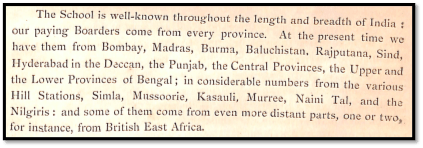
Upon the return of the School to Lucknow, it was found necessary to admit Boarders, to supplement income, especially following the renovation required because of the destruction during the Uprising. Principal, Mr George Schilling on 17 May, 1859 wrote to the Governors:
GRATUITY
Some of the boys who had been in the School shortly after its establishment were now young men, ready to go out into the world. While the school was still in Benares in October, 1858, the Capt. Cockrell, the Hony Secretary, acting in place of Mr Schilling recommended to the Committee for a gratuity to be granted to a senior boy who had been recently employed.
Ten years later, by January, 1869, the recommendation was altered to provide clothes and a small purse.
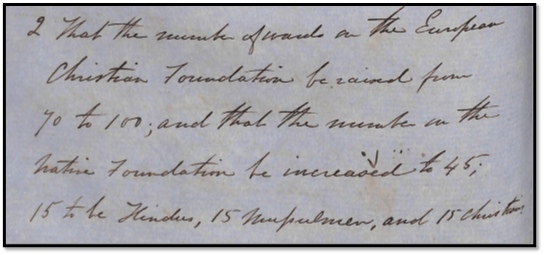
In the meantime, community affiliation was becoming more marked. The number of boys who could be accommodated on the European and Anglo-Indian Foundation was increased. At a meeting of the Committee on 7 November, 1859, it was resolved that “the number of wards on the European Christian Foundation be raised from 70 to 100; and that the number in the Native Foundation be increased to 45; 15 to be Hindus, 15 to be Mussulmen, and 15 Christians”.
MILITARY COMPORTMENT
Volunteer Force
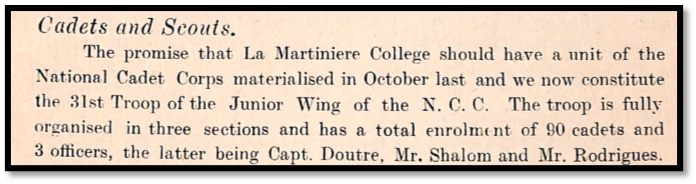
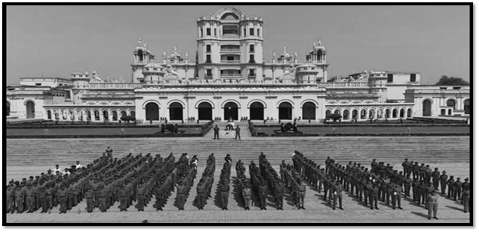
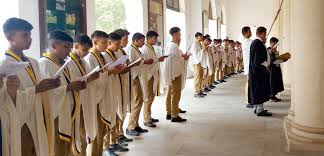
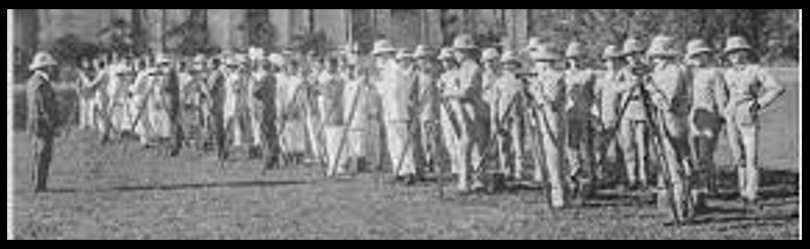
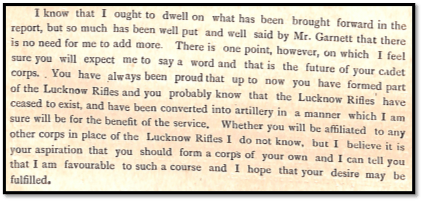
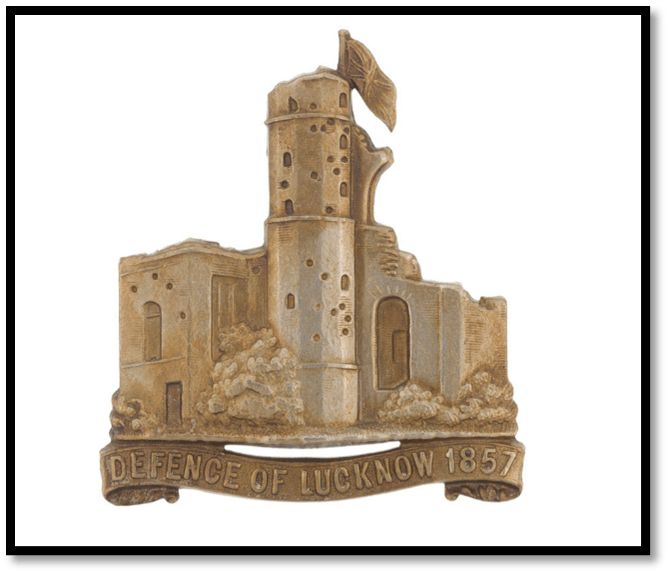
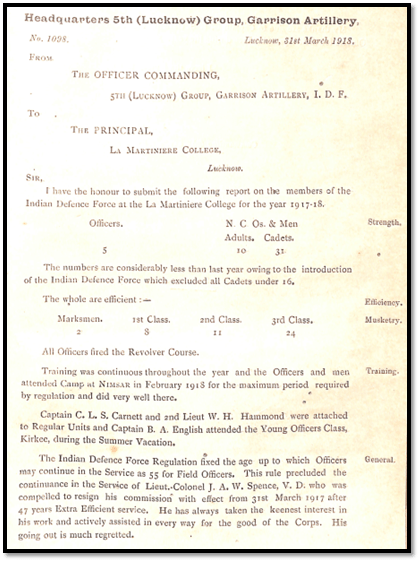
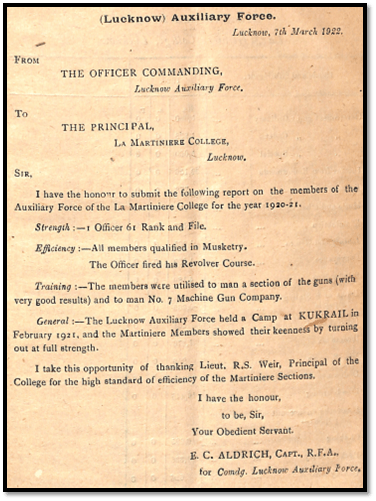
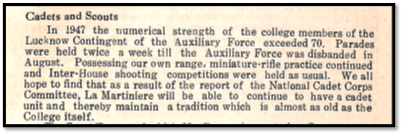
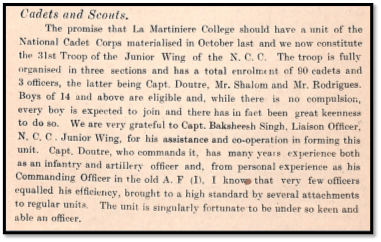
Following the harrowing events of 1857, the first formalisation of what was already a strong military tradition was the establishment of the Cadet Company of the Oude Volunteer Rifles. The Volunteer Force was a citizen army created as a popular movement throughout the British Empire in 1859. Many of the regiments of the present Indian Army are directly descended from Volunteer Force units. In 1860 the Cadet Corps was formed, consisting of school-age boys. La Martiniere was immediately affiliated. Like the adult volunteers, the boys were supplied with arms by the War Office. Cadet Corps were usually associated with private schools. They paraded regularly in public.
This not only increased the military discipline for a residential school but also trained the boys for defence in volatile times, where a few years earlier there had been an unexpected call to arms. The gap between the European ‘Us’ and the native ‘Them’ was starkly increasing. The bearing of arms and military drill inspired generations to join the armed forces both for Empire and later, independent India. The excellence in activities related to the National Cadet Corps (NCC) thereafter is a direct offspring of this exercise.
This was duly reported in the Annual Report, along the extensive list of arms and ammunition that had been supplied to the College.
A VERY ENGLISH SCHOOL
Great emphasis was being laid on pupils’ ability to communicate in English, for boys on the European Foundation. This was despite Claude Martin’s diktat for the school to be established “to learn the English language”. Boys were refused admission if they were deficient in English language skills, even though this was the raison d’etre for the school’s existence.
Comparisons were made with Eton and Winchester. In fact, it was seen as a matter of pride, that more children, were looked after by the Martin Foundation than, at Winchester itself. There were constant attempts for the school to be made more European. This extended to the decision that children above the age of 8 years would only be admitted College if they knew the English language.
Principal Leonidas Clint in 1855 wrote in despair regarding the credentials of a boy who had the most European appearance but who had to be dealt with like a native.
A similar complaint was made regarding the standard of English in the College by Principal Stobart in the Principal’s Report of 1861:
If indeed the standard for the admission of pupils could be raised, if that which is called the European Foundation of the College were really so , if instead of boys who differ little in their first joing the College from natives we could have English boys to a greater extend then – with the difficultles above alluded to removed.
On 12 May, 1865, the Governors reiterated “applicants for their children to the Foundation be told that they must take steps to have the children taught English. When the children can speak English and have fair English manners and habits, applications for their admission will be entertained.”
RACIAL SEGREGATION
In 1871, a reference was made to a letter from Mr Charles Currie, the Commissioner of Lucknow and Governor of the College, regarding the admission of a little Abyssinian boy to the Foundation of the College (European Department). It was directed that answer was to be sent “that there are at the present no vacancies, that the list of the applicants is full and that there is no prospect of the boy being taken”.
Racial segregation was a reality. In 1877, for example, two boys whose parents had applied for Free Foundation were denied the privilege, the Governors resolving: “Of the candidates in List B Henry L******d (VIII) and Robert L******d (IX) being ‘natives with European names’ are ineligible and their names are to be removed from the list”.
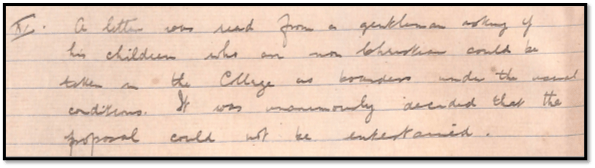
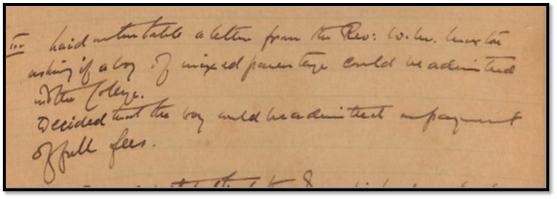
Being Christian in faith did not warrant admission. In March 1898, the Committee considered a letter from Kunwar Harnam Singh, seeking admission for the son a Christian Reverend Goluknath of Jalandhar. The Order of the Committee was terse:
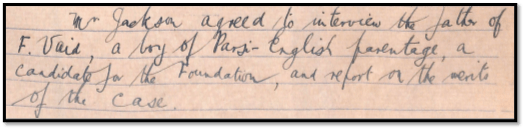
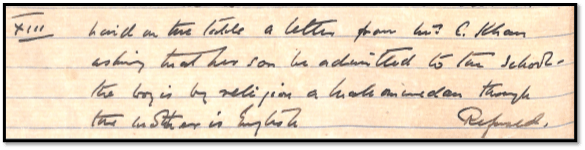
The ‘No-Native’ policy, extended to all Non-European communities in subtle and not so subtle refusals for admission of boys over the years. In April 1879, Mr Eduljee, a Parsee gentleman residing in Lucknow applied for admission of his two sons as paying day-scholars. By Order of the Committee, “… the Principal (was) directed to reply that according to the Rules of the College the application cannot be entertained.” Mr Eduljee then met the Principal in his office on 21 October 1879 and followed up the meeting with another application for admission of the boys as paying day-scholars. The Committee remained adamant and the Principal was directed “to refer the previous resolution of 2 April, 1879 to the applicant, a copy of which had been sent to him.”
FEE STRUCTURE
On 12 October, 1863, a revised fees structure was announced for Boarders and Days-scholars. As before, this was based on a sliding scale, depending on the income of the parent:
Fees for Day Scholars
CAPITATION FEES
In 1864, rules allowing capitation fees payable were passed. This was an unofficial donation, collected by the College in exchange for a boy’s admission.
Distribution of Capitation Fees (1864)
The allowances were made on the understanding that they were never to be in excess of the balance of profits on boarders’ payments. This condition was later overlooked. The benefits were distributed among the Academic Staff in a well-documented commercial exercise. This was bound to affect the demography of the Institution, as admission now had a commercial interest.
LOCAL GUARDIAN, AGENT AND CAUTION MONEY
The formal structure for care and responsibility of resident scholars now also included representatives of the pupil’s family. In January, 1867 it was resolved:
“That in the case of the admission of paying boarders and day-scholars who may in future be admitted to the College and whose parents reside out of Lucknow, be expected to appoint an Agent in Lucknow for the payment of the College fees. This rule is similar to one in force in the Calcutta Martiniere. Also, that in the case of boarders that applicants furnish the name of some respected person who will undertake to receive the boys in case of the death of their parents.”
By the end of the year, this rule was tweaked to predict the introduction of a Caution Money clause, by parents of Boarders being expected to deposit two months fees in case an Agent or Guardian could not be appointed.
THE LAWRENCE REPORT
A major furore was created in the College in 1874 with the publication of what came to be known as the Lawrence Report. Mr A. Lawrence had conducted a study of European and Eurasian Schools in India. The twelve suggestions regarding the College, on Page 213 of this report, were considered offensive by the Local Committee of Governors. It also led to definite policy statements being formulated regarding the demographics of La Martiniere College, Lucknow. It led to serious re-examination of the character of the College and determined its course for the future.
The chief suggestions in the Lawrence Report that were found offensive to the Committee were recorded with explanations by each member of the Committee on 14 August, 1874:
Suggestion III“The Martiniere should become a portion of the educational system of the Country.”
The seemingly innocuous language had ramifications that were objected to by every Member. In essence, it was felt that the ethos of the Institution, was sought to be dramatically modified. Rev. Moore, a Member of the Committee who had served as Chaplain of Benares when the College was temporarily lodged there in 1858-59, objected vehemently, writing that the attempt would: “make the Martiniere such, viz. a refuge for bastards and thieves and bazaar sweepings … In a word the Martiniere is to become a portion of the educational system of the country by taking the lowest seat until another prophet arises to send us up higher again.”
Principal Stobart spelled out the charitable principle on which the College had developed until then, with regard to children specially chosen for assistance by the Founder: “My own views are that these European and Eurasian children ought to be humanely treated, treated with respect and with reverence: that all means should be taken to raise them in the social scale, to give them self-respect, to make them truthful and honest and brave, and that everything that savours of ‘pauperism’.”
Suggestion IV“That it should be made a great cheap School or Asylum for poor children, Orphans having the preference.”
Mr J. C. Nesfied, co-opted to the Committee as the Director of Public Education, Oudh and more famously known for his authoritative book on English Grammar was of the opinion “that a school which is organized and worked on the principles of an Asylum, Refuge, or Workhouse, and which sets up an educational barrier and refuses to educate beyond it at any price, can never afford a wholesome training to the young.”
In a rare development, the Committee resolved that their Opinions be published in a printed format and circulated.
THE FIRST PROSPECTUS
First Prospectus
The first Prospectus of the College for the European Section was drafted, submitted and approved in October, 1869. An updated revised version, which included descriptive rolls of pupils was approved on 21 February, 1877. This contains the categories of pupils admitted to the College.
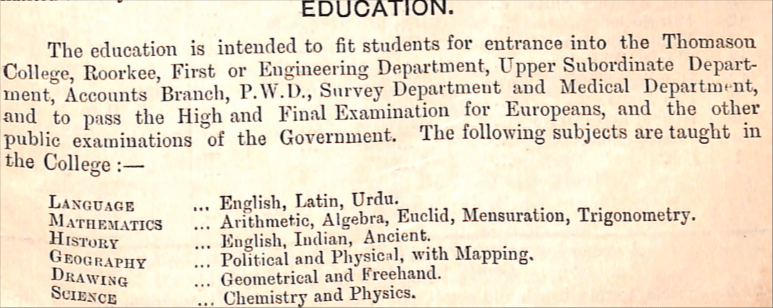
This four-page leaflet, printed at the American Methodist Printing Press, Lucknow included sections providing a brief overview of the history of the College, subjects taught in the College for preparation of pupils for the Thomason Engineering College, Roorkee and the Entrance Examination to Calcutta University. Other insertions included Distribution of Time, Holidays, Clothing, Rules and Regulations with a table of fees for Boarders and Day Scholars. This Fee Chart was a sliding scale based on the certified income of the parent. Other charges were included optional facilities like games, private tuition in French, German Greek and Music and Art.
By this time, the status of pupils had been established, with FIVE classes verified, with the special codicil that “In the College all Classes are treated alike”:
It was clarified that “The Institution has been authoritatively pronounced a Church of England School, but no undue influence with a boy’s creed will be attempted or allowed [Trustee’s Memo. of the 12th November 1862]”
DESCRIPTIVE ROLLS
In 1872, ‘Rules for the Internal Discipline of La Martiniere College’ were ‘Printed for Circulation among Officers in A.D. 1872”. This included Descriptive Rolls for all pupils. While the Rolls for Boarders and later, for Day-Scholars, contained standard information regarding identity, the Rolls for Foundation applicants were invasive and embarrassing.
Besides the formal details of identity, parentage, residence, income, occupation of father (including whether he was dead or alive), the information required included the legitimacy of the boy. In the event of the father being deceased, a declaration was required whether the mother had remarried, whether the stepfather was ready to contribute to the boy’s education, the number of dependents on the mother and how they were to be taken care of and if the boy was a ‘full orphan’.
Questions included, ‘Is the boy English in his habits? Can he speak and write English’; ‘Is the boy Eurasian or pure European?’. The information recorded included enquires about pensions, compensation to the College on leaving and whether the child would be taken home for the ‘long holidays’ from 15th August to 6th October. Finally, guardians were reminded “It is deemed advisable that all boys should visit their friends at least once a year. (General Rules XL)”
SCRUTINY OF THE FOUNDATIONERS
It was the norm to avoid admitting boys to the Foundation if the father had been in the British army, as the boy eligible for admission to the Lawrence Asylum, Sanawar.
The Lawrence Asylum had been established by Sir Henry Lawrence in 1847, whose intention was to provide for the education of orphans, both boys and girls, of British soldiers and other poor white children. In the early days some Anglo-Indian children were admitted. Lawrence insisted that preference should be given to those of “pure European” parentage, as he considered they were more likely to suffer from the heat of the plains.
Therefore in 1873, it was found necessary to put additional questions to those whose fathers had served and died or were pensioners of the army.
Some of the questions included:
Has application been made for this boy to the Lawrence Asylum?
Has he been admitted to the benefits of “the Lower Orphan School”?
Was the mother within the authorized number of soldiers’ wives, and in receipt of subsistence allowance?
Is the boy’s mother still a widow?
Undertaking for Foundationers
It was not enough to seek written information, the material provided had to be certified by persons of authority, sometimes, twice a year.
To avoid or to minimize the use of forged documents and untrue responses, in order that those truly eligible for the benefits of the Foundation be elected, a precautionary procedure was implemented by guarantors or referees being required to recommend a candidate. In April, 1873, the following Order was implemented “That in future, no boy be elected to the Foundation of the College until answers to the printed questions are certified to be correct by the Chaplain of the station where the boy resides or by some other public functionary”.
Two years later, it was found necessary to increase vigilance by a demand for half-yearly reports on the condition of the Foundationer’s family. In July, 1875 it was resolved “That a Form be prepared and circulated half-yearly, to be signed by the Parents or guardians of Foundationers and counter-signed by a Minister of Religion or Magistrate of a District, shewing if any changes have taken place in the positions or circumstances of the parents or guardians of Foundationers or in those of the Foundationers themselves”.
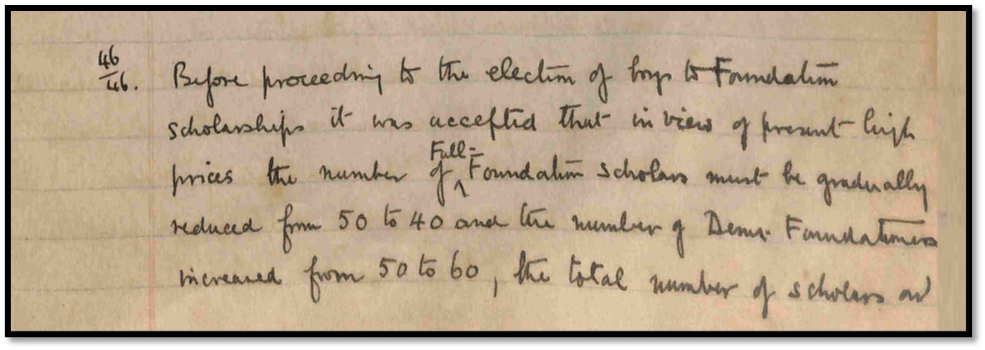
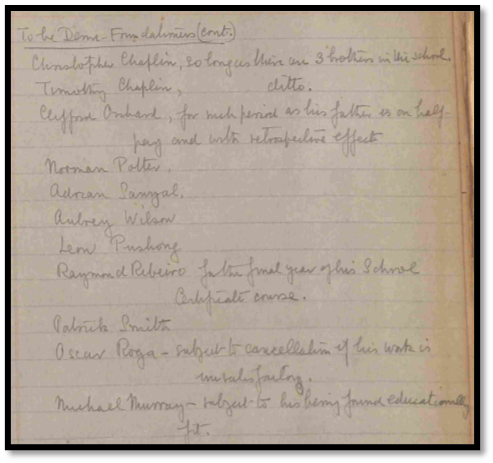
DEMI- FOUNDATIONERS
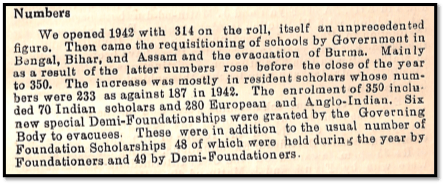
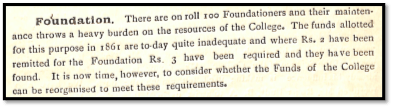
The College had been promised an increase in grant by the Trustees of Rs 1000/- per month in 1861. The Trustee described this as “the largest amount that can with prudence be added to the present monthly allowance for the support of the College”. This was immediately allocated by the Governors for an increase of an additional five boys to the Foundation, along with subsidized expenses covering forty other boys in the boarding house. This subsidized support was gradually becoming a ‘demi’-foundationership. The ethos of the College was to pass on needy pupils whatever financial advantage could be gained. This was formalized on 21 March, 1861:
“That five more foundation scholars be added to the European foundation and forty boys be added as boarders on a payment of Rs 6/- per mensem to cover all expenses as soon as the extra monthly allowance for the support of the College is obtained.”
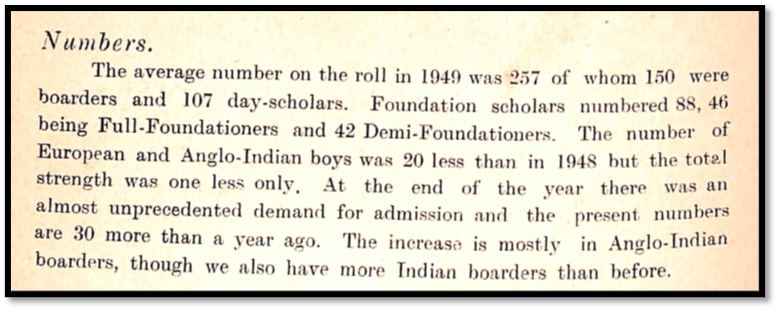
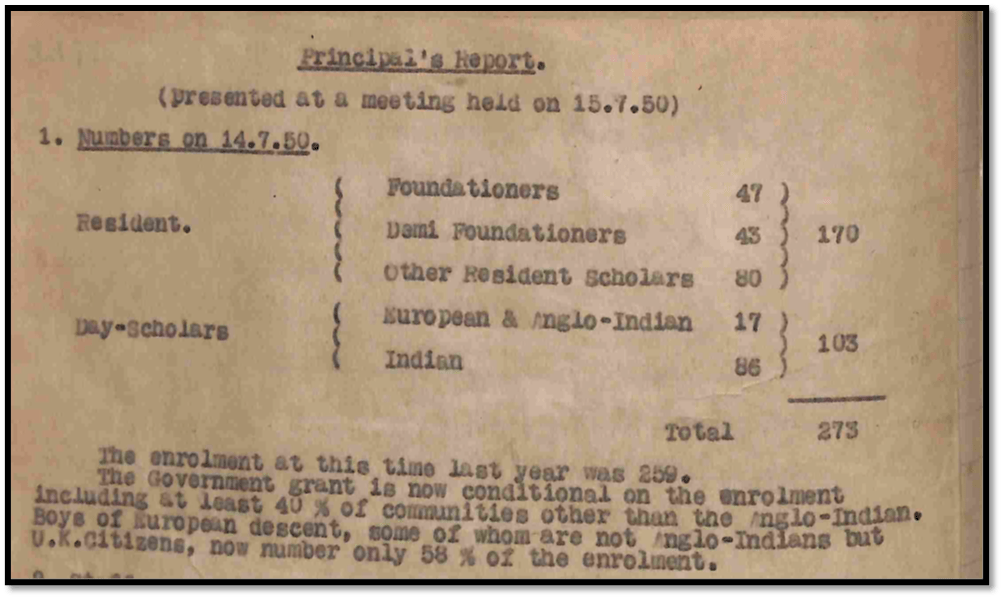
The term ‘demi-Foundationer’ was a later addition. While the number (100) had been fixed for Full Foundation pupils, there was generally an excess in numbers of applications, Such boys were admitted as ‘Supernumerary Foundationers’, so described on 9 March, 1876. They paid a subsidized monthly fee (in 1876) of Rs 10/-/- per month. Change to the Full Foundation was possible upon the recommendation of the Principal and the concurrence of the Board, though such change of status was rare. As a result, those who had the ability to pay limited fees continued to avail of the discount, leaving more deserving cases for the Full Freeships.
The term Demi-Foundationer (later reduced to ‘Demis’) became current from 21 June, 1878, when a review of the number of boys supported by the Foundation was carried out. The Governors resolved and reiterated:
INCREASE IN THE NUMBER OF DAY-SCHOLARS
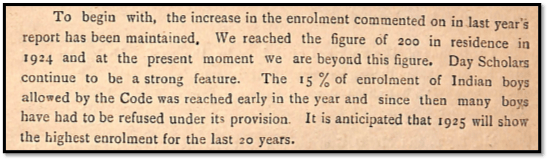
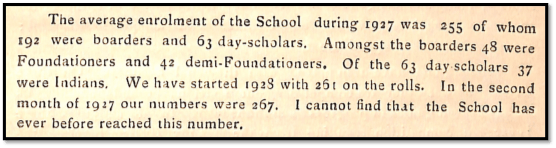
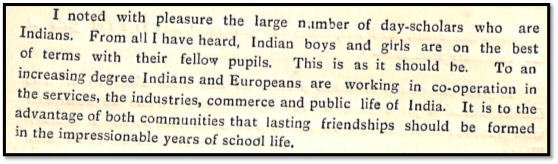
With La Martiniere College becoming more popular, it was found viable, 24 February, 1881, to increase the number of day-scholars to forty.
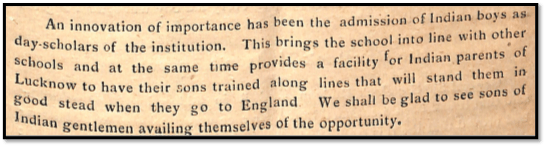
The demand for education began to increase towards the end of the century. Nevertheless, there was still ambivalence regarding the status that new admissions to the College would enjoy or the communities that could be admitted.
THE BRITISH EMPIRE
Victoria Regina
Queen Victoria was formally proclaimed Empress of India in 1 January, 1877. There was a certain arrogance, swagger and discrimination in all written communication from the College. La Martiniere College encouraged its pupils to be proud of Queen and country. The East India Company no longer had control over the funds of the Foundation and Martin’s bequests had to be re-examined and reapportioned. For example, money set aside for the release of debtors and prisoners of the East India Company, which had now ceased to exist, was alternatively to be utilized for the education of girls, using the precedent of the Girls’ school in Calcutta to justify this expenditure.
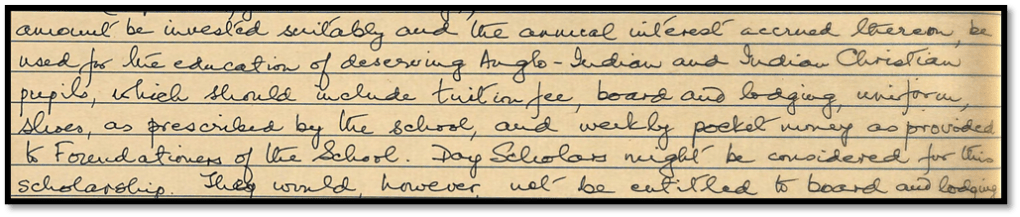
THE PRINCIPLE OF MERITORIOUS POVERTY
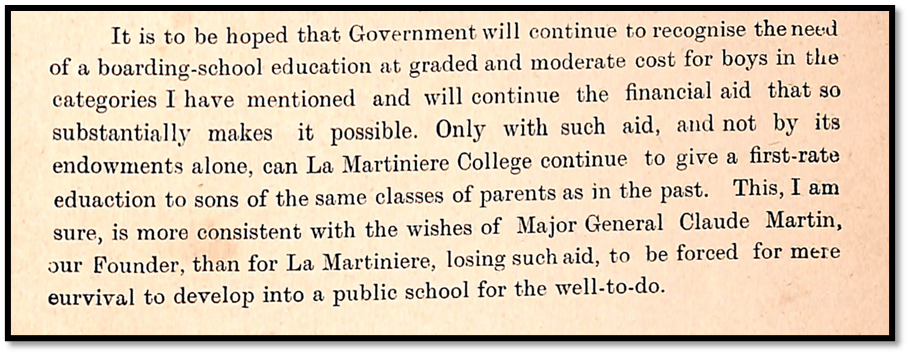
From time to time in the life of an institution, it is found necessary to recalibrate the raison d’etre for the establishment. Towards the end of the first half-century of La Martiniere College, this was summed up by Principal Stobart in his annual address in 1879:
Speaking of the guiding principle of admission to the Foundation, Principal Stobart coined the phrase ‘meritorious poverty’ and further presented an explanation:
A single man’s bounty, well-invested funds, a consciousness of the spirit of charity that is the underlying ethos of the Founder’s bequest has made it possible for many to be educated. This, it was hoped, would be in perpetuity. The obligation lies in solemn trust of those who in an unchanging sequence are called upon to act as stewards of his Will. Indeed, this solemn stewardship has been largely honoured. The school in Lucknow was established 40 years after his death, precisely because the executors called upon to implement his Will, determined that despite all attempts by various forces to garner some part of his vast estate, Constantia House would, vide Article 27 never to be sold “and the house is to serve as college for educating children and men in the English language and religion. Those that wishes to be made Christian”. The same sentiment was recorded in Article 32: “for to keep the said Constantia House or College for learning young men to English language and Christian religion if they feel themselves so inclined”. Further, in Article 33 he determined that the school would continue in perpetuity – “the establishments of Calcutta, Lyon and at Lucknow, as that they may be permanent and exist forever”.
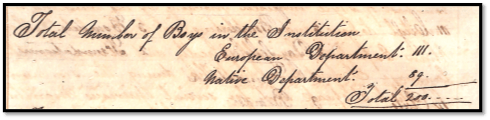
Martin’s Will, though exhaustive is also rambling. The details of individual bequests, gifts, investments, lists of properties, and so on is expansive. When it comes to fitting this into viable dimensions, it was left to the Court at Fort St William, Calcutta to be instructed by the Privy Council to lay down a Scheme of Administration. The broad outlines of the Will were codified in practicable terms. The Decree establishing La Martiniere College, Lucknow determined that to begin with, a school for 200 boys would be established, of which 50 would be in residence. It was clear that these fifty boys in residence would be taken care of by the Foundation and the term ‘Foundationer’ came to be used to define them. It might also be assumed that the 150 other boys, both European/Anglo-Indian and Native would be educated free of cost.
It is a matter of controversy as to how Martin intended his bequest to be utilized for the education of boys. The Will is silent on the race of the beneficiaries, leading to various interpretations of his intentions. Martin in his Will had stated that either Muslim clerics or Christian priests were to instruct the boys. The Scheme of Administration decreed: “That the Establishment shall at least consist of one Principal of the College, one head teacher in the English Department, one Arabic, one Persian Maulvi”. The nationality or race of the boys to be admitted was not specified. It was specified in the Scheme of Administration that “this Court doth further order, decree and declare that admission to an equal participation in the benefits of the College be given without preference in respect of religion or sect”.
“To learn the English Language” a key phrase in the Will, may be interpreted as teaching the English language and western education to those who presumably did not have these language skills or who were not exposed to western knowledge. This would clearly point to the ‘native’ population, though it could also include European and Anglo-Indian boys who by their circumstances had fallen away from the stream of western learning and ideas.
“To learn the Christian Religion to those who desire” a linked key phrase in the Will points very directly to boys who were not Christians by default, through baptism in infancy. Once again, this points to the ‘native’ population which was not widespread Christian by choice. Vide this interpretation, La Martiniere College, Lucknow was intended for the ‘native’ population, where specifically there were to be no restrictions in communities seeking admission; a fact also endorsed by the Scheme of Administration laid down by the Court, which deserves quick repetition: “this Court doth further order, decree and declare that admission to an equal participation in the benefits of the College be given without preference in respect of religion or sect”.
THE FLEDGLING YEARS (1845-1857)
The corpus of the school, made up of 112 pupils on the first day, included 95 pupils who were part of an informal school, described as a “Reading School”, conducted by a Mr Archer, who also joined the Staff at La Martiniere. It is presumed that the ‘native’ students were all day scholars, as no provision was made for their accommodation till later. The remainder of the pupils were European or Anglo-Indian. All pupils were completely supported by the Foundation known as the Martin Charities.
The native pupils decreased in number, we are told, having been under the misapprehension that their attendance at La Martiniere would be rewarded with a stipend. It must be recognized that not much importance was placed on education in general; attendance at La Martiniere was inconvenient, as the premises were much removed from the native city.
Once numbers began to stabilise, it was formally decided to allocate a specific number of boys who could be taken care of by the beneficence of the Foundation, based on the funds available. Demarcation for native pupils and European pupils was neither considered in the Will of the Founder or Scheme of Administration of the Court. Yet, as soon as the school began functioning, discrimination asserted itself. The foundation of the demography of the institution was established. This would have repercussions in the decades to follow.
The Trustees found it convenient and practical to stick to the letter of the law and provide education, with complete support from the Foundation, to underwrite expenses for native boys. Neither did the Will of Claude Martin mention, nor did the Scheme of Administration lay out that the separate racial communities should receive instruction, boarding and lodging together. Therefore, a completely acceptable compromise was worked out: this European controlled school would also consist of a separate ‘Native Department’. This Native department, though within the precincts of Constantia House was separate. In this manner, education was provided to all communities, the foundation took care of the expenses of all, Constantia House was fully occupied as a school, albeit with different sections.
There is no record of there being any interaction between the communities of the two groups of boys. Boarding, lodging, diet, curriculum, instruction, furniture and apparatus were different. The list of items first required by the two ‘departments’ is on record. The items indicate the difference in the requirements for European scholars as contrasted with native scholars: Copy books vs slates; quills vs reeds; English ink vs oriental ink; desks and benches vs dhurries for seating.
List of Supplies and Furniture required for the Native and European School
It was presumed that the initial number of boys to be admitted would be between 120 and 150. This included both European and Eurasian boys and Hindus, Muslims and Christians, in what was referred to as the Native Section or Oriental Department.
European Boys
The areas for the European and Native Schools were also demarcated. The Native Students were accommodated in the South Wing while the others were set up in the North Wing. Classrooms and teachers were different. The establishment was different. Books were different and even the requirements for the setting up of classes and what could be described as teaching aids were different.
Books were hard to come by. They had to be sourced from distant Calcutta and the red-tape involved in the setting up a new institution under the direct supervision of the Court in Calcutta made every member of the Committee wary. In a prognostication for the spirit of the College, Principal Newmarch in a Circular of 12 November, 1845, a little over a month of the foundation of the College recorded “I may state meanwhile for the satisfaction of some members of the Committee that among the books which I have selected there is no work of Religion or Politics”.
The Will of Claude Martin expressly states that there would be no discrimination based on faith professed. This ideal would have been impracticable in the social, cultural and political environs of the time. Using prevailing contemporary bigotry, it was conveniently interpreted that the Institution would display a preference for European and Anglo-Indian boys.
The North Arc
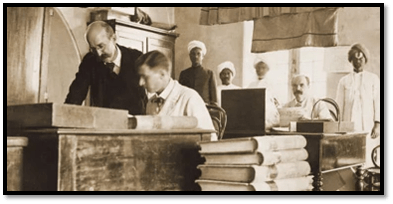
Such apartheid, it seems, was completely accepted. In addition, kitchens for the preparation of meals were different as were systems of medicine. A Native doctor occupied Mahal Serai and it was found suitable for the Trustees to establish an account for the upkeep and pension of the native doctor.
The character of the Institution is moulded by those in charge. In 1852, Lt Col Sleeman, Resident at Lucknow, wrote the Trustees of the Lucknow Martin Charities in Calcutta in this regard. Dr Mowat, a Medical Officer sent by the Trustees in Calcutta, was travelling to Lucknow to report on the status of the Lucknow Martiniere. It was his task to report on the kind of education most suited for the institution. Sleeman’s opinion in this regard is recorded:
Gentleman,
… Globes, Atlases, instruments for observation and survey, model machines, a model room, instructors in civil engineering, plan drawing and writing, are much required but doctor Mowat will report on all these matters. We can never expect to have any but pupils of the humblest classes who much depend upon the daily labour for their daily bread; and the instruction they most require is that best calculated to fit them for the employment open to them.
Lt Col. W. H. Sleeman, Resident at Lucknow, 18 November 1852
An attitude of condescension and patronage, keeping in mind the demographics of the Institution, is exuded through remarks like these.
The first Principal of the College, John Newmarch had the unenviable task of collecting facilities for the new school. This was under constant scrutiny from a Local Committee that wished to have a say in everything. The selection of books, apparatus, teaching aids, living accommodation, etc. were all reported on almost daily, by means of Circulars. The angst is unmistakable, causing Newmarch to explode: “I earnestly request dispatch in this business as the College is not merely at a stand still, but the students are getting into bad habits for want of the means of affording instruction to them: in fact if it were not that it would bear the appearance of a wish to shirk work, I should recommend to the Committee to dismiss the scholars altogether until we are in a position to afford them effective instruction.” This radical suggestion led to series of power struggles; the British Resident Mr Davidson, refusing to attend the meetings of the Committee and the Principal refusing to attend on him in the Residency premises.
Principal, John Newmarch resigned his appointment on 31 September, 1846 after a tumultuous year. He was succeeded by Mr Leonidas Clint who took charge on 1 December, 1846. His immediate task was to make preparation for the reception of the resident Foundation pupils and Boarders. He was convinced that Boarders could be received by 8 January, 1847, if “vigorous measures taken without delay” were carried out.
Purchases of furniture and articles “indispensable to obtain before receiving the boys” were to be made from Cawnpore, while “the cooking utensils (could) be purchased in Lucknow, this may be said with certainty of those required for the Hindoos and Mahomedans.” By the end of January, 1847, Principal Clint was confident of establishing the Boarding House. He wrote: “I am of the opinion that I should be authorized to intimate to the parents or guardians of the Foundation scholars that the Institution is now open for the reception of this description of Boarders.”
Caste
Caste was an issue from the first days of the school. In the first year of the school’s existence, instructions had to be taken on the sensitive issue of caste Shortly after the opening of the school, a Circular dated 2 June, 1846 sought clarification:
“I should also bring to the notice of the Committee that an application has been duly and formally made by a boy of the Mihtur (Mehtar) caste for admission as a day scholar. It is much to be feared that this admission would tend to drive other boys from the College, but as there is no other objection to the admission of the applicant, the Principal cannot in the face of the decree which establishes the College take upon himself the responsibility of refusing his application. It appears to him a choice between injustice and inexpediency and he has requested that the advice and the directives of the Committee may be given him in the difficulty.”
Discrimination in admission on the basis of caste raised its ugly head again in 1849. Principal Clint sought special instructions from the Committee of Governors in this regard:
… 2. A boy of the Chumar caste has applied for admission. This not being an ordinary case, I solicit your instructions as to its disposal.
Circular No 157, 27 November, 1849
The response of the Committee was ambivalent. The British Resident of the time, the famous William Sleeman who ten years previously had supressed Thugee in North India, wrote in response to the Principal’s request for advice:
“I do not recollect what was determined by the Committee about the offer for. His claim to admission in the foundation was I think rejected and he proposes only to send another as a pupil on condition that the first was to be admitted.
“I know not whether the Rules admit of a Chumar being taken as a pupil – if not they should be adhered to – I think there are objections to it.”
Circular No 157, 27 November, 1849
Mussalman Foundationers
The mixing of communities in common living conditions took its own time. In 1853 it was recorded “We have at present 63 boys on the European Foundation and 9 on the Native. I recommend that the numbers be increased to 70 & 14. The ratio will then be so as it was formerly: viz. at 5 to 1.” The balance was heavily tilted in favour of the European Foundation. On the Native Foundation, Mussalman boys were entered early.
Hindu Foundationers
The first Hindu boys were admitted to the Foundation in 1853.
The admission of the first Hindu boys was recorded and shared with the Governors:
Seven weeks later, on 13 December, 1853, vide Circular No. 331 Mr Crank, officiating as Principal, in place of Mr George Schilling, recorded for the Local Committee of Governors:
Gentlemen,
I have the honour to forward for your inspection, lists of applicants for admission on the Foundation.
The European cases appear to be deserving of your notice, and I believe many of the native ones are also; most particularly: (Nos. 1, 2, 3, 4, 19, 23, 30, 35) to which I more particularly beg to draw your attention.
We have 16 vacancies for Europeans and 10 for Hindoos; the Mussalmans, already numbering ten.
The Dormitories
The first attempts to attract paying resident scholars, a component of the Scheme of Administration, was unsuccessful. This is determined by inference following a Circular to the Committee, on March 25th 1856. Principal George Schilling acknowledged that Boarding pupils had not been attracted by the reasonable terms offered and determined a plan of making admission to the College desirable by the proposal of ‘Exhibitions’. These were traditional financial grants offered on grounds of merit or demonstrable necessity. It was hoped that the revenue of the College would be thus increased as well as attracting academically capable students.
Gentlemen,
I also beg to submit for your consideration, the following proposals:
1.
That the terms for boarders, be raised to 25 rupees per mensem, to include all charges, but for books and clothes. The present terms of Rs 15 per month have failed to attract boarders to the College and in my opinion, tend very much to lower the estimation in which it is held.
2.
That 30 exhibitions of three grades be established in the College.
10 of the first grade in value Rs 200 per annum each.
10 of the second grade in value Rs 150 per annum each.
10 of the third grade in value Rs 100 rupees per annum each.
They might be awarded either as scholarships for proficiency in knowledge as exhibitions to aid the boys of promising abilities, or as an assistance to those in needy circumstances towards educating their children. It appears to me that the following advantages will probably accrue from their establishment:
They will afford means of dealing with all applications for admission to the benefit of the Charity. According to the circumstances (more or less needy) of the applicants, they are likely to attract to the College a higher class of boys to the great advantage of those already in it and will increase its number without adding materially to the expenses of the Institution.
As the expense to the College of boarding a boy is considerably less than Rs 150 per annum, it follows that the holder of an exhibition of the First Grade will cost to the College 50 rupees per annum; of the Second Grade will cost the College nothing; of the Third Grade will pay the College 50 rupees per annum, so that it will be unnecessary to propose any reduction of the number of boys on the Foundation to provide funds for the establishment of these Exhibitions. That the course of instruction, the rules regarding the proposal, exhibitions and the arrangements of the College generally, be printed in the form of a Circular. That an abstract from the Circular be advertised in the papers with the dates on which the Committee will elect candidates, its admission to the Foundation as well as for exhibitions.
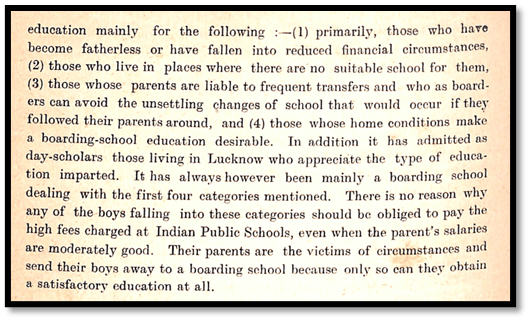
Charity came at a price, often at the arbitrary discretion of the Principal of the day. There is no evidence of a single application for admission to the Foundation, once recommended by the Principal, being turned down by the Committee. The ‘Descriptive Rolls’ prepared were personal and invasive. The documents provide an insight into the demographics of the boys who was admitted to the College. A sample from 28 April, 1857 is typical. It describes the circumstances of three applicants: J. Cassidy, Joseph Williams & G. Creed.
A cursory examination of the observations indicate the age of the boys (10, 9.5, 11), their Parents (all three orphans); Lineage (East Indian, Native, European); Knowledge of English (Little, little or no English, speaks English well) and on whom the boys were dependent. The Principal’s remarks were of significance: While Cassidy could be admitted his grandfather was in employed by the College; Joseph Williams’ lack of knowledge of English made him “a more objectionable companion to introduce among the boys”, while Creed’s candidature “wants practically to assisting two orphans.”
Typical Descriptive Roll for election of Foundationers
THE CHANGING DEMOGRAPHICS OF LA MARTINIERE COLLEGE, LUCKNOW (1845 – 2025)
This is Part I of a FOUR-part series on the eponymous topic.
It is divided into sections for convenience in uploading and reading.
Part 1 deals with the first fifty years of the life of the College (1845-1895) and roughly corresponds to the time scale covering the establishment of the College to the turn of the century (1900)
INTRODUCTION
Claude Martin by Johann Zoffany
La Martiniere College, Lucknow, established by Maj. Gen. Claude Martin, H.E.I.C.S., has emerged as a behemoth on the educational scene in North India, largely due to the accretion of a series of factors that have helped to create its unique image. As a ward of the Court, it has neither been established by a Trust nor is it supervised by a Society. The estate extends to being one of the largest land banks for a single school in India. Its history includes the French, the East India Company, the Kingdom of Oudh, the British Empire and the Republic of India. It is the rare school to be permitted to carry a flag of honour presented in acknowledgement for contribution of its Masters and pupils during the Defence of the Residency in Lucknow. It is an institution that has adapted to change without ignoring tradition. It is a much-loved home for all who have studied or worked there.
Yet, despite these unique realities, the institution has been steadily reinventing itself. Once a purely European school, it is now made up of boys who are completely Indian. This transition and the change in demography are an interesting study that includes discrimination, charity, racial compulsions, law, ethics and above all the indomitable spirt of the adolescent boy.
The institution today is a legal entity, protected as an institution of the Anglo-Indian linguistic minority, seeking protection under Articles 30 and 31 of the Indian Constitution. It has nevertheless aligned itself by choice to praise-worthy practices and commitments encouraged by government for equity without losing sight of the core principles by which the institution was founded.
Throughout its existence in the controversial circumstances of history, there have been varied charges related to discrimination of different types. These include ‘negative discrimination’, i.e. unfair treatment to individuals, groups or communities, causing harm and inequality. ‘Positive discrimination’ is a term that can be misleading. It is a contested concept where certain groups are treated more favourably. This is often unlawful and can undermine the purpose of equity by causing ‘Reverse discrimination’ and resentment.
Yet, discrimination, positive or negative, is to be considered in the context of the times under consideration. On a national scale, there is evidence that there has been negative discrimination against certain communities; therefore, reservations for such groups, which have been brought into place after the adoption of the Constitution of India, may be seen as a means of converting such, negative discrimination, to positive protection through political representation and social repatriation. Positive discrimination through the system of providing privileges in opportunities for education at La Martiniere College, Lucknow to certain groups or communities, especially Europeans and Anglo-Indians, known loosely as ‘foundationers’ may be seen in this context.
THE ESTABLISHMENT OF THE INSTITUTION
Claude Martin signed his Will on 1 January, 1800. Relevant to the establishment of La Martiniere, Lucknow are Articles 27 and 32 of the document:
ARTICLE 27
My house at Luckperra or Constantia house is never to be sold as it is to serve as a monument or a tomb for to deposit my body in and the house is to serve as a college or for educating children and men for to learn them the English language and religion those that should wishes to be made Christian.
ARTICLE 32
For to keep Luckperra house or Constantia house as a college for instructing young men in the English language and taking care of my tomb which house was properly my reason for having built it wanting at first to make it for my tomb or monument & a house for school or college for learning young men the English language & Christian religion if they find themselves inclined.
The enormous wealth of Claude Martin warranted fierce legal battles for about 40 years after his death, which occurred on 13 September, 1800. Eventually, on the orders of the Privy Council, a scheme of administration was drawn up and the College was established by a Decree the Supreme Court in Fort William, Calcutta on 22 December, 1841. This was based on the broad principles set down in the Will of Claude Martin:
The Court at Fort St William, Calcutta
“ … a College sufficient for not less than 200 scholars with a combination of boarding and lodging within the institution for at least one fourth of that number … this Court doth further order, decree and declare that admission to an equal participation in the benefits of the College be given without preference in respect of religion or sect and that according to the condition expressed by the King of Oudh in giving his permission to the Establishment of the College, those students only who voluntarily desire to be instructed in the Christian Religion shall be taught it and in conformity to that condition, no works on Christianity shall be admitted as Class books in the College.”
Constantia: Claude Martin’s country residence
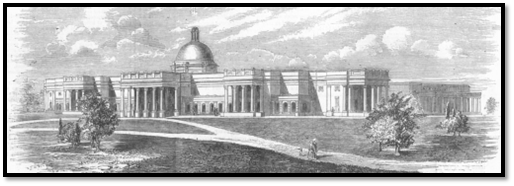
La Martiniere College was founded in 1840, with classes commencing in 1845, when the buildings were suitably prepared to receive pupils. The institution was in an ambivalent administrative condition, located in prime property down the river Gomti, close to the palace of the Muslim Nawab of Oudh. The Christian British Resident was ensconced in the palatial Residency, a short distance from the Nawab’s Palace. The contest between the native Nawab and the Colonial powers also delayed the establishment of the College. The Nawab objected to a teaching of the Christian faith within his territory, acquiescing when convinced that the Will of Claude Martin clearly stipulated that the teaching of the Christian faith would only be offered “to those who desired”.
The Constitution of India (1950)
La Martiniere College, Lucknow continues to enjoy the privilege of this protection following the establishment of the Republic of India. The Constitution of India (1950) in Article 366 (2) defines an Anglo-Indian and provides certain safeguards for the protection of the said English-speaking linguistic minority community. This is especially relevant for the educational institutions established by Europeans, such as Claude Martin, the Frenchman who bore the rank of Major General in the Honourable East India Company Service.
Seal of the Supreme Court, Calcutta
The relevant Articles in the Will, the detailed Scheme of Administration and the commitment to refrain from proselytising, establish the protection of the boys supported completely by the foundation. This, in fact, forms the underlying ethos of the institution.
Ethos is the underlying character, the core beliefs, the guiding principles that form the foundation of a community or institution. This, in the case of La Martiniere College, Lucknow is ‘Charity’ immortalised in a significant line of the School Song – “All his Martial deeds may die: lasting still his charity”. This ethos, while abstract, is assisted by traditions that protect it. Traditions are the specific practices passed down through generations. If tradition is seen as the “what” that is done; ethos is the “why” or the fundamental spirit that drives it.
Again, the experiences of the Founder that influenced his decisions need to be considered to establish context for the establishment of the Institution. Education for Claude Martin was the paramount way to lift out a person from penury and disadvantage. Claude Martin himself received a rudimentary education, referred to in his Will. His advantage in progressing through life was the result of staying abreast with academic and practical pursuits. Consider his work as a cartographer with James Rennel, the father of cartography in India. Measurements, topography, operating apparatus, drawing etc were skills that were learned and imbibed. This placed him much ahead of his peers. He did have a deep respect for officers of the East India Company, men who had received well rounded educations for that time, which they used for the subjugation and colonisation of an empire controlled by an island mass that was trifling in comparison. As he grew older, not having children of his own, there was a silent respect for the ingenuity of children, which was often hampered by a lack of opportunity for education and of physical care.
Racial Discrimination
It is significant that even in an age where racial discrimination was prevalent and accepted, he provided equal opportunity for all races and communities, no doubt circumscribed by contemporary realities, like gender. The Lucknow bequest only envisaged a school for boys and men, with the studious omission of girls and women, perhaps due to the mores of a traditional, orthodox and conservative local society.
Later interpretations and machinations of the Will of Claude Martin made the institution he envisaged and the charity by which he was driven, moulded into convenient interpretations based on political requirement, racial discrimination, security and clashes in culture.
Constantia: 1814
The Will of the testator must be respected. It was after all his vision, munificence and wisdom to set down in writing and appeal to governments and courts in generations ahead to protect his interests. “I am in hope government or the supreme court will devise the best institution for the public good … as that it be made permanent and perpetual”.
It is part of the civilized world to adhere and respect this as enshrined in law, practice, convention and precedent. Claude Martin requested that a copy of his Will was “to be deposited in the Supreme Court, to which I recommend my executors, administrators, assigns, or trustees, to put this Will and Testament under theirs protection, or tender the protection of government if necessary;”
THE PLIGHT OF VULNERABLE CHILDREN
(James Martin ‘Zulpheekar’)
In the mid-19th century, there would have been absolutely no opportunity, for European and Anglo-Indian children to receive an education if the family lost the breadwinner or had domestic difficulties through separation, desertion, or other challenges. For such children not to descend to becoming ‘bazaar trash’ was only possible if special opportunities or a ‘quota’ was provided for them. This is what Claude Martin envisaged, especially by observing the white trash in the bazaars that had gone ‘junglee’ due to the lack of parental influence in their lives. One such boy was James, a Georgian lad in difficult circumstances. James had been born of a drunken father who came to Martin with a plea to return to Georgia, indicating the inability to do so due to a lack of money. He was willing to give up his son James into the permanent care of Martin, if he could be provided with financial assistance, to return to Georgia.
The story spun by the father turned out to be incorrect. He squandered on drink the money given to him by Martin. Whether he thereafter returned to Georgia or not is unknown What is recorded is that James was taken in to Martin’s household and even given his surname as a patronym. The child was adopted and cared for by Boulone-Lize, Martin’s young companion. Sometime later, James’ mother appeared on the scene with an infant son called Amodbeg. The boy James continued to be cared for by Boulone, while his birth-mother became a retainer in Martin’s household. The child James was given the alternative Islamic name, Zulpheekar. James was sent to Calcutta to be educated and as an adult conducted the affairs of the zenana in which he had grown up.
Perhaps due to his traumatic experiences as a child, his love for his adoptive mother who followed the Islamic faith, or his interaction with the wider society of Muslims, the boy vacillated between Christianity and Islam. He eventually died a Muslim in 1835, predeceasing his adoptive mother and before the institution that came to be known as La Martiniere was established. He was buried near the mosque that he had built, known as Gori Bibi ka Masjid in Peer Jalil Ward in Kaiserbagh.
Boulone-Lize and James Zulpheekar Martin
When we consider, the condition of James and the rag-tag of mixed ancestry that filled the bazaars of Colonial towns, we cannot but be moved by the strange fate and condition of such children. It might seem a romantic notion, but the story of James Zulpheekar Martin and the manner in which he was provided for by his benefactor, may be seen as a part of the motivation to establish these schools. To sustain this claim, consider that Article 9 of Martin’s Will tells of Zulpheekar being sent to Calcutta to be educated. Almost the same words are used in delineating the foundation of the school in Lucknow. They include: the study of the English language; the study of the Christian faith; the choice to be exercised by the beneficiary.
Article 9: “… and when he (James) became a tall boy, I had him put at school at Calcutta, for to learn to read and write English, as also to learn the Christian religion, that he might choose whether the one or the Mussulman, or any he may choose; he preferred the Christian, he and he was Christened in Calcutta church by the name of James.”
Article 27 echoes similar language “a college, or for educating children and men for to learn them the English language and religion; those that should wishes to be made Christian at or by that house.”
(Boulone-Lize & Sally Harper)
Boulone (Boula Begum)
Even more arduous would have been the survival of the vulnerable girls. Even during his lifetime, Martin had donated to charities for orphan girls in Calcutta and Madras. More specifically, the condition of two of his female companions indicate him being moved by the condition of abandoned children. The antecedents of Boulone-Lize (Boula Begum), declared by him as his favourite companion, indicate a case of child abandonment. Boulone was of noble birth; her family being connected to the Mughal court in Delhi. At about the age of nine, under disturbing circumstances, she ran away when it is reported her father murdered her elder sister in an honour killing.
The other girl, among the seven women he had as part of his establishment was Sally, an illegitimate child, said to be fathered by the one-time Resident of Lucknow Colonel Gabriel Harper. Sally would never be acknowledged by her father and under other circumstances, she would have been ostracised. There are several examples of exploitation or neglect of children. Claude Martin himself made commitments to take care of native families of European men who were his friends, who decided to return to Europe, leaving such women and children to largely fend for themselves. Providing opportunity for abandoned children, could be seen as positive discrimination and an opportunity for a better life for such children.
Martin’s biographer, Dr Rosie Llewellyn-Jones comments: “Life for abandoned or abducted girls, especially those of mixed blood was precarious enough, even if they did not starve to death during famines or end up in brothels”. The same was probably true of boys.
The boys, European, Anglo-Indian or native, were more advantaged. By means of an education, they could advance in life in a manner similar to Claude Martin himself. But such boys were also constrained by circumstances, the alleviation of which could be encouraged by education. European and Anglo-Indian boys were not only sons of officers. They were, in the case of Europeans, sons of low-ranking soldiers, men in the subordinate services of the East India Company or half orphans, without the financial means to return to Britain. In short, boys who bore all the physical characteristics of their race but who had descended to the flotsam and jetsam of the bazaar. Most strikingly, they even lacked a knowledge of the English language, one of the passports to success. The loss of their native language was the result of having to struggle to survive in communities that were different to their racial, cultural and linguistic stock.
(Native Children)
Conscious of the condition of all children in such circumstances, Martin did not restrict the privileges extended by him to people closely associated to his race. These benefits were to be applied in the case of native children; to give them a leg up through the transforming influence of education. La Martiniere was envisioned to be accessible to young men and boys, irrespective of their faith.
Seeing native children in difficult conditions, brought on by no fault of their own, Martin was perhaps moved to bequeath his vast wealth primarily for the education of such children, both boys and girls. This education would materialise by means of his Foundation. It would be financially possible to provide such children with a haven along with a chance for a better life in the world into which they had been unwittingly born.
Martin’s charity towards children and education was not restricted to Lucknow. Lucknow was a traditional and orthodox city. It was only practical to establish a school for men and boys. In the cosmopolitan Calcutta, equal bequests were made for the establishment of two institutions, each for boys and for girls. In Calcutta, there would have been a much larger number of illegitimate or abandoned children and orphans, both boys and girls who would benefit from such a bequest.
It is the practical establishment of a Foundation that made this charity a reality. Martin, vide his Will appealed to governments of the future to regulate the application of his wishes. Every residual benefit from the property and investments as declared in his Will were to be used for this prime objective:
“After every article of this Will and Testament is or are fully settled, and every articles provided and paid for the several pension, or the gift, donation, institution, and other, any sum remaining may be made to serve – first, buy or built a house for the institution, as that it may be made permanent and perpetual, by securing the interest by government paper either in India or Europe, that the interest annually may support the institution; for this reasons I give and bequeath one hundred and fifty thousand sicca rupees more, according to the proportion that may remain after every articles of this Testament is fulfilled, then this sum to be added for the permanency of that institution …”
October 1 has been designated as Constantia Day since 2012. It is the date, in 1845, when classes were first conducted in the College. While this may be seen as the Foundation Day of the College in Constantia (therefore Constantia Day), it is not be confused with Founder’s Day, the 13th of September, which was specifically designated by the Founder to commemorate the date of his death.
For forty years after his death, Claude Martin’s Will was contested by persons connected with him from India and France. The matter found its way to the King’s Privy Council that issued directions to the Court in Calcutta to set out a Scheme of Administration for the establishment of the school in Lucknow. The said decree by which this was established was issued on 21 December, 1840. It took another five years for the basic infrastructure to be readied to receive the first boys of the College.
It was the intention of the first Trustees of the Institution for the College to be opened on 13 September, 1845, wherein Founder’s Day and Foundation Day would coincide. A series of circumstances prevented that from happening.
Dr James Spencer Login, M. D., Pro Tem Secretary
The Pro Tem Committee of Governors was made up of select individuals in Lucknow, with the British Resident serving as the ex-officio Visitor of the College. The officiating Honorary Secretary to the Committee was the medical doctor, James Spencer Login M. D. working in pro tem capacity, Dr Login was specially chosen for the task, being a member of the inner circle of the officiating Resident Mr T. R. Davidson. Login was the Resident Surgeon in Lucknow in 1838 as well as physician to the Court of Oudh. This 39 years old Scotsman was a man of several parts, well-suited for the task.
Sir James Spencer Login M. D.
Login was deeply influenced by the Scottish Enlightenment, a movement that emphasised education, rational thought and moral responsibility. These were the contributing factors for him to be appointed as the first Honorary Secretary of La Martiniere establishment. His most intense work was compiling the first Rules and Regulations of La Martiniere College. This contribution effectively set the foundation for the ethos of the College.
Dr Login’s contribution to the establishment of La Martiniere, Lucknow is overshadowed by his other achievements while in the service of the East India Company. Notable among these is his appointment as the Governor of Lahore in 1849. He will always be remembered by history for the most poignant aspect of his career, which was his guardianship of Maharaja Duleep Singh, the deposed child ruler of the Sikh Empire following the annexation of the Punjab in 1849. In addition, he was entrusted with the possession of the famous Koh-i-Noor diamond.
Dr Login and his wife Lena Campbell took care of the young impressionable boy, accompanying him to England where the child became a favourite of Queen Victoria. It is Login who conveyed the famous Koh-i-Noor to Governor General Lord Dalhousie, which later was presented to Queen Victoria, under circumstances that are controversial till today.
The Committee of Governors
To understand the administrative foundation on which the College is built, it is significant to consider the members of the Committee of Governors throughout its history. The first members of the pro tem Committee included the following:
The Pro Tem Local Committee of Governors, La Martiniere College, Lucknow (August, 1845)
T. R. Davidson Esq.
T. Reid Davidson served as the officiating British Resident in the court of the Nawab of Awadh in Lucknow from 1845 to 1847.
Brigadier M. Webber
No information extant. The supposition is that as per his rank, he would have been effective as an officer of the Bengal Army of the East India Company, and stationed in Lucknow Residency, which was also known as Lucknow Cantonment.
R. M. Bird Esq.
Robert Merttins Bird, a British colonial administrator, known as the Father of Land Settlement in Northern India. He is recognized for developing the land revenue system in the North-Western Provinces of British India, which included the area that is now Lucknow. Between 1833 and 1841, he oversaw land settlement operations and implemented the “Mahalwari” tax reform. He held the honorary rank of Captain.
Lt Col Wilcox
Lieutenant Colonel Richard Wilcox was a British astronomer who served as the Royal Astronomer in the court of Nasir-ud-Din Haidar, the King of Awadh, in Lucknow during the 1830s and 1840s. He took charge of the royal observatory, known as the Tare Wali Kothi or “Mansion of Stars,” in 1835. The building is still extant as immediate neighbour to La Martiniere Girls’ College and now houses the State Bank of India. The observatory maintained advanced astronomical equipment. Wilcox assisted with the publication of the Lucknow Almanac and supervised the translation of English books and journals on astronomy into Persian and Urdu.
Rev. Dr J. J. Carshore, D.D.
In common with the chaplains of the Army Chaplains’ Department, his ministry would have chiefly entailed leading public services, visiting military hospitals and burying the dead. During his period in Rai Bareli and Lucknow, the chaplain’s duties to the military were subject to ongoing refinement. In 1857, J. J. Carshore published his Bengal Chaplain’s Vade-Mecum, a comprehensive guide to EIC chaplaincy. Significantly, Carshore emphasized the chaplain’s responsibility for inspecting regimental schools, experience of which he had received while serving on the Committee of Governors of La Martiniere, Lucknow.
ESTABLISHMENT OF THE COLLEGE – Founder’s Day vs Foundation Day
Minute No I of the Local Committee of Governors was recorded by the Officiating Secretary, Dr J. S. Login. The struggles of practicability while following the letter of the law was evident at this tentative time. Much of the formality and anxiety was related to an interpretation of the fulfilment of the decretal orders of the Court regarding the date of establishment of the College. The Court had decreed that the College was to be opened on Founder’s Day, the 13th of September, which the Founder himself had determined should commemorate the date of his death. However, the first Principal who had been appointed could not be present in Lucknow until the 23rd of September, 1845. The opinions of the Members were solicited. This is on record as the very FIRST official Minute of the Local Committee of Governors, 180 years ago!
NOTES OF THE MEMBERS OF THE LOCAL COMMITTEE
The First Principal/Honorary Secretary, Committee of Governors – John Newmarch
The first Principal, Mr John Newmarch, arrived in Lucknow on 23 September, 1845. The formality of taking charge as Principal and Secretary to the Local Committee of Governors was completed and recorded by Dr Login:
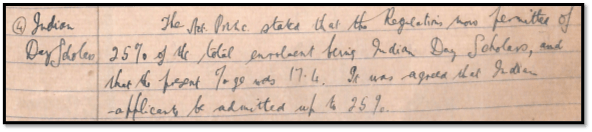
Classes began a week later on 1 October, 1845 – Foundation Day, today known as Constantia Day. This was recorded in the first monthly Report of the Principal to the Governors on 12 November, 1845 by a simple confirmation: “The College opened on the 1st of October last”.