
THE NEW MILLENNIUM
This Part deals with the first quarter of the 21st century and roughly corresponds to the time scale of the beginning of the new millennium (2000) to the 175th anniversary of the establishment of the College (2020)
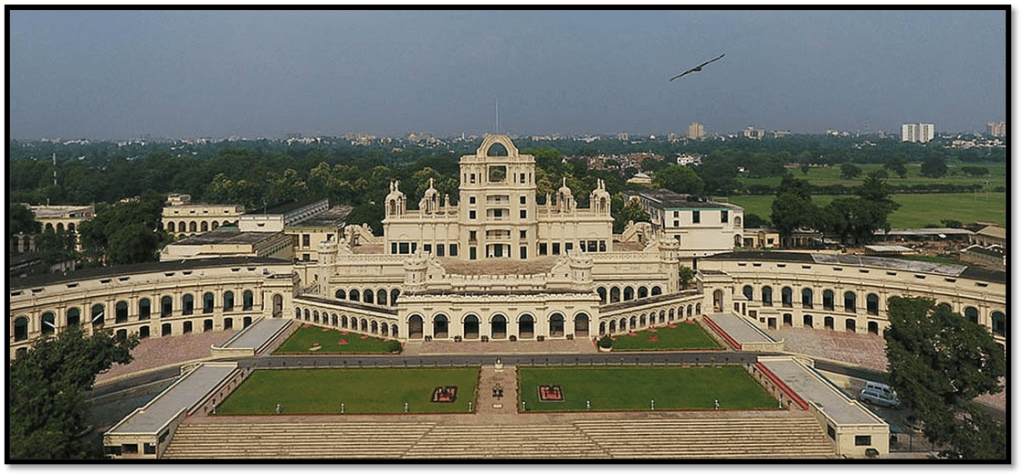
Section 1
The Century of Land and Liberalization
The turbulence in the demographic changes in the College in the second half of the previous century settled into calm passivity as the nation asserted its independence and its republican credentials. The pressure of increasing numbers was also beset by pressures related to the greatest physical asset of the College – its unmatched land bank. The commercial and residential sectors of the city now surround the serene Lakhperra, or place of one lakh trees. The pressure of encroachment and demands for requirements for public works put added pressure on the administration of the College. A conflict of interest has seen those who were entrusted with taking care of the property being implicit in the gradual chipping away of the vast estate.
La Martiniere College, Lucknow entered the new millennium having discarded the prejudices of the past, which included segregation and race. The new millennium would throw up different challenges in the demographics of the College while also creating the challenge of the century – its vulnerability in maintaining the title of its vast estate – a land-pocket now in the heart of the city.
Turning a Nelson’s eye to encroachment seemed a better option than prudent leasing or licensing of land for limited time and purposes. The Principal was expected to be the chief executive for the maintenance of the land without the authority to function independently for its protection. This also severely dented the availability of his time and priority for academics and the moulding of young men and boys. Increased admissions meant increased pressure of expectations from parents who, with the arrogance of numbers, demanded individual and personal attention and intervention for the smallest of causes. Increasing awareness of child rights was a welcome addition to the educational experience. Arbitrariness was replaced by due procedure. This was an excellent addition which prevented misuse of authority. It nevertheless required men of stature, resilience, courage and suavity to balance the conflicting pressures.
The focus on the challenge of maintaining the clear title of the land does not have direct bearing to the study of the demographic changes in the College. Nonetheless, it offers a partial explanation as to how the vision of the Founder, his Will, and the Scheme of Administration set up for the College was often overshadowed by vigorous attempts to protect the land. Protecting the land has become a daily constant, requiring acumen, expertise and legal skills at different levels of administration.
It is nevertheless germane to know the items related to land that were on the Agenda of the first meeting of the Governors held on 19 February, 2000. It is pertinent that these items have been, without fail, included in the Agenda of every regular meeting of the Governors, so that they are not lost sight of. In the meantime, some issues resolved themselves, some became flashpoints, some return from time to time as bug bears. Nevertheless, there is clear documentation on each of the issues related to land, providing great hope that in time, even the most contentious of issues shall be resolved.
On 19 February, 2000, the first meeting of the Governors in the new millennium was held:
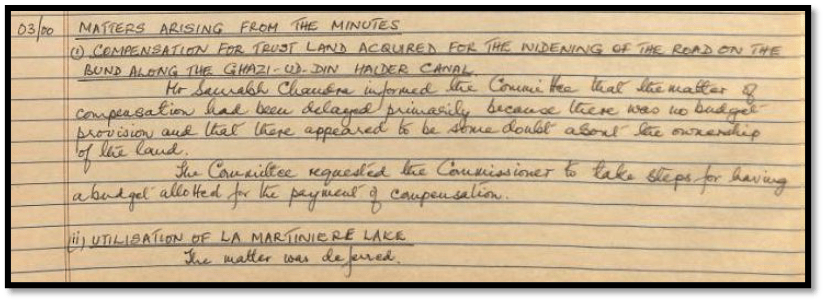
The following items related to the land of the College were listed:
03/00 MATTERS ARISING FROM THE MINUTES
- COMPENSATION FOR TRUST LAND ACQUIRED FOR WIDENING THE ROAD ON THE BUND ALONG THE GHAZI-UD-DIN HAIDER CANAL
- UTILISATION OF LA MARTINIERE LAKE
- LETTER FROM THE TRUSTEES IN RESPECT TO PROPOSED ACQUISITION OF LA MARTINIERE ESTATE LAND BY THE AVAS EVAM VIKAS PARISHAD
- RENEWAL OF LEASE OF GOLF CLUB
- REQUEST FOR LAND BY THE U.P.S.E.B. FOR CONSTRUCTION OF A 132 KV SUB-STATION AT MARTIN PURWA
- REQUEST FROM THE GOLF CLUB FOR 65 ACRES OF LAND
- REQUEST FROM PIONEER SERVICE STATION
While certain items continued to be sensitive, others fell by the wayside. Fresh causes were added to the list in the first 20 years of the 21st century. By the time the institution reached 175 years in 2020, the agenda items related to land of a regular meeting of the Governors, land included:
- Compensation for Trust land acquired for the widening of the road on the bund along the Ghazi-ud-din Haider canal
- Utilization of La Martiniere Lake
- Matters pertaining to the Lucknow Golf Club
- Observations regarding the Lucknow Master Plan 2031 with respect to the Martiniere Estate
- Renewal of lease of land for UPPCL 132 KV sub-station
- Renewal of lease of land to the Lucknow Zoo
- Lease for Sewage Pumping Station
- Construction of toilets on La Martiniere Estate
- Request for additional lease of land by the Golf Club
- Request from the U. P. Golf Association for the allotment of a portion of La Martiniere estate land for starting a Golf Academy
- Proposed Acquisition of La Martiniere estate land by the Avas Evam Vikas Parishad
- Request for land belonging to La Martiniere estate for a helipad for the Chief Minister
- Proposal for Electricity poles to be erected over Martin Trust Estate
- Request for lease of land from the Lucknow Development Authority for an Environmental Park
- Sewage Pipeline across La Martiniere estate
- Request for a piece of land on the Martin Trust Estate for the purpose of installing a mobile tower
- Establishment of a Tennis Academy
- Barricading of roads of La Martiniere Estate
- Observations regarding the Lucknow Master Plan 2031 with respect to La Martiniere Estate
- Objections from the Archaeological Survey of India
- Matters related to the demarcation of Boundaries of La Martiniere Estate
- Status of land on which is located the tomb of Sally Begum
- Litigation against construction of a cremation site on the Eastern Boundary of La Martiniere Estate
- Illegal occupancy by U.P Jal Nigam Sharda Canal Office
- River Front Encroachment
- Events related to the Tomb of Maj. Hodson
- Attempt at land grabbing
The Liberalized Native School
In the meantime, the demographics of the College were affected chiefly by increasing numbers, especially among the day scholars. The number of day scholar pupils outstripped the number of resident scholars by 1955. On 26 February, 1955, the numbers were: Resident Scholars 173, while Day scholars had increased to 211.
It was made clear to all that “La Martiniere is essentially a residential College and in order to maintain its character it is necessary to limit the admission of non-resident pupils.” The rapid increase in numbers was also in keeping with Government policy for ‘mass education.’ The College was aware of the challenges that this increase in numbers would have on the overall ethos of the College, still seen as primarily a Boarding school.
It was reiterated that it was the Resident Scholars, of whom the Foundation pupils were a part, who constituted the ‘nucleus of this College’. In flattering laudatory terms, it was reminded that it was the Resident Scholars “who are called upon to continually uphold our traditions and out motto, ‘Labore et Constantia’ – ‘By labour and constancy’”.
Education, in general, was in high demand; La Martiniere College, Lucknow had an excellent track record in tradition and history; English-medium education was at a premium; the ‘old’ schools retained a degree of sophistication, so valued by observers and prospective parents of candidates for admission; English was spoken by teachers and pupils exclusively in the College; habits and manners were still old world and European in tradition; the patina of polish was not restricted to academic excellence; the precincts of the school were sprawling; the unique events of history affecting the College was unmatched; the traditions were consciously transferred through the generations; there was a new equality, highly encouraged, which ignored caste and religious identity; the teachers and officers maintained a western orientation by belonging to the closest of the European tradition through the Anglo-Indians; the Anglo-Indian pupils, diminishing in number, were nonetheless the leaven maintaining the flavour of a westernised school.
The beginning of a century, in this case a millennium, is an opportunity to pause and take stock of evolution and development in any institution. During the last century, race and community had influenced the demographics of the College. There was a process of exclusion, and the steel frame of colonial prejudice made institutions such as La Martiniere exclusive, though not necessarily elite. Parents of boys attending the College in colonial times came from families that reflected the cross-section of urban middle-class professions in India. Until Independence, the urban middle class emerged due to British administration and modern education. Typically, boys who attended were sons of military personnel, clerks in British government offices, schoolteachers, doctors of Western medicine, accountants and auditors, railway officers and supervisors, mission-linked or church associated staff, postal and telegraph staff. With political changes, the sons of taluqdars and landed elite were added to the list, as day-scholars. The English‑medium education provided and its proximity to colonial power made the College attractive to families linked to the Raj’s service economy, rather than merchants or artisans.
During the early post-Independence period, there was the huge diaspora. The British, the Anglo-Indians, the Burmese and the new citizens of Pakistan created a vacuum that was gradually filled by the sons of the bureaucracy and the salaried middle class. Most often, these were families that were employed by the government, which was the largest employer. This included civil servants of all categories; public sector employees, including PSUs, banks, and the LIC; engineers in government projects; doctors in government hospitals; schoolteachers and university teachers; public-sector managers, and so on. Established Lucknow business families engaged in printing, medicine, construction etc. also joined the ranks. The cross-section indicated a domination of job security and state employment.
The social demographics underwent change with the promotion of socialist ideology, especially affected by the period of the license Raj. The expansion and of the College in numbers and a new burgeoning middle class that was expanding with new professions, affected by government controls, was evident. Professions represented in the school roll from the 1970s to the 1990s included: bank officers, chartered accountants, small business owners, traders and shopkeepers, junior engineers, government contractors and sales officers in Indian companies. Social prestige was still strongly tied to stable salaried employment, especially government jobs.
The boom in the economy post liberalisation induced a change in professions as reflected in the admissions to the College following 1991 to the beginning of the 21st century. Economic reforms transformed the urban job structure and expanded private-sector careers. La Martiniere College now seemed to invite sons of software engineers and IT professionals, call‑centre and BPO employees, private-sector managers, marketing and HR professionals, private bank and insurance executives, media, advertising, and PR professionals, politicians, real estate and construction professionals. There was a huge change in incomes, professions, mobility and awareness. Education was one more service. Attitudes and expectations also underwent change. This phase marked the rise of a service-driven urban middle class and declining dependence on government jobs.
By 2020, the time the College entered the 175th year of its establishment, the urban middle class had become highly diversified and fragmented. Boys admitted during the last twenty years have come from families involved in service and knowledge-based occupations. These included: of software developers, data analysts, AI engineers; startup founders and tech entrepreneurs; consultants and financial analysts; digital marketing specialists; designers and content creators; doctors in private hospitals; freelancers and platform-based professionals in educational technology and health technology. La Martiniere College, in keeping with the times and its gradual evolution, accommodated the new middle class, shaped by globalization, technology, and private education. Admissions now reflect economic capital over institutional rank with the Foundationer system still permitting non‑elite occupational backgrounds, maintaining the school’s original philanthropic mandate.
These trends are consistent with the sociological and economic studies of India’s middle class. It is to be noted that the College does not maintain records of profiling based on caste, income and profession. The reconstructed pattern is based on the changing fee structure, the record of Foundation pupils, alumni records, and typical studies of traditional and old Anglo-Indian schools. Therefore, these inferences are based on context and cannot claim to be statistics based on documented institutional facts.

 Macky's Mart
Leave a reply to VIVEK SHIVDASANI Cancel reply