
The First Decade
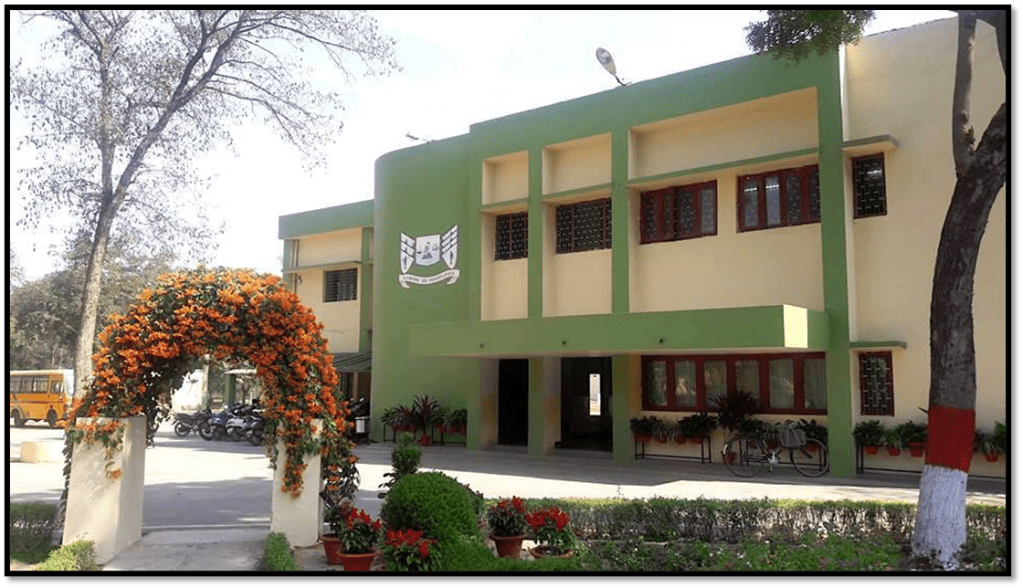
In the first decade of the 21st century the expansion of the College vis a vis numbers, continued. This was considered necessary to generate more revenue for running the institution. It would have been prudent for incremental changes in the fee structure to accompany the plans of expansions. An annual increment in fees was severe taboo: Notices to parents regarding a hike in fees were always apologetic and included the phrase ‘unwillingly constrained.’ Financial management did not take into consideration inflation, cost of living, increase in staff, increment in salaries and so on. It would take another decade before professional financial consultants were brought in to advise on these matters.
The ‘solution’ was the myopic decision to increase the number of pupils to generate revenue, while maintaining the status quo as far as existing facilities were concerned. Every inch of occupiable space was utilized. It was considered ‘imaginative planning’ to tinker with the heritage building and to insert mezzanine floors in the colonnades of Constantia, to build shoebox structures as classrooms, to close in well-ventilated corridors and verandahs in the mad rush to accommodate more pupils. Principal Elton deSouza announced on Prize Day 2001: “Even though hampered with extremely limited resources, it has not turned out too badly using a little imagination, some ingenuity and much technical advice. Creating a mezzanine floor with stairs leading to the upper room from the verandah, has given us two Computer Rooms, each capable of catering to forty students with ease.” Indeed, the pupils did seek admission in large numbers, and it was felt that the system would survive.
The demographics of the College were changed due to volumes. A neglect of the Boarding House facilities contributed to a fall in the number of resident scholars, whose presence and subsistence were not only self-supporting but helped to defray overhead expenses for the philanthropic work for the Foundationers, as desired by the Founder. The number of Foundation pupils who could thus be supported fell to an all time low. In the first five years of the 21st century, pupil strength as reported by the Principal in the Annual Report was as follows:
| Academic Year | Total Strength | Day Scholars | Boarders | Foundationers | Demi-Foundationers |
| 1999-2000 | 2190 | 2023 | 148 | 17 | 02 |
| 2000-2001 | 2065 | 1935 | 110 | 16 | 04 |
| 2001-2002 | 2298 | 2175 | 107 | 10 | 06 |
| 2002-2003 | 2386 | 2255 | 120 | 04 | 07 |
| 2003-2004 | 2569 | 2438 | 121 | 06 | 04 |
The abysmal number of Foundation pupils while the classrooms were burgeoning is a striking irony.
In the year 2000 a significant development inducing change in the demographics of the College was the approval and promulgation of the Service and Conduct Rules for Employees of the College.
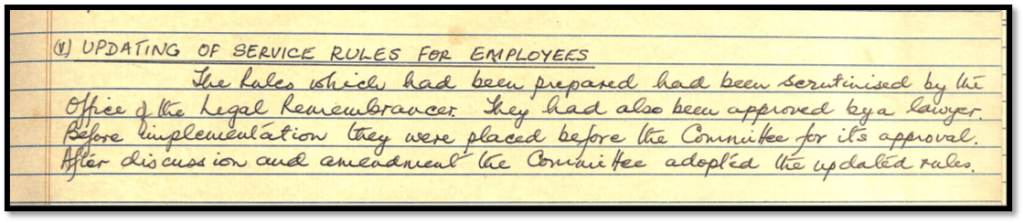
Besides streamlining the regulations for staff, the great added advantage was the perquisite for concessional education for children of permanent staff of all categories in both La Martiniere institutions in Lucknow. This was defined in the Rules, as follows:
(o) Educational Concession
Employees who have children studying in either La Martiniere College, Lucknow or La Martiniere Girls’ College, Lucknow shall be liable to pay concessional fees of Rs 15/- p.m. for each child.
Effectively, this meant that boys and girls were guaranteed admission into classes that suited their academic abilities. In addition, the social fabric of the institutions was immediately altered to the great advantage of equitable education for all social classes.
It must be specified that this decision was not an act of philanthropy. It was a respectable perquisite for serving members of staff who paid a nominal Rs 15/- per month as fees. In no way could this be linked to the system of Foundation pupils but seen as a right, derived from the Service Rules. In may be recalled that until then, sons of teaching and administrative staff were accommodated as Foundation pupils, with the stipulation of them continuing in the College as Resident Scholars only. The children of ancillary staff had not been included for this privilege.
The preoccupation of the administration was an increase in pupil strength. In the first decade of the 21st century, one regular meeting of the Governors, annually, would include related items on the agenda for expansion:
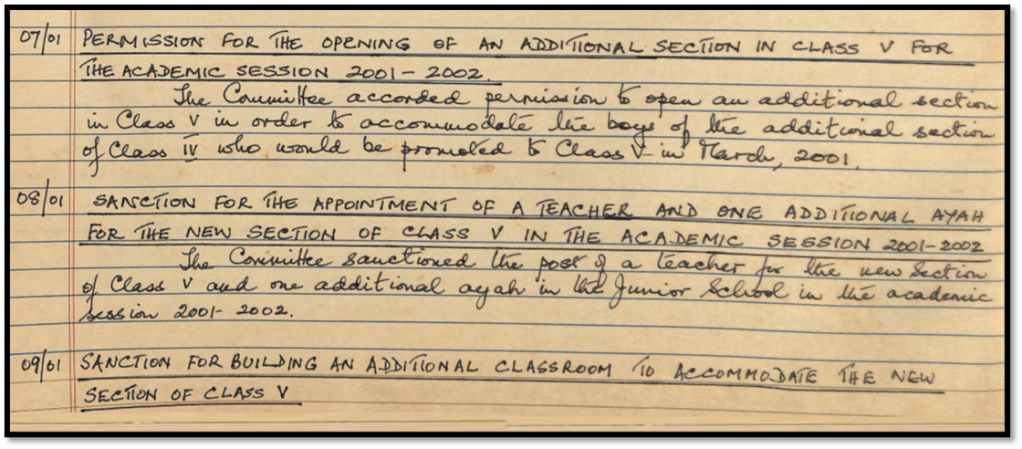
At the end of the decade, each class had reached 6 sections. Principal Elton deSouza in the Annual Report for 2009-10 described the addition of sections to classes as a “new cycle”. It was difficult to keep up with the altering number of sections in each class. Each new section that had been opened in Nursery over the years began a longitudinal plan of education that would continue for 14 years. Nevertheless, it is accurate to report that the increasing demand for admission was, in part, being fulfilled.
DEVELOPMENT
Additional Classes
In an attempt to meet, in small measure, the increasing demand for admission, and in continuation of the new cycle, a sixth section, Preparatory F had to be opened to accommodate those who had been promoted from the additional section of Nursery Class, opened the previous year. A fifth section was also added to classes 2 and 7 to accommodate the students who had been promoted from the additional sections of Classes 1 and 6 added in the academic session 2008-2009.
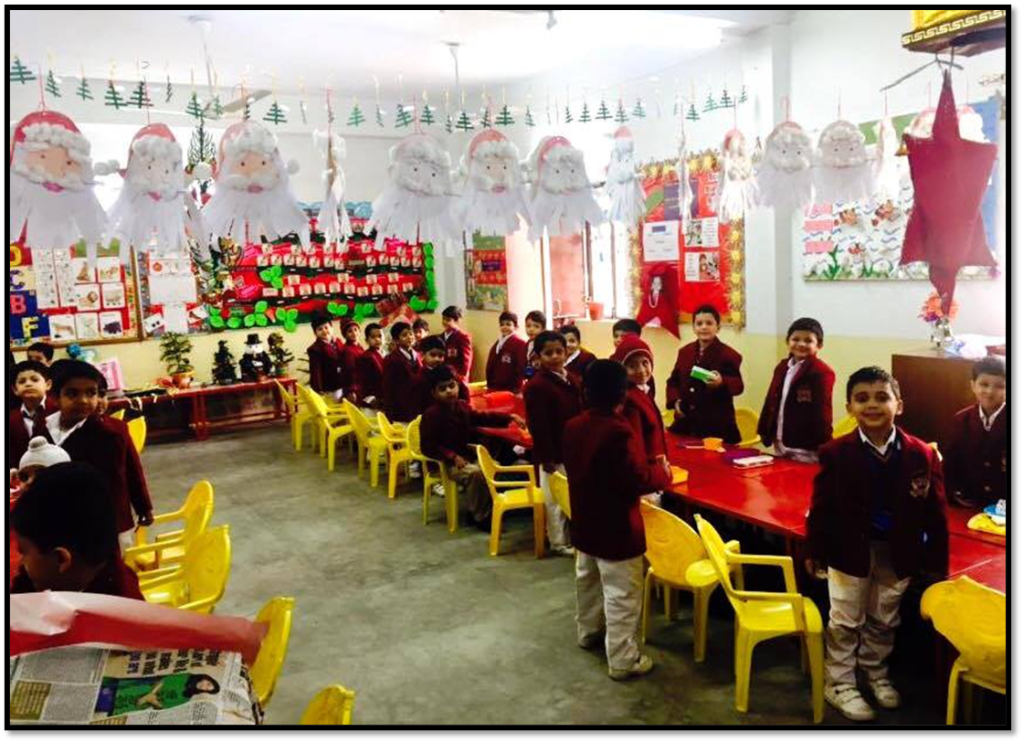
In July, 2007, the most ambitious plan for the expansion of La Martiniere College, Lucknow was proposed. Principal deSouza reminded the Governors that “the College had no dearth of land, an asset which a large majority of schools did not have. In order to make the maximum use of this valuable asset it was proposed that the existing educational facilities be expanded.”
“The proposal was to begin with the opening of 10 Sections of the Nursery Class w.e.f. the academic session 2008-2009. Once started, each year the existing five sections in each class would increase to 10. Over a period of fourteen years the educational facilities La Martiniere would be able to provide would be doubled.”
The grand plan would ensure that “Each department would have its own playgrounds and adjuncts such as auditoriums, laboratories, administrative office, gardens and infrastructure for a complete school.”
Visualised in the manner of a commune, there was not enough though put into funding of the project, maintenance of the ethos of the College, the interaction between all categories of students and above all, the spirit of La Martiniere, which, while preparing students adequately for the outside world, remained insular in traditions and practices.
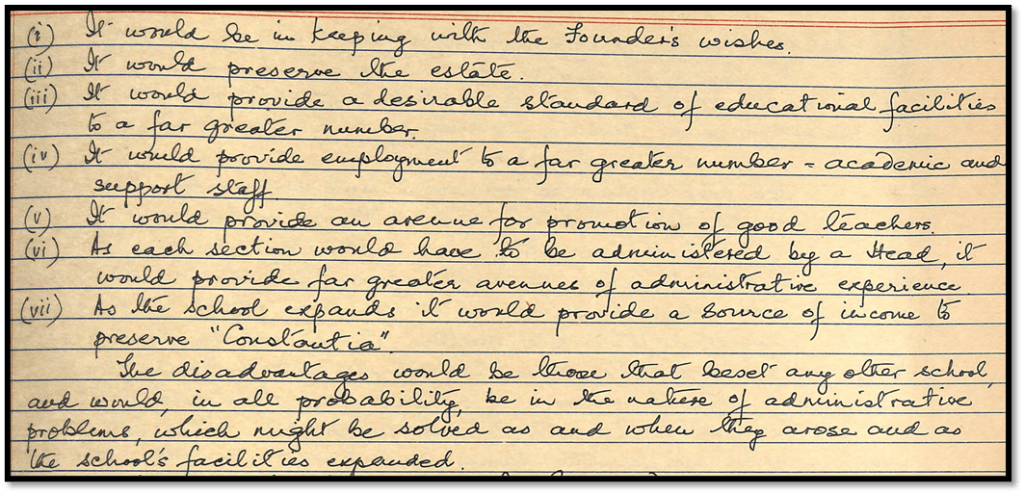
Assembly-line education was not without projected advantages and foreseeable disadvantages. These were summarised for the Governors at the meeting of 21 July, 2007:
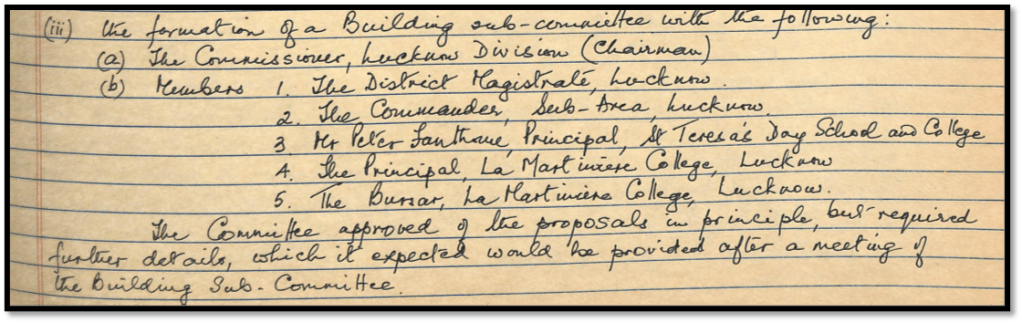
To ensure that the plan would materialise, the Governors set up a sub-Committee for this purpose:
The demographics of the College would have completely changed had this proposal converted into reality. Instead the more mundane work of running the establishment continued with a maximum increase in fees of 8% – translating to Rs 50/- to Rs 95/- for different classes, was proposed to be charged from 1 April, 2008:
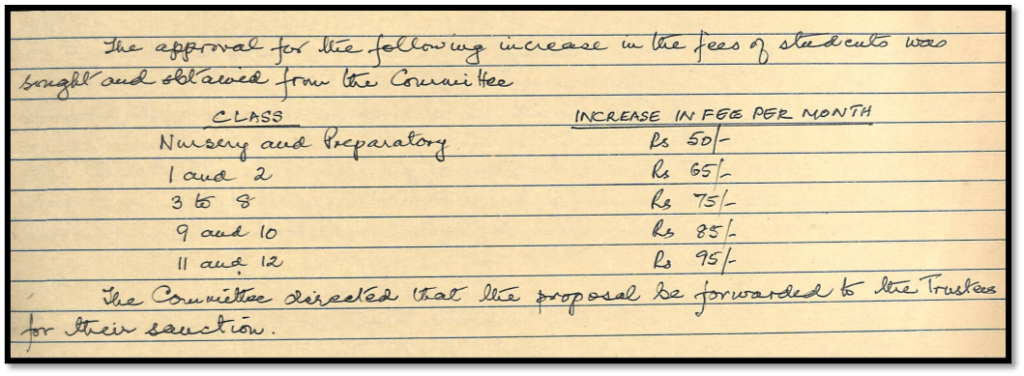
The increase in fees, whenever sanctioned in this decade was invariably fixed at 8% and was not commensurate with the financial indices in operation for a gradual enhancement of fees. As a result, when the financial belt had to be tightened due to an overall slump in physical and logistic standards in the decade that followed, the fee hike was seen as exorbitant. Financial capability became the default meter by which pupils were admitted. La Martiniere College, Lucknow ran the risk of converting to a school exclusively for the wealthy, with the social demographics being unevenly balanced by the almost non-existent Foundation pupils and the boys privileged to be offered concessional fees as sons of all categories of permanent staff. The social balance was perilously at risk.
In this decade of financial tumult, the old spirit of philanthropy, generosity and gratitude continued to express itself through the great and small contributions made by alumni in different ways.
In January, 2004, Lt Col C. F. Hamilton sent the College a Demand Draft of Rupees two lakhs, with the request that the interest thereon be used to help finance Anglo-Indian boys who had passed through the College, with their further education. The donation was gratefully received. The Principal was instructed to extend thanks to the donor and to administer the fund by informing Anglo-Indian boys, who were Foundationers, that money was available for them to pursue their higher studies. The Committee “would sanction a reasonable amount to be paid from the interest derived after investment.” Sadly, this came at a time when the number of Foundationers was at an all-time low, with 6 full Foundationers and 4 demi-Foundationers on roll.
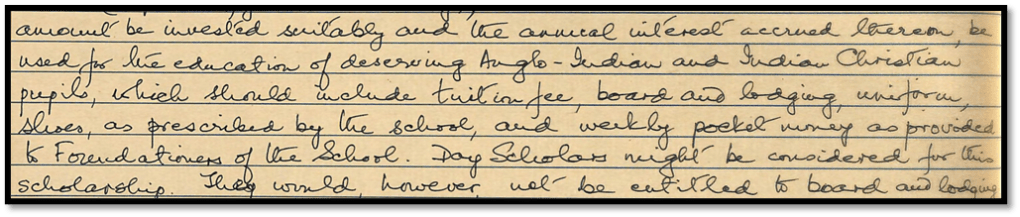
The following year, i.e. 2005, as earlier reported, Mr Adrian Holwell Sanyal, one of the first non-Anglo-Indian Foundationers to be granted that status in 1955, bequeathed a part of his estate to the College. This was for subsidizing/freeship to deserving boys of the Christian community only, for education only. He wished “to return in good measure the facility extended to him during his youth. What he was he owed to the sense of values he imbibed at La Martiniere College, Lucknow.” Rs 52 lakhs was forwarded by his estate to be invested and the annual interest accrued thereon be used as stipulated. A further Rs 8 lakh was made over to the College sometime later by the Income Tax department, following a representation by the College.
 Macky's Mart
Leave a comment