
The Nineties
The Close of the Century
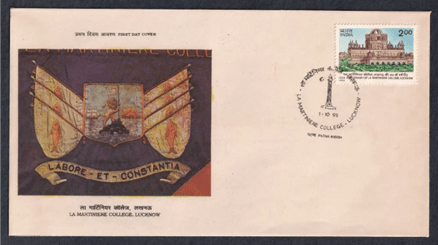

As the last decade of the 20th century approached, it was a time to take stock of the way the Institution had evolved, viz-a viz its demographic structure. The institution continued to play a significant role in the educational landscape of India throughout the century. The institution’s founding principles, rooted in Martin’s Will, had emphasized education in the English language and Christian religion for boys who so desired, while explicitly avoiding religious discrimination in admissions.
The College’s demographic composition and policies even in the first half century of its existence reflected the complexities of colonial society. By the end of the 20th century, the clock had turned full circle to accommodate children from all communities, without discrimination. This was enforced by the democratic path that independent India had chosen to follow in the mid-20th century. Segregation was now infra dig. There was no longer discrimination in facilities, curricula, and daily life. Race and religion ceased to be a dominant factor. The balance had shifted with the tidal wave of Indian pupils. There was a tsunami of day scholars that had changed the demographics of the institution, struggling to maintain the tenor of the typical British public school.
The College’s advocacy and commitment to supporting boys from disadvantaged backgrounds, a principle evident in the continuance of the ‘Foundationer’ system had been submerged by the surge of admissions, especially from families of the middle class for whom expenditure on education was considered viable.
The College was turning elite, through vehemently opposing the idea of elitism. This dichotomy was evident in the criteria for admission where a knowledge of English and conformity to Western habits still played a key role in the tacit admission criteria.
As from the time of its foundation, La Martiniere adapted to changing circumstances and the needs of pre- and post-Independence. Administrative practices were formalised through detailed documents on procedures, rules and regulations, especially for Staff. The rigorous verification of candidates for Foundation support that had characterised the intake of such pupils in the previous century was diluted, with the Principal being delegated with the responsibility for selection of the fractional number of such boys found eligible.
By the end of its first 150 years, La Martiniere College had retracted from the prejudices of colonial society; it had evolved to being a multi-cultural school encouraging inclusivity.
Admissions were now a contested issue, This had direct bearing on the demographics of the College. Controversy accompanied the expansion of the College with interested parties attempting to use influence through power and persuasion for candidates to be admitted. This touched even the ermine of the Bench. Admissions in both La Martiniere College and its counterpart for girls became a contentious issue, with calls for transparency and accountability in the procedure.
The Governors were instigated to constitute a sub-Committee to “review the policy, procedure and practice with regard to admissions”. The sub-Committee that included the Principals of both institutions met to discuss this for the benefit of the Governors on 7 April, 1990.
Both Principals had circulated details regarding the policy, procedure and practice that was then being followed. After considerable discussion, “it was felt that the maintenance of standard should continue to be the primary responsibility of the Principal.” Reading between the lines, it becomes evident that some sort of leverage, grace and favour was to be extended to members of the Committee:

This was the beginning of active intrusion into determining the composition of the student body. It also established the practice of letters being sent by members of the Committee on behalf of particular candidates, a practice that continued into the following century. These letters were seen as symbols of status and preference. It would not be possible for any Principal or selection authority to admit candidates based on these recommendations alone.
In the meantime, admission of Foundationers was handed over to the Principal. Through the 1990s the practice of advertisement in the newspapers was followed, but fell out of practice when the privilege reduced to a trickle and Foundation scholars approached the College through word of mouth. A typical entry in the Minutes of 10 August, 1991, characterised the manner in which this agenda item was handled annually:
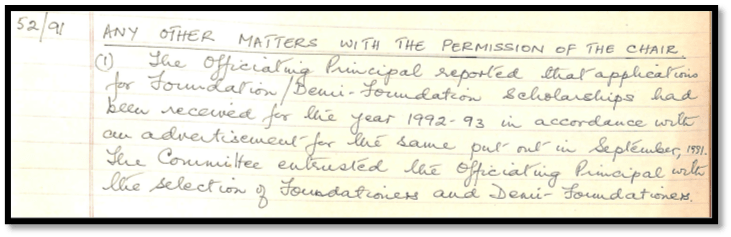
The annual practice was completed when the Committee was ‘informed’ about the annual selection:

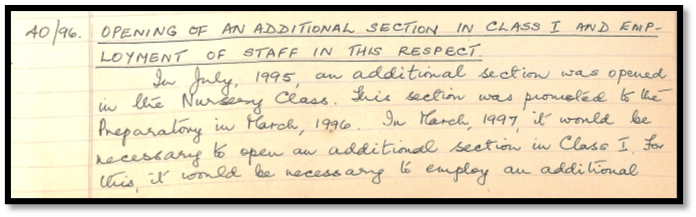
Expansion continued. In November, 1996 Principal Elton deSouza reminded the Governors that at an additional section had been opened in 1995 Those pupils had been promoted to the Preparatory class in 1996. Therefore, the process of including one more section from the session commencing in March, 1997 would have to permitted annually for the accommodation of these boys as part of a longitudinal plan.
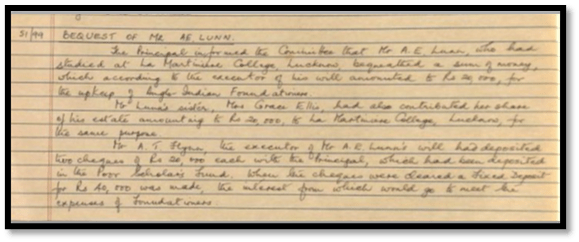
Following the tradition of several Foundation pupils, who had gone on to progress financially in professional life, Mr Arthur E. Lunn, a former Foundation pupil, bequeathed a bequest for the upkeep of Anglo-Indian Foundationers. This was placed in fixed deposit, the interest of which would be utilized as per the donor’s Will. This action was reported, significantly, at the end of the decade, ironically, on Children’s Day – 14 November 1999. It was a suitable gift of meaningful charity returned for charity that had been received by a grateful former scholar. It also ended the century with a reminder that the College had been founded for ‘lasting charity’.
La Martiniere College, since its founding, adapted its administrative and admissions practices to reflect changing societal values, especially in the post-Independence era. The school evolved into an inclusive, multi-cultural institution, yet admissions became increasingly contested, prompting calls for transparency and the establishment of review committees. While the Principal retained key responsibilities, external influences and recommendations began to play a role in admissions. Over the years, processes for selecting Foundation scholars changed, with tradition upheld through charitable contributions and the continuation of the College’s founding principles of lasting charity and service.
 Macky's Mart
Leave a comment