
The Eighties
Whither ‘Lasting Charity’
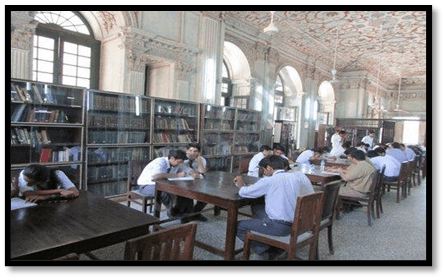
The 1980s seemed to be the decade where the offer of charity was questioned, re-questioned, permitted, withdrawn, subsidized. It was converted to a competitive exercise. It included a qualifying examination. It even required parents of pupils on the Foundation to pay fees, albeit highly reduced. The status of the Foundationer seemed to overshadow all other aspects of admission policy in that decade.
In the meantime, numbers steadily increased with the usual sops being granted to Foundation pupils, with strenuous checks and balances to disqualify candidates rather than encourage such opportunities for education of the disadvantaged.
While other developments, physically and academically followed an upward trend, the trend was to keep the Foundation pupils at the bare minimum. In this decade, no other aspect of College life received as much attention by the College as the status of these boys.
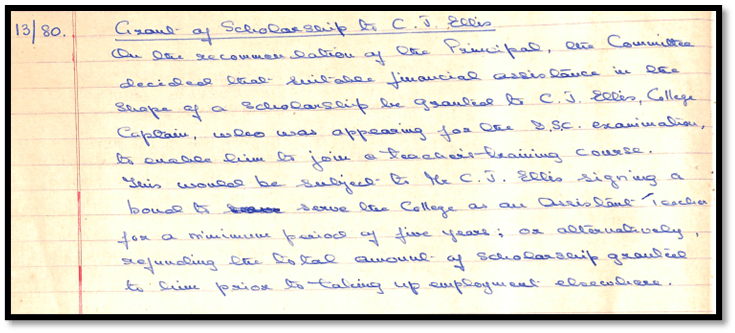
In 1980, there was the resurrection of the Roorkee Scholarship that had fallen into oblivion since decades had passed from the time that Thomason College, Roorkee had stopped being the most prestigious and sought after College for engineering aspirants. The lapsed scholarship, still officially available now diversified to include beneficiaries from among the meritorious deserving from academic disciplines other than engineering. Carlton J. Ellis was chosen for a scholarship that would have been, in part, underwritten by the Roorkee Scholarship fund. This was to cover costs for a teacher training programme, for which he would sign a bond, committing him to serve in the College, on payment, for a minimum of five years. This was confirmed by the Governors in 1981. Steps such as these were designed to encourage young Anglo-Indian men to take up teaching as a profession. The further advantage would be to have an old boy on the Staff, and in Ellis’ case, an effective College Captain. It was designed to maintain the Anglo-Indian component of the demographics of the College.
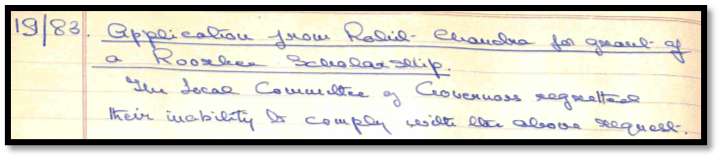
The revival of the Roorkee Scholarship awarded to Carlton Ellis was a one-off event in the 1980s. It was never repeated. Instead, mystery surrounds the application on behalf of Rohit Chandra, a pupil in 1983, where the Governors merely recorded “their inability to comply with the above request.” The Roorkee Scholarship and the endowment for the same has never been mentioned again.
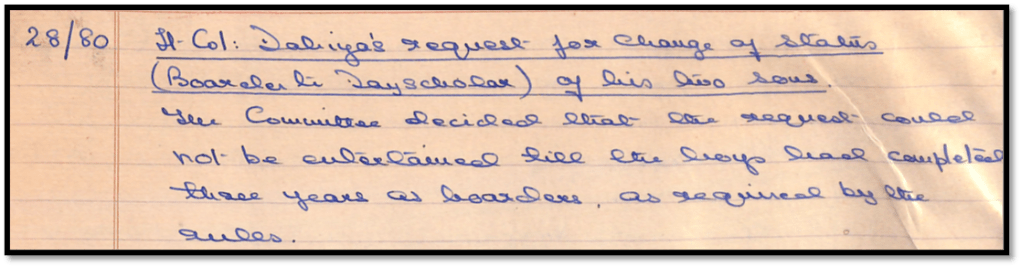
With the opening for opportunities for education in the country, La Martiniere College was still an institution of choice for admission of boys. Unfortunately, there were unpleasant occasions when a boy, to gain admission, was presented as a resident scholar, while once the admission was confirmed, the parent would apply for a change of status to day scholar. The College had to scrutinize all applications for such change in status, often bringing it to the knowledge of the Governors. As a rule, it was required for a pupil to complete three years’ tenure as a resident scholar, before the consideration of a request for a change to day scholar status.
In August 1980, the Governors rejected the request of a parent on this basis alone. A change in status would also mean a loss of revenue, necessary to cover overhead expenses of the boarding house.
An year later, the Governors were again approached for a similar change in status from resident scholar to day scholar. The request was turned down with the Governors adding that “there were no special circumstances to justify a departure from the rule.”
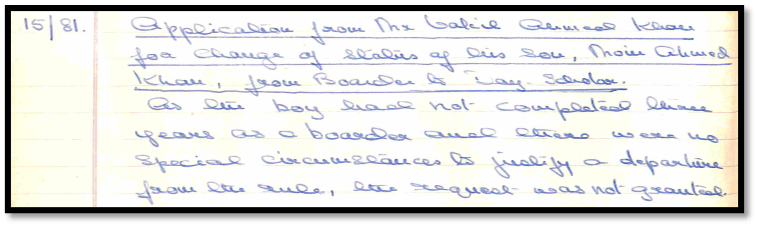
The attempts to convert pupil status began in the 80s and continued. Regrettably, even genuine cases had to be overlooked due to what was becoming a scandal. Years later, it would be seen as a dubious way of obtaining higher Boarding fees, while permitted a boy to proceed on ‘day scholar leave’, sometimes for sessions together. This ensured increased revenue, without the corresponding expenditure on a Resident Scholar. The practice, under this guise, was corrupt.
Occasionally, requests would be made within a few days of a boy being registered as a Resident Scholar. Homesickness aside, this would become an unhealthy practice where some boys admitted as Boarders would not spend a single night in the dormitory, proceeding on ‘day scholar leave’, even before attending their first class.
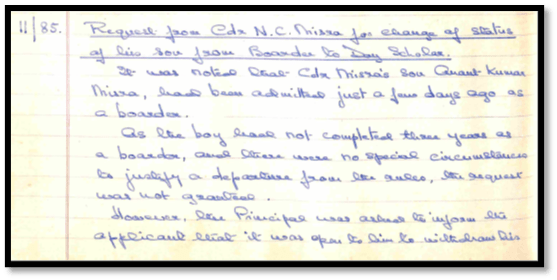

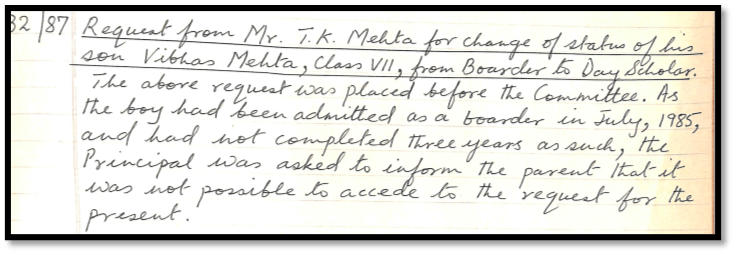
The requests for change of pupil status came with particular regularity:
The downslide in numbers of Foundation pupils continued, with even the notional limit of 100 Foundationers being far from met. The Principal’s Report presented in 1980 provided statistics of an increase in total numbers of almost 300%. The figure was reported to justify the need for the expansion of physical facilities. Yet in the same context, the total number of Foundation pupils was reported to be 45.
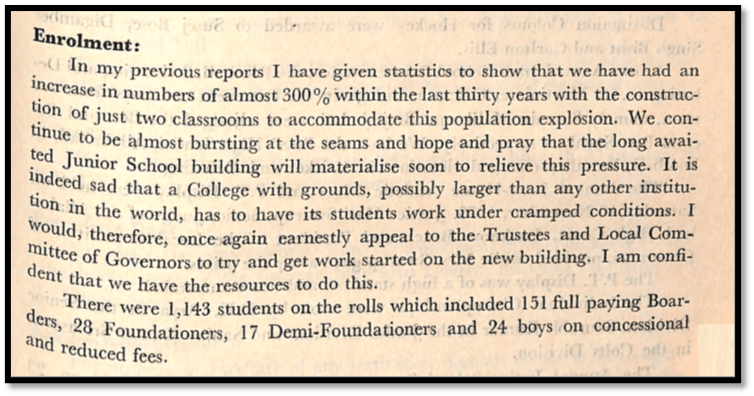
Statistics are quoted to fit a particular context. In 1981, the Principal’s Report referred to the 1905 figure of a total number of 248 pupils of which 24 were day scholars.

Records indicate that there were 100 Foundationers and 124 Boarders in 1905. The ratio of Resident Scholars and Foundationers was withheld from the 1981 Report. Instead, the increase in the number of Day Scholars in 1981 was recorded as 1024. This was from a total of 1234 pupils on roll. A quick calculation would indicate the ratio and percentage of the Foundation pupils, spanning the difference of 76 years. In 76 years, the percentage of Resident Scholars had dropped to 5.6%, while the total number of pupils on roll had increased by 5 times the number to almost 400%.

With increasing numbers there was in fact a dramatic decrease in the percentage of boys educated by charity.
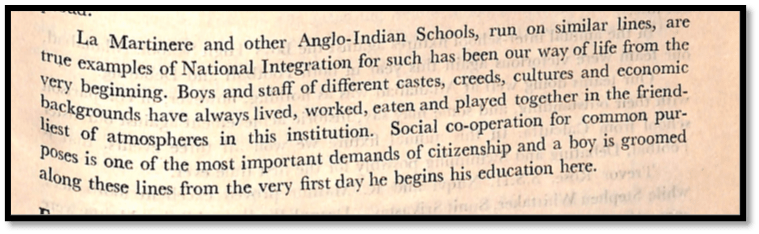
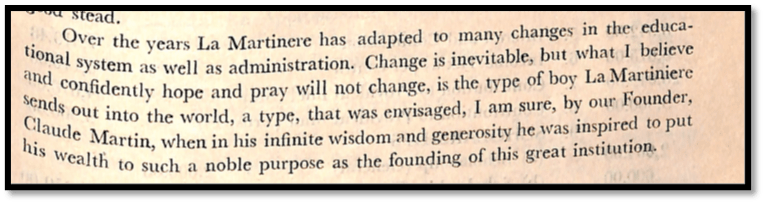
By 1982, the Principal was reporting on the homogeneity of the demographics of the College. Principal Shaw referred to La Martiniere and other Anglo-Indian schools as “true examples of National Integration”. Perhaps erroneously he described this as having been “our way of life from the beginning”. The claim sounded hollow when we consider the discrimination that existed due to race and colour; the discrimination that contrasted charity with affordability; the discrimination in even the training in the use of arms before Independence. The rhetoric conceals the clashing social forces that underlie the surface calm. Superordinary goals, described as ‘tradition’, are the acceptable compromise when there is conflict.
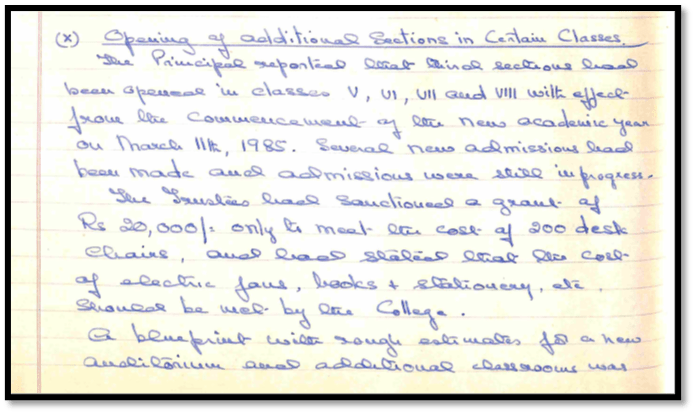
The expansion that had begun in the tenure of Principal Daniells, continued through the 80s. Corresponding expenditure was sanctioned by the Trustees only for furniture to equip new classrooms, while it was left to the College to arrange for fittings. The Principal was instructed by the Governors on 30 March, 1985 to forward blueprints and estimates of costs for expansion to the Trustees.

The raison d’etre for Foundationers was once again questioned in 1985, when the Minutes 23 November, 1985reverted to the old tune of requiring a candidate to ‘qualify in an admission test’. This was a competitive exercise, far removed from the principle of unqualified charity that had motivated the Founder for his bequest. Scrutiny of the income of parents was focused on in detail. This seemed more like an attempt to deny the ‘scholarship’ on the financial soundness of the family, making redundant the admission test to qualify for a ‘scholarship’ on merit.
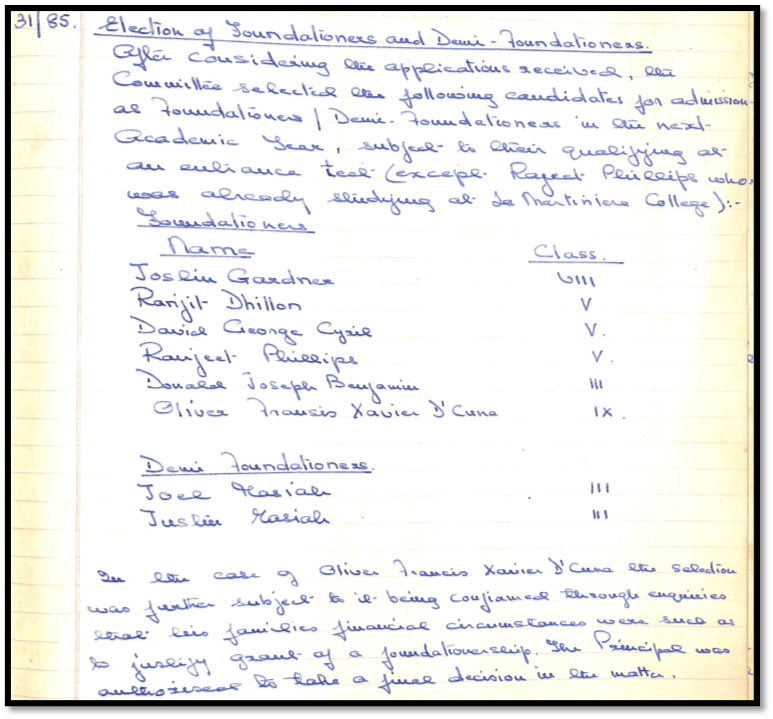
Perhaps the pressure of work and time led to the choice of Foundationers and Demi-Foundationers being delegated to the Principal, rather than taking up the time of the entire Committee of Governors. In February, 1987, the decision to select ‘individual cases’ was left to the Principal. This practice has since continued.
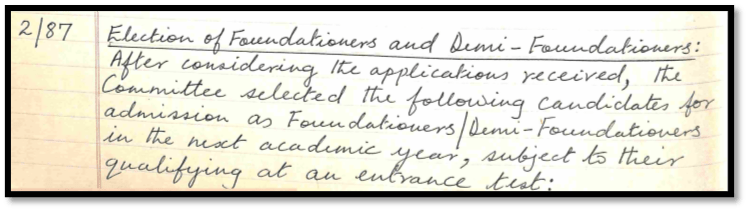

The qualifying ‘entrance test’ was set for candidates in April, 1987. All those who wrote the test were granted admission.
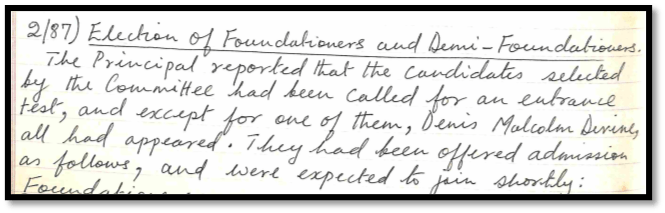
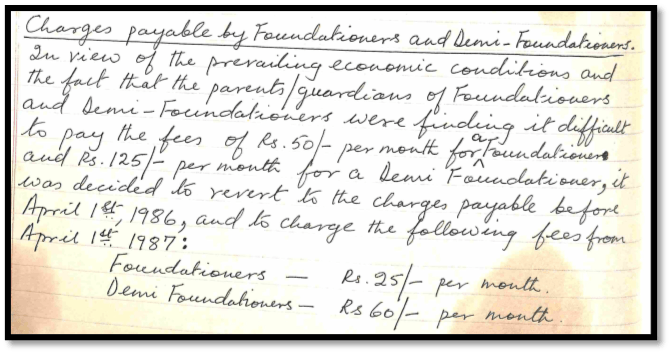
At the same meeting where the Principal had reported the selection of candidates for the Foundationers and Demi-Foundationers held April 7 1987 the controversial decision that had been taken in 1986 was retracted. This was regarding payment of fees for both Foundationer and Demi-Foundationer pupils. The Founder’s bequest had been watered down a century earlier by the introduction of ‘supernumerary’ Foundationers and the nomenclature soon changed to describe resident scholars for whom a reduced fees was charged as ‘Demi’-Foundationers. This had been steadfastly overlooked as the numbers on roll continued to increase. This needs a constant reminding that it is not in keeping with the Will of the Founder or with the Scheme of Administration set out by the Court.
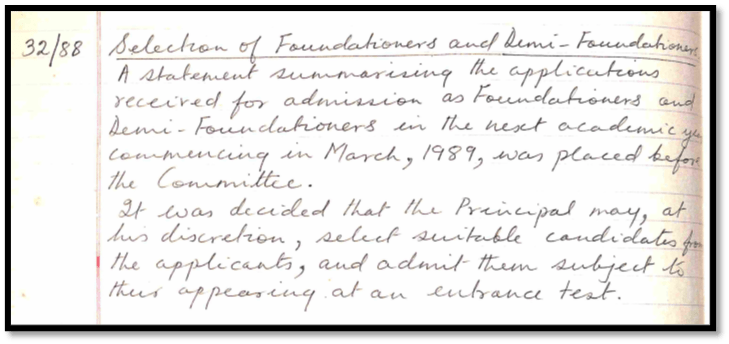
The delegation of responsibility to the Principal for the selection of pupils to be supported by the Foundation was reiterated in 1988. The Principal was authorised to “at his discretion, select suitable candidates from the applicants, and admit them subject to their appearing at an entrance test.”
There is no doubt that financial resources to maintain the boys supported by the Foundation was limited. This was particularly apparent as by the end of the decade, the paltry amount that was routinely handed out for the support of Foundationers from the Trustees was appallingly low. In addition, it was expected that a certain percentage of the amount received was to be transferred to La Martiniere Girls’ College, for which a receipt and statement was required by the Trustees’ office. In 1989, correspondence began to request for an increase the annual grant towards maintenance of Foundationers and Demi-Foundationers.
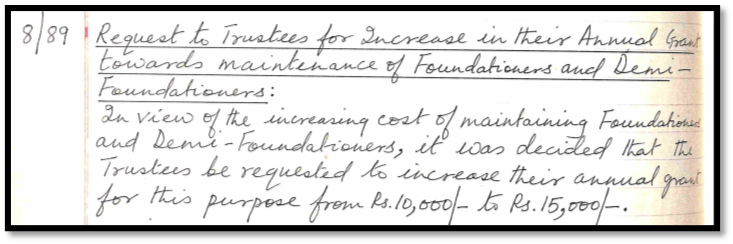
The Trustees replied negatively. This was duly reported to the Governors.
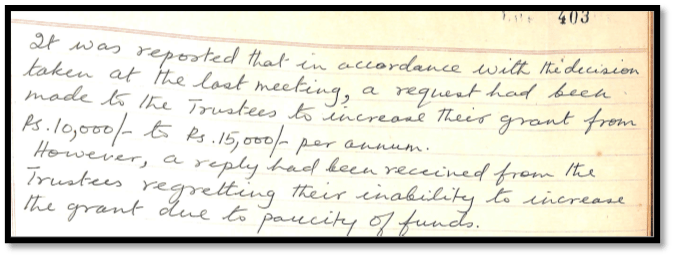
This item has become a permanent entry on the agenda of every meeting of the Committee of Governors from 1989 till date.
Regrettably, in 2018, the nominal amount of Rs 10,000 for the upkeep of a minimum of 100 scholars that had been received from the Trustees towards this expenditure ceased to be remitted. The trust of the Founder and his permanent appeal to the government of the day may be said to have been betrayed.
Claude Martin set down in writing, an appeal to governments and courts in generations ahead to protect his interests. “I am in hope government, or the supreme court will devise the best institution for the public good … as that it be made permanent and perpetual”.
It is part of the civilized world to adhere to and respect the Will of a testator, especially when it is for a noble, charitable purpose. Claude Martin requested that a copy of his Will was “to be deposited in the Supreme Court, to which I recommend my executors, administrators, assigns, or trustees, to put this Will and Testament under their protection, or tender the protection of government if necessary.”
 Macky's Mart
Leave a comment