
The Seventies: The Decade of Numbers
The problem of plentiful numbers continued to affect the 1970s. Day scholar numbers soared, while the increase in the number of day schools all over the country, especially the satellite towns of Lucknow considerably decreased the number of admissions to the Boarding House. The Resident Scholars were described time and again by laudatory metaphors and epithets such a ‘backbone’, ‘salt of the earth’ and ‘nucleus’ of the College. With increased opportunities for receiving education locally, the option to send a boy to Boarding school was based not on necessity, but on convenience, tradition and traditional beliefs of independence, self-sustenance, survival and discipline. Sons and grandsons of old boys followed in their fathers’ footsteps. The one community of boys who could always be depended upon to continue their education in the College for all their school years were the Foundation pupils. Most often due to absolute necessity, straitened financial means and a surety that a Martiniere education would provide them with a leg up in life. Regrettably, means to ensure a steady supply for this nucleus of boys, a fraction compared to the ever-increasing numbers of admissions was not considered. Candidates on the Foundation were not encouraged. Negative discrimination was becoming rampant. There was no clarity on the number of boys who could be accommodated, leaving ‘vacancies’ unfilled. Sons of members of Staff were included as Foundation pupils; the provision of free education for such children not having been officially ratified. Such sops pacified the receivers but did not contribute to maintaining the ethos of the Institution, established by the ‘lasting charity’ of the Founder.
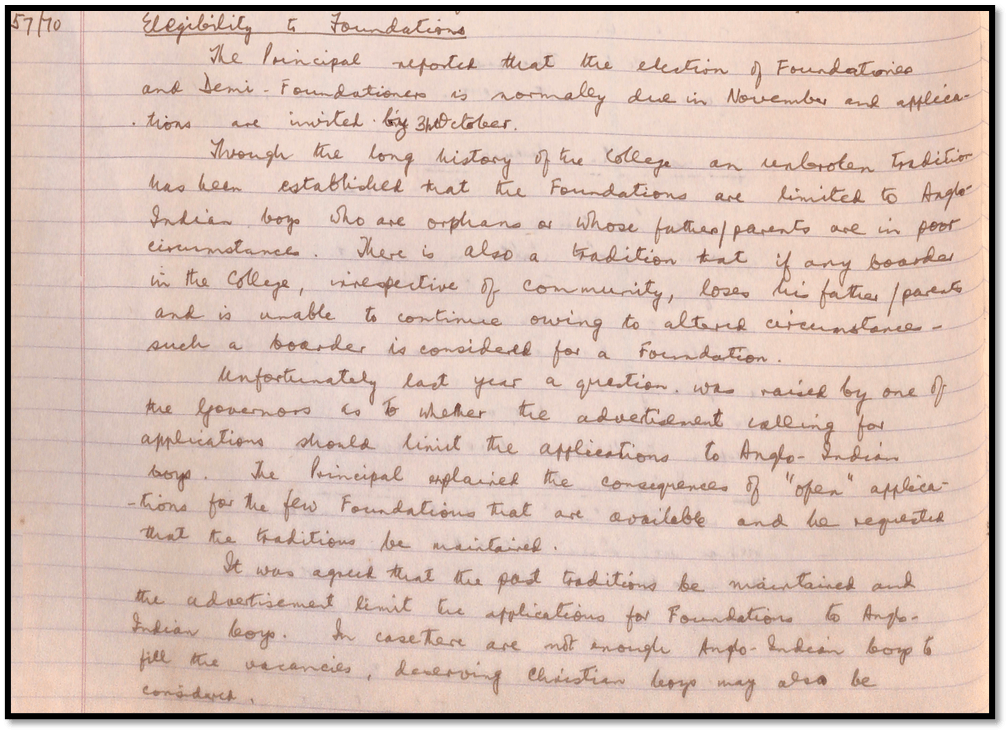
The very principle that established the Foundation was questioned by the highest authorities, requiring the Principal to set out the objectives behind the practice. Strangely, the provision to open eligibility to the Foundation to all communities as envisaged by the Founder, the Scheme of Administration and the restructuring of the College in Independent India was overlooked. A somewhat parochial view was adopted by the Governors on 28 August, 1970 by a definition for the eligibility of Foundationers. In effect the practice for the election of Foundationers included:
- Advertisement for ‘vacancies’ on the Foundation by 31 October of each year, for the following academic year, in January.
- The limitation of Foundationers to Anglo-Indian boys, who may be orphans on with very limited financial means.
- The conversion of a Boarder, irrespective of community, to the status of a Foundation pupil in the event of the loss of the family breadwinner.
- Deserving Christian boys may be considered in the event of Anglo-Indian boys not filling the vacancies.
The Governors adopted Resolution 57/70, which agreed that despite individual contrary opinion: “It was agreed that the past traditions be maintained and the advertisement limit the applications for Foundationers to Anglo-Indian boys. In case there are not enough Anglo-Indian boys to fill the vacancies, deserving Christian boys may also be considered.”
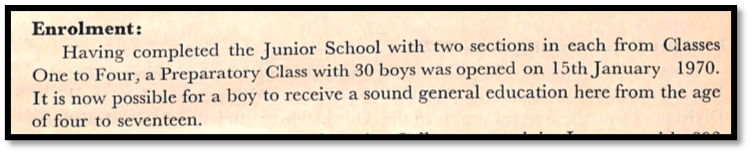
In January, 1970 a Preparatory class was opened for boys of 4+ years of age. The numbers therefore further increased. Additional sections were envisaged. The Principal proudly announced that it was now possible for boys to receive education from the age of 4 to 17.
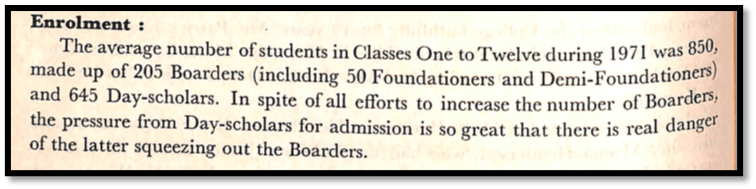
By 1971, despite attention being given to the admission of Foundationers, the number on the Foundation reduced to 50 boys. This included both Full Foundationers and Demi-Foundationers. The focus and concentration seemed to be on the admission of the Day-scholar pupils, though much regret was expressed at the way the Resident Scholars were being ‘squeezed out.’
1971 was also the year in which an additional section for Preparatory was opened. Besides the change in demographics, due to numbers, the physical facilities were also at breaking point, not sufficient attention being paid in advance to logistics related to the increase in numbers. Pleas for a new Junior School campus were made.
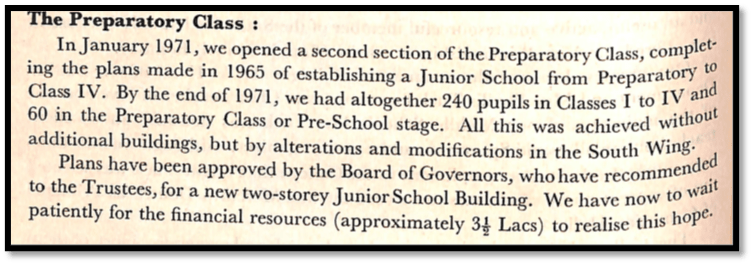
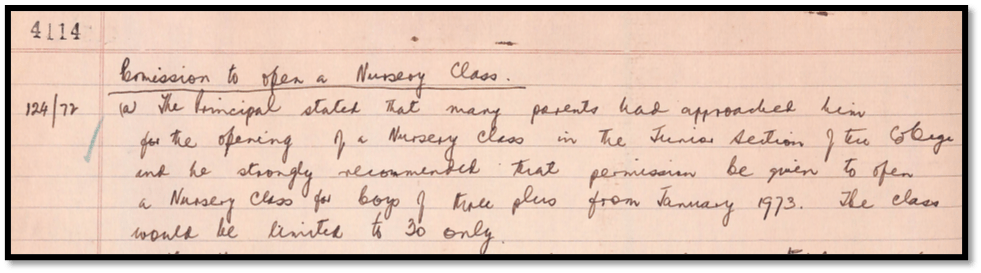
In 1972, permission was granted for the long-awaited longitudinal completion of the school, in terms of number of classes. On 10 October, 1972, the principal sought permission to open a Nursery for boys of three plus years from January, 1973. It was proposed that the number of seats would be limited to 30. The opening of Nursery was duly carried out by the Chairman, Mr (Justice) O. P. Trivedi in January, 1973, thereby completing the Junior School, which had begun in 1966.
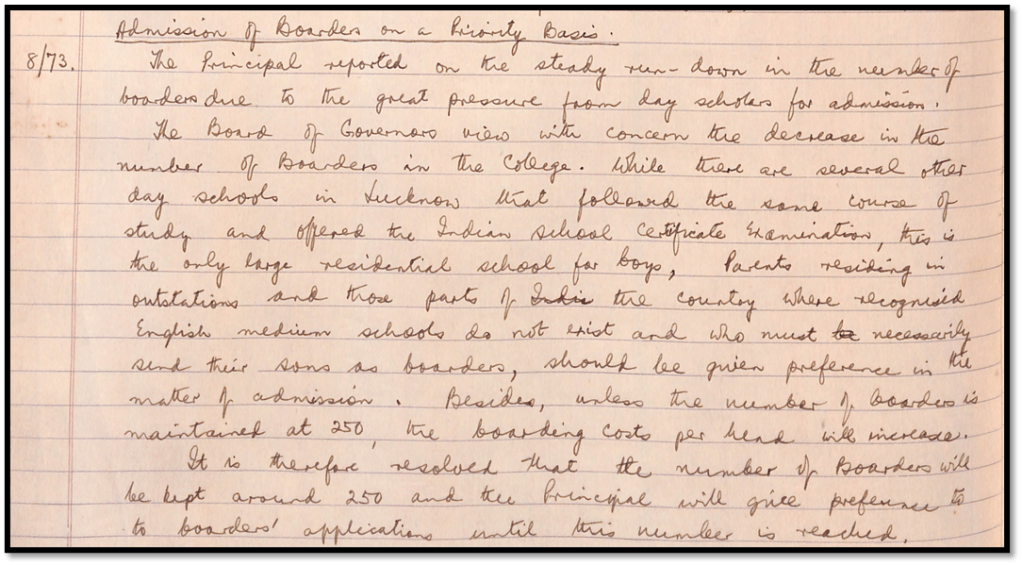
The College seemed to wish to promote the myth that the Institution was primarily to cater to Resident Scholars, despite there being five classes in the Junior School (From Nursery to Class 5) in which Boarders were not admitted. The Principal recalled that there had been “a steady run-down in the number of Boarders due to the great pressure from the day scholars for admission.”
Realising that the ethos of College was being eroded, it was proposed that Boarders “should be given preference in the matter of admission.” The economics of running a Boarding School could only be viable if a minimum number of 250 Scholars were in residence; failing which, the costs per head would increase. It was therefore resolved that the strength of the Boarding House would be maintained at about 250 and that preference would be given to the admission of Boarders until this figure was reached.
La Martiniere College, Lucknow was no longer an institution offering certification in the Sciences and the Arts. In 1973, Commerce was introduced for the first time as a subject in the Senior School. This generated a trend of sons of businesspersons being admitted to La Martiniere for studies that suited their interests. It also began a trend of cautiously exploring the introduction of subjects of study which were gradually becoming mainstream. The College was no longer restricted to being a School, training pupils for the Entrance examinations for the Thomason Engineering College, Roorkee. The eponymous scholarship, so cherished till the beginning of the 20th century, was now considered a misnomer, as grants were offered for the study of Medicine, Teacher-Training and Technology. Indeed, the demographics had undergone much change.
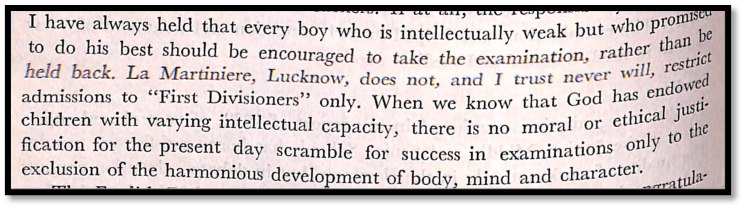
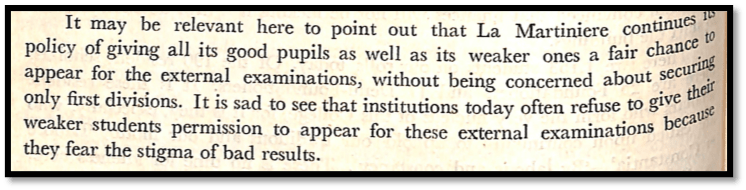
Lt Col Daniells may be credited for making La Martiniere College, Lucknow a modern institution, Anglo-Indian in character, and among the more populous mixed day/boarding schools in the State. Essentially, the ethos of La Martiniere College, Lucknow was to promote holistic development and inclusive education. In the last Report that he presented for the year 1974, he stated “I have always held that every boy who is intellectually weak, but who promised to do his best should be encouraged to take the examination, rather than to be held back.” That statement ensured that all boys would be given a chance. With prophetic guidance he declared: “La Martiniere, Lucknow, does not, and I trust never will, restrict admission to ‘First Divisioners only.’ He concluded his tenure by approving that “there is no moral or ethical justification for the present-day scramble for success in examinations only to the exclusion of the harmonious development of body, mind and character.”

D.E.W. Shaw
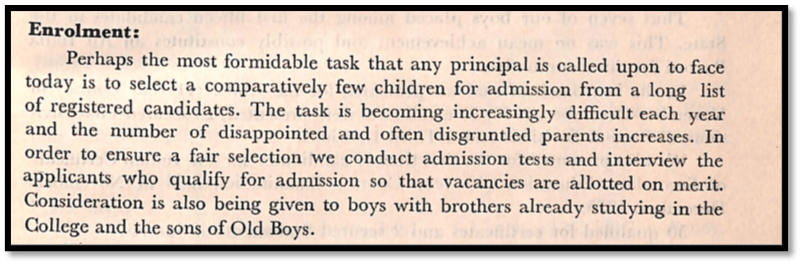
Maintenance of ethos was the slogan of Principal D.E.W. Shaw, who succeeded Lt Col Daniells on his retirement in 1974. In the Principal’s Report for 1976, he reiterated what previous Principals of the century had stated. The maintenance of ethos could in some way ensured if consideration in admission was granted “to boys with brothers already studying in the College and the sons of Old Boys”. The demographics of the institution would be balanced by the families of those who had had the privilege of being educated at La Martiniere, while extending facilities to first time admissions to the College.
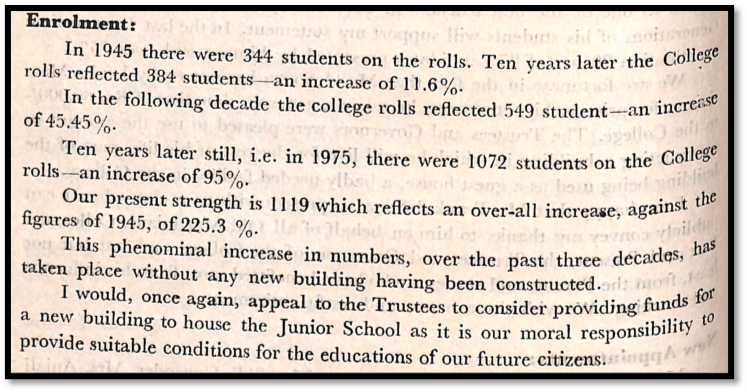
Sadly, by 1976, the number of pupils on the Foundation had further decreased to 39, while the total strength of the College was a significant 1078.

While absolute numbers regarding admissions were recorded, it was an academic exercise to work out the increase in percentages.
While delivering the Principal’s Report for 1977, the Principal quoted the astounding number in enrolment for the beginning of 1975. The strength was 1072 pupils. The guests at Prize Day were understandably surprised that the figures for those years reflected a 225.3% increase over the figures in 1945. The fine print was overlooked. There were only 39 Foundationers (both Full and Demi-) in 1976. This accounted for an appalling 3.64% strength of boys who were privileged to enjoy the ‘lasting charity’ of the Founder. The numbers indicate a travesty and an eyewash by maintaining less than 40 pupils on the Foundation, with the projection of the Institution being a school founded to accommodate at least 25% of the pupil strength on charity. Disappointingly, there was no authority to take up the cause of boys socially and financially vulnerable.
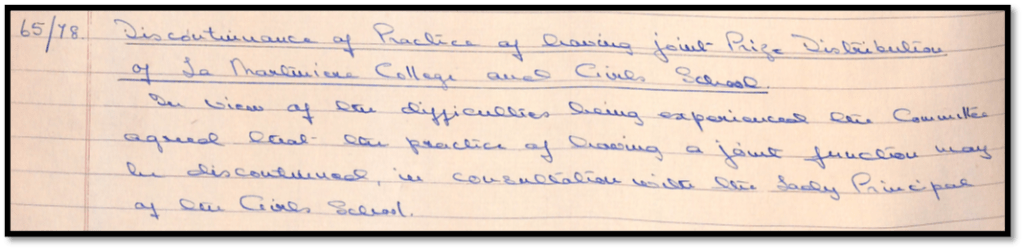
La Martiniere Girls’ School, now La Martiniere Girls’ College, had been an arm of the College established by Claude Martin. The Girls’ institution had moved on, with formal events being conducted jointly. The vestiges of demographic change were further removed when in 1978. The old tradition of joint Reports by Principals of both institutions being read together annually at Prize Day and published as a common comprehensive record was discontinued. The boys’ and girls’ Colleges did still conduct certain programmes together and use facilities commonly, but the umbilical cord had been severed, leaving only some cultural and administrative remains.
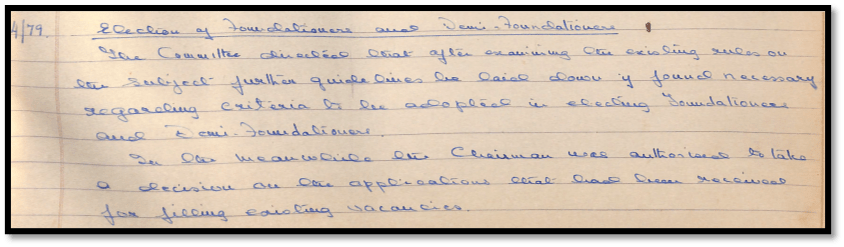
Formal records indicate that that the continuance of Foundationers was regularly reported at meeting of the Governors. For example, on 7 April, 1979, the Minutes of the Governors meeting record that ‘further guidelines’ be laid down ‘if found necessary’ for the election of Foundation pupils. This was circumlocution. In the meanwhile, the Chairman was authorised to take a decision on the applications received.
Despite the official decisions for the election of Foundationers, the absolute numbers marginally increased from 39 in 1976 to 42 in 1979. The 1979 numbers were reported in the Principal’s Report. Nevertheless, it was reiterated that it was the Resident Scholars, of whom the Foundation pupils were a part, who constituted the ‘nucleus of this College’. In flattering laudatory terms, it was reminded that it was the Resident Scholars “who are called upon to continually uphold our traditions and out motto, ‘Labore et Constantia’ – ‘By labour and constancy’”.
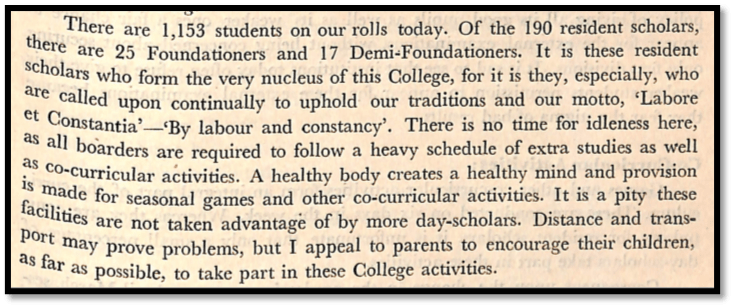
As the decade closed, the foundational values of the Institution were repeated. Despite changes in demography, politics, social correction, academic challenges, finances and above all, vast numbers, the Principal reminded:
 Macky's Mart
Leave a comment