
THE PREDICAMENT OF THE FOUNDATION PUPIL
The first half of the twentieth century was turbulent in every part of the world. The first World War had changed the dynamics of politics, the great depression had affected the economic stability of the world, the Independence movement was gaining momentum, the world was at war once again in 1939.
Amid these global changes, the British Empire was becoming an anachronism. This is reflected in the constant pulls and pressures on a micro-level within a single institution called La Martiniere. The calls for greater acknowledgement of the local population were strongly opposed by those who wanted to maintain the status quo in benefits for race, language and religion.
Regrettably, the existing state of affairs failed to re-evaluate the provisions of the Founder’s Will or look for means to ensure that the tenets of Charity, which had motivated his bequest, were aligned to the requirements of the times. The unfortunate damage was done by affecting the primary beneficiaries of his charity, which is, the pupils on the Foundation set up by him. There were no advancements displayed for the benefit of the Foundationers, a line of action that continued until Independence and beyond. Strategic financial investment, sensible capitation to subsidise expenses towards foundationers and other practical domestic arrangements were ignored. The Foundationer was beginning to be seen as a parasite, an excrescence that could not be wished away. Claude Martin’s ‘lasting charity’ and school for the deprived to exist ‘in perpetuity’ had lost its direction. This would become worse as the decades progressed with the source of funding being restricted to the bare minimum requirement according to the letter of the law, a complete lack of transparency by members of the Trust and the mere fulfilment of form, to keep the institution up and running.
The game of numbers continued to be played with fulfilling the requirements of the original Scheme of Administration set up in the context of the Will of Claude Martin. The number of 100 Foundation pupils set in 1859, when the total number of pupils on roll in the College was 200. This figure included both the European and Native Departments. The number 100 has been used through a major part of the history of the College as a lodestone figure. This, regrettably, was only following the letter of the law. The percentage of pupils (in 1859, i.e. 50% of the total) is not considered. The College has continued to increase in pupil strength over nearly two centuries and is now in excess of 3000. There is still ambiguity and a silence on the number of boys to be supported either by the Foundation or by a clever use of residual profits, to fulfil the tone and spirit of the Will of the Founder.
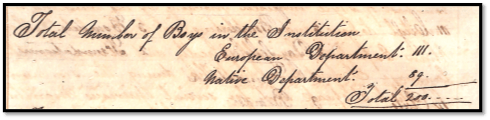
The figure of 100 set in 1859 exclusively for the European Foundation, is a convenient nod to the law. Within this figure of 100, various permutations and combinations have been made:
- Before 1859, the number of the European and Eurasian Foundation was set at 70.
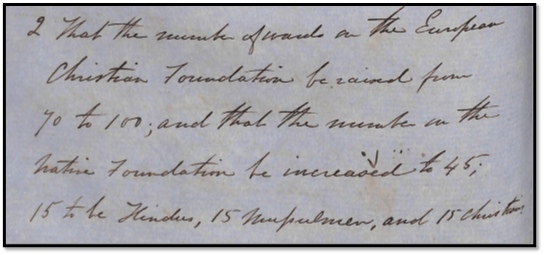
- On 7 November, 1859 the nomenclature was changed from ‘European and Eurasian’ to ‘European Christian’ Foundation. The Governors resolved that “the number of wards on the European Christian Foundation be raised from 70 to 100;”
- On 7 November, 1859, the limits for the Native Foundation were set vide the same Resolution, which continued: and that the number in the Native Foundation be increased to 45; 15 to be Hindu, 15 to be Mussulman, and 15 to be Christian.” In effect, a total of 145 full-Foundation scholars was determined.
- In February, 1861, the 15 Native Christians were absorbed into the European Christian Foundation. There were therefore 15 less in the Native Foundation, while the number 100 remained constant as the quota for the European Christian scholars.
- A watering down of the original charity began with the admission of ‘Supernumerary Foundationers’ who paid a subsidised fee and were recognised as Foundation pupils in 1876.
- In 1876 the Native School was abolished. Therefore, funds for the education of the 30 Hindu and Muslim scholars, acknowledged as Foundation pupils or Scholarship holders were now released.
- The amalgamation of the supernumerary scholars with the total number of 100 Foundationers was conceived and executed in 1878. Foundationers were demarcated at 80 and demi-Foundationers at 20. The maximum number of Boarders remained unaltered at 100.
- In the early 1920s, the breakup of scholars on the Foundation was altered to 50 scholars on the Full-Foundation and 50 scholars admitted as demi-Foundationers.
In 1946, referring to the high prices, the number of full-Foundationers was reduced from 50 to 40. Simultaneously, the number of demi-Foundationers was increased from 50 to 60. It was made clear that the “total number of scholars on the Foundation remaining as before at 100.”

 Macky's Mart
Leave a comment