
The ‘First Indian’ Students
The first Indian boys were admitted to the College to the ‘Remove’ class: the name given to the class in an English Public School, equivalent to year 11 in modern school education. The nominal Roll for 31 December, 1920 includes the three Indian boys:
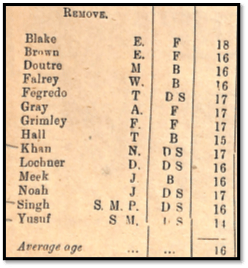
The three Indian boys, first admitted to La Martiniere College, Lucknow in 1920 were:
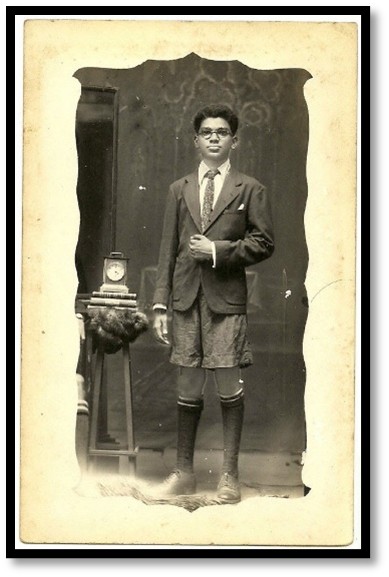
- N. Khan (17)
- S.M.P. Singh (16)
- S. M. Yusuf (14)
Significantly, the Remove class also accommodated M. Doutre. Mr Meredith Doutre would later be the first Indian Principal of the College.
Admitting Indians was publicized as an ‘innovation of importance’ when referred to in the Principal’s report of 1920.
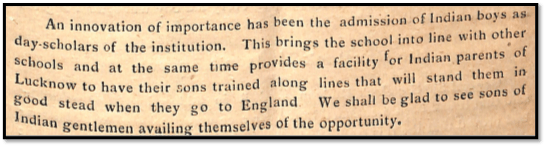
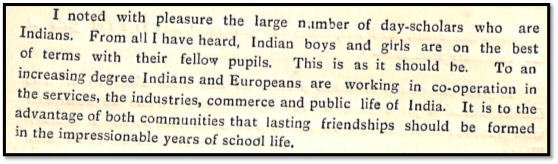
The condescension extended had to be felicitated the following year when, in 1921, Principal R. S. Weir in the Annual Report recorded:

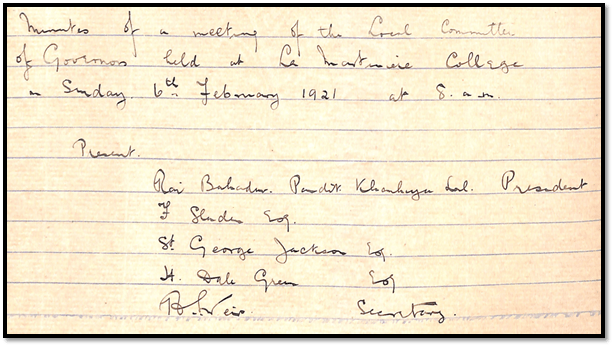
India was changing rapidly and men of stature, Indian by birth, were taking their places in Society, including La Martiniere. The ironies of history were made evident when the first ‘Indian’ Chairman of the Local Committee of Governors who was appointed was Rai Bahadur Pandit Kanhiya Lal, ICS, the Judicial Commissioner of Oudh. He had presided briefly as Chairman in 1919 and thereafter took over as Chairman for an extended period in 1921. Pt. Kanhaiya Lal had been a distinguished member of the Provincial Service and later became a Judge of Allahabad High Court.
‘Rai Bahadur’ was the honorific title given by the British in India, primarily to Hindus. Similar titles were awarded to other religious communities, such as ‘Khan Bahadur’ for Muslims. The earlier refusal for admission of Khan Bahadur Mohammad Hasan Khan by the same Committee under a different Chairman was evoked.
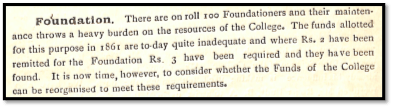
The Principal’s Annual Report for 1923, delivered on Prize Day, 1924 confirmed that there were 100 scholars assisted by the Foundation. The breakup of numbers of Foundationers and demi-Foundationers was not quoted, but from 1924, the number of Full Foundationers was maintained at a maximum of 50, while the number of demi-Foundationers was increased to 50.
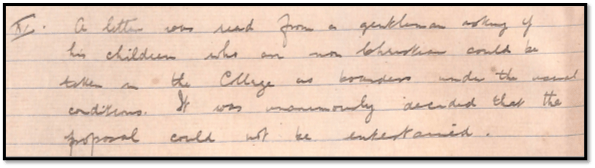
The demographics of the College were defined by societal mores and communal considerations. While it was by then an accepted that Indians would be considered for admission as day-scholars, communal living with boys of other faiths was still not accepted. On 8 March, 1924 applications for boys for admission to the Boarding house were rejected unanimously, as the boys were non-Christians.
Rather than admit non-Christian boys to the Boarding House, Mr Charles Currie, Commissioner of Lucknow and a Governor of the College mooted a proposal for building a hostel exclusively for Indian boys. This was when he addressed parents on Prize Day in 1925, for which he was the Chief Guest:

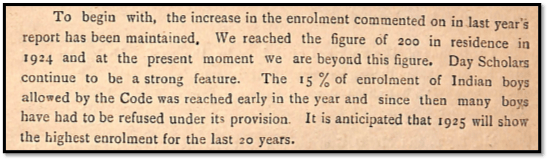
The Government Code for European Schools required that up to 15% of pupils were to be Indian boys. Principal Weir reported in 1925:
The demarcation to restrict the percentage of Indian pupils was sanctioned by official approval, despite Indian officers increasingly being in control. On 24 February, 1926 with Justice Wazir Hasan as Chairman, the following resolution was adopted:
“VII Read a letter from the Inspector of Schools to the Governors asking their views on the advisability of altering the 15% rule regarding admission of Indian boys. The Governors decided that they were in favour of no change in the figure for the present but that they would communicate with the Inspector should fresh exigencies arise.”
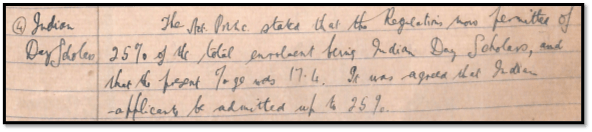
By 1928, Principal W. E. Andrews reported to the Govenors on the changing demographics in the College as required by law. On 29 July, 1928 it was therefore resolved:
Indian Day Scholars
The Principal stated that the Regulations now permitted of 25% of the total enrolment being Indian Day Scholars, and that the present percentage was 17.4. It was agreed that the Indian applicants be admitted up to 25%
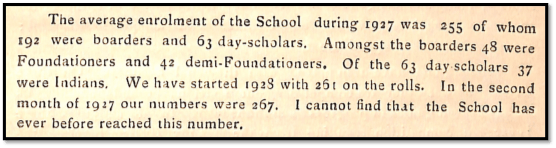
The demographics of the College increasingly began to reflect the number of Indians admitted. Figures were scrupulously maintained. In the Annual Report of 1928, the Principal reported that of the 63 day-scholars in attendance, 37 were Indians.
A gradual change in attitude towards Indian students was also surfacing, compelled, no doubt by the reality of circumstances. Chief Guest Sir Alexander Muddiman, Kt, KCSI, CIE and Governor of the United Provinces of Agra and Oudh at Prize Day, 10 March, 1928, attempted to smelt racial acceptance:
By 1928, the Committee recorded that as per the regulations in force, 25% of Indian boys could be admitted as day-scholars. The Indian community had been under-represented at 17.4 %. On 29 July, 1928, this anomaly was sought to be rectified.
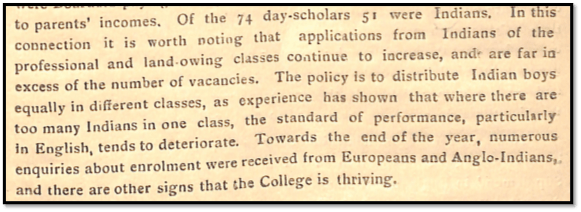
The admission of Indians boys, generally of professional and land-owning classes, was not without its difficulties for the European School. Chief among them was that standards in English were deteriorating. In his Annual Report on Prize Day, 1930, Principal Andrews recorded:
The changes that were taking place were rapid. On 23 August, 1930 the Governors asserted that the College was being run on the pattern of a British Public School and that there was a preference for masters with a British University training, despite the accusations of racial discrimination.
8. Resolution of Anglo-Indian and Domiciled European Association of All-India & Burma
A circular letter from the Education Department, U. P. Govt, to all Governing Bodies of European Schools, was read, asking for opinions on a resolution of the Anglo-Indian and Domiciled European Association, All India and Burma.
The resolution briefly was that
(a) the matriculation examination should be taken by students in European Schools,
(b) racial discrimination in making appointments to the higher posts on European Schools should cease, such appointments to be made irrespective of nationality and of the country in which the degree is obtained,
(c) Indians should not be members of the Governing Body of a European School.
The Committee were of the opinion that
(a) the Matriculation Examination might be introduced as an option, but that the existing curriculum of studies and of public examinations should not be altered,
(b) this paragraph was badly worded and did not express the Associations real intentions: that this College, being run on the lines of a British Public School, would prefer men with British University training;
(c) legislation on this point was not necessary.”
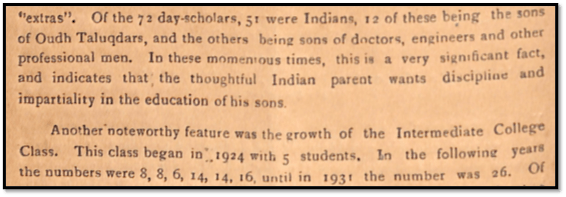
In 1931, Principal Andrews’ Annual Report presented the growing popularity of the Intermediate College system, which had a direct bearing on the demographics of the Institution. Both the domiciled European community as well as the Indians admitted to the College were aware of the need for higher education. Principal Andrews recoded “that “the thoughtful Indian parent wants discipline and impartiality in the education of his sons … It is obvious from this that the domiciled community are now fully alive to the importance and necessity of higher education.”
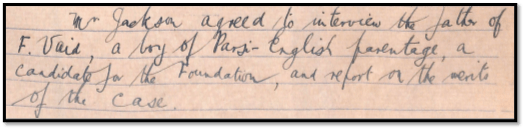
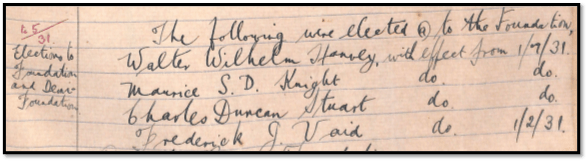
The admission of boys despite their faith began to change in the third decade of the century. An exceptional case, details of which are withheld, is when the application of a Parsi-English boy was received for admission to the Foundation. This had never happened before. A highly respected Governor of the College St George H. S. Jackson, MLC and Bar at Law agreed to interview the father of the applicant Fredrick Vaid to report on the merits of the case. The details of the interaction are not available, but on 17 April, 1931 Fredrick J. Vaid was among the boys officially elected to the Foundation.
 Macky's Mart
Leave a comment