
Military Comportment
Alongside academics and accreditation, the European nature of the demographics of La Martiniere was maintained by a strong and much-admired Volunteer Corps, a Civil Defence movement with the underlying purpose of being able to call up reserves of young men in case of an emergency, such as had evinced itself in 1857. This was exclusively for British and Anglo-Indian boys. While the physical training and skills taught were useful, the underlying principle was to further the gap between the ‘us’ and ‘them’ of the European and the Native.
Following the harrowing events of 1857, the first formalisation of a military tradition had been the affiliation with the Oudh Volunteer Riles (1859) and the Cadet Corps (1860) consisting of school-age boys. The bearing of arms and military drill inspired generations to join the armed forces both for the Empire and later, in Independent India. The excellence in activities related to the National Cadet Corps (NCC) thereafter is a direct offspring of this exercise.
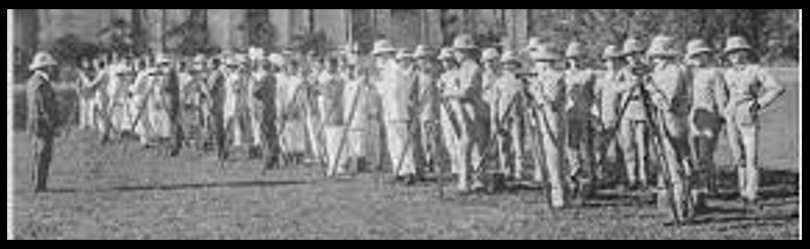
In 1909, the activities of the Volunteer Corps were singled out for special commendation by the Principal in his Annual Report:
“Now what is being strongly advocated in England, not only by the Heads of some public Schools but by the War Office, is that with a view to ensure an effective increase in the defensive forces of the country, drill and Military training should be made a part of the education of all School boys of suitable age and size. Here in the Martiniere, as far as this particular School is concerned, we have, I think, anticipated this movement and gone a considerable distance in this direction, having done our part in the great programme for “the universal training of English School boys in drill, manoeuvre, and the use of arms.”
“Every boy who comes to the Martiniere is required on attaining a certain age and size to go through the Musketry Course and to drill regularly with his Company, making use of the Rifle or Carbine which the Government supplies. He begins his practice with the Morris Tube in the shooting gallery attached to the Gymnasium and then proceeds to the Rifle Range on the Martiniere grounds.
“In this way the school has done its share to provide a reserve of trained men who can be relied upon in an emergency.
“This has been going on for the last thirty years during which time the Martiniere Volunteers on leaving school, some 1500 of them, have carried their knowledge of weapons and drill to every part of India…
“Yes, there is every reason to believe that, if the occasion should arise, they would behave just as well as their gallant predecessors and fathers who, in the Siege of Lucknow in 1857 held ‘the Martiniere Post’ in the Residency.”
At the commencement of the First World War, the Volunteer Corps was disbanded and replaced by the unpopular Indian Defence Force (IDF). This was a part-time defence force established in 1917 to release regular troops from garrison duties. Units in the British section were all British and many of the Europeans were conscripted. Under the IDF, military service was compulsory for all Europeans residing in British India between the ages of 16 and 50. Boys of La Martiniere between 16 and 18 were only obliged to undertake training and not service. The IDF was generally unpopular due to conscription.
The Chief Guest at Prize Day, held on 24 March, 1918, Major-General E. S. May, C.B, C.M.G. referred to the unpopular move to disband the Lucknow Volunteer Rifles.
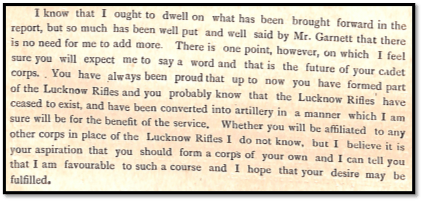
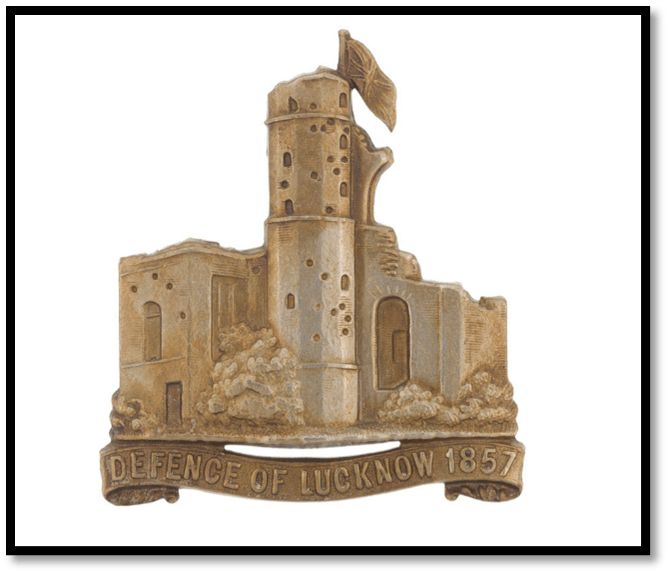
On that day, the Principal Mr Garnett in his report for 1917, referred to the emotional link that had been broken when the Martiniere boys had had to surrender their badges, proudly worn in recognition of the contribution during the Mutiny. He complained that the vibrant infantry tradition in the College had been replaced by the artillery:


Nevertheless, the Martiniere boys received good reports from the Garrison Commander of the IDF:
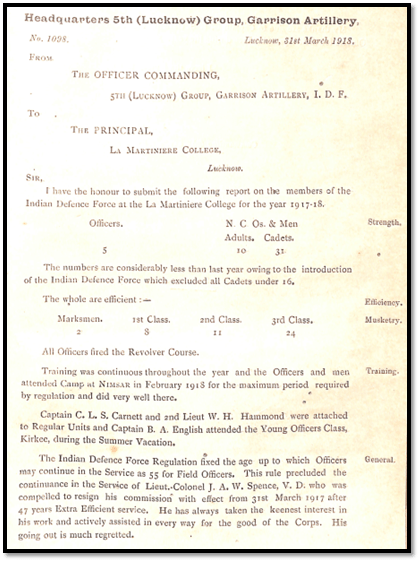
The unpopular Indian Defence Force was disbanded and replaced by The Auxiliary Force (India) (AFI). This was a part-time, volunteer military organization formed in 1920. It was open only to Europeans and Anglo-Indians and was modelled after the British Territorial Army. The AFI was disbanded after India’s partition, and its role was succeeded by organizations like the modern Indian Territorial Army and the National Cadet Corps (NCC).
Appreciation for the contribution of the Martiniere boys was received from the Commanding Officer of the Lucknow Auxiliary Force in 1922.
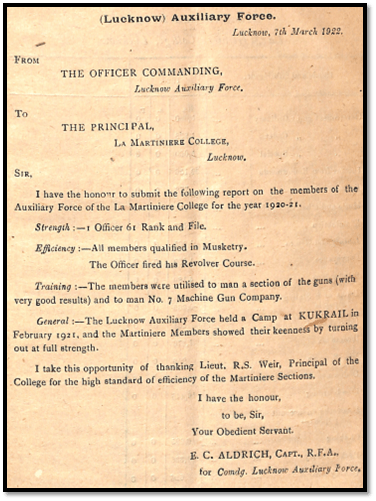
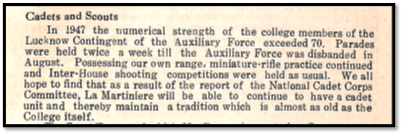
The annual Military Training Report, a component of the Principal’s Report for 1947 records: “The Lucknow Contingent of the Auxiliary Forces (India) was disbanded finally on 14th August, 1947.”
The National Cadet Corps (NCC) was formed as the youth wing of the Indian Armed Forces. The NCC was officially raised on July 15, 1948 following the promulgation of an Act of Parliament based on a bill approved by the Constituent Assembly.

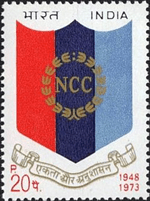
Commemorating the 25th Anniversary Of The NCC, 1973
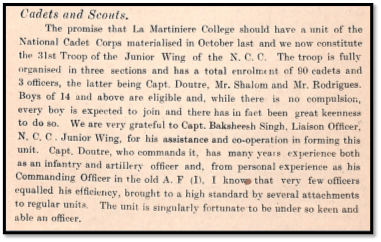
The establishment of the National Cadet Corps in the College was a continuum of successive systems of national service and para-military training. Unlike its previous avatars, the NCC was exclusively for Indian citizens:
 Macky's Mart
Leave a comment