
THE NATIVE SCHOOL
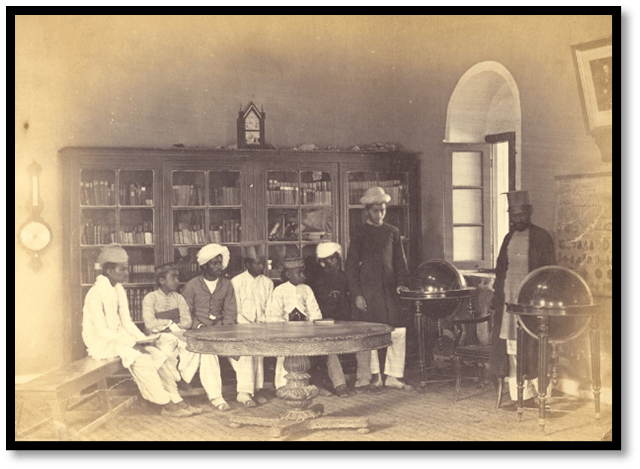
The Native School was established perforce to fulfil, with minimum questioning, the provisions of the Will of the Founder and the directions contained in the Scheme of Administration as decreed by the Court. The discriminatory attitude was evident from the time of establishment. The fear, propelled by the events of 1857, only added to the establishment being seen as an excrescence. The Native School could not be wished away as it had existed for more than 12 years under the directions of Trustees and Governors. The gradual dissolution began with the decision to move the Native School out of Constantia. This was achieved by means of a clever ploy, to ostensibly relocate the facilities to an area closer to native habitation for the advantage of the native students.
A series of hurdles were set up to gradually close the Native School. This formally proposed on 20 August, 1860 it was resolved by the Committee:


In addition, a fee was charged for each pupil. This was in an age when education was not at a premium and the cost effectiveness of sending a boy to La Martiniere rather than a cheaper local school was an option. Education itself was not given great importance and in any case, La Martiniere for the native pupils was not a sought-after brand. Parents who had admitted their children to the Native department with the false impression that they would receive a stipend were now expected to pay a fee, which was unthinkable.
The Committee simultaneously resolved:
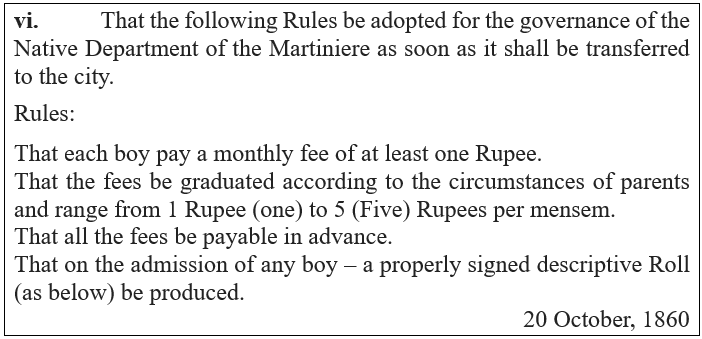
Following an outcry, the Committee, three months later, on 15 February, 1861, altered its decision regarding fees. It offered sops by reducing the base fee by 50%. A sliding scale would be followed for fees, depending on the income of the parents. In addition, a new category of Native pupil, i.e. the ‘Scholarship Holder’ was set up. This was a reinvention of the provision in the Scheme of Administration where the Martin Charities had offered education to boys of all communities and sects. The earlier Native Foundation was reinvented in this manner. Charity was no longer gratuitous but had to be earned.

By now, the Native School was out of Constantia and functioning at what was informally known as Makbara Wajid Ali Shah, the Sibtainabad Imambara in Hazratganj. This housed the tomb of Amjad Ali Shah and others. The construction was completed by his son Wajid Ali Shah.

The creation of Native scholarship-holders in February, 1861 was immediately followed by a well-reported decision regarding Native Christians who had until then benefitted from the Native Foundation. The Principal’s Report acknowledged, “In March, 1861, the Native Christians of the Foundation were removed from the Native Department and attached to the European side and distributed into 3rd and 4th Classes of the College.” The demographics were changing yet again with 14 Native Christians now physically living with European & Anglo-Indian boys which included 75 Foundationers and 27 Boarders.

The building in which the Native Department of the College has hitherto been conducted has by order of the Chief Commissioner been made over to the relatives of the late King of Oudh. The “Doulat Khana” has been placed at the disposal of the Committee and I now write to request your permission to have the place cleaned and it rendered fit for the reception of the Native Scholars. The large room in the building which I propose for the school room requires whitewashing and some trifling temporary repairs. All that is now absolutely necessary might be done I think for an amount of Rs 30/-/- (Thirty). I request for permission to expend this sum in order that the duties of the school may commence on 1st of next March.
Circular, 11 January, 1864
Nevertheless, it was still considered an unnecessary burden to continue with the Native School:
Resolution VI
Resolved that the Principal be requested to draw up a report on the advisability of closing the Native Branch of the College (at present located in Dowlat Khana) and of making such arrangements with the Committee of the Canning College as shall ensure compliance with the terms of General Martin’s Will, while the necessity of keeping up a separate establishment for the Native Department shall be done away with.
Minutes, 26 October, 1867
The scheme of ‘Scholarship Holders’ in the Native School was made more stringent, though an attempt was made to align the system with the original Foundation system that existed when the School began in 1845. On 29 June, 1869 the Committee:
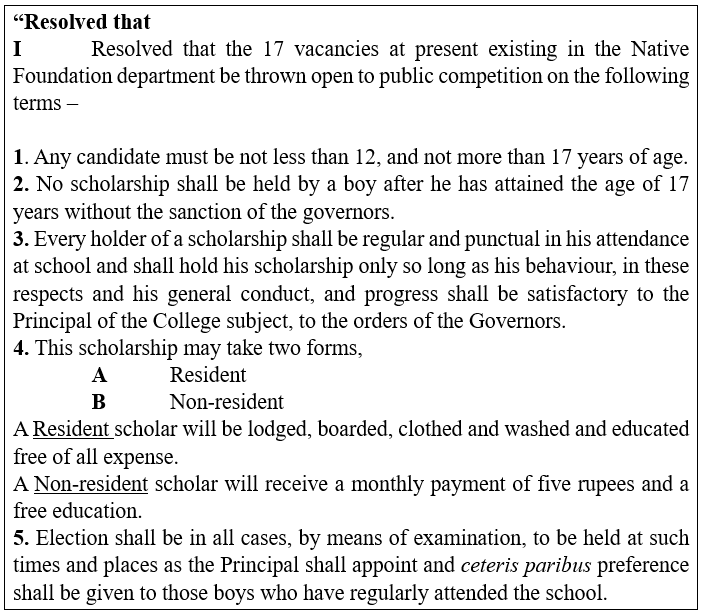
The Native School’s concerns again surfaced when the use of the Daulat Khana was challenged.
Resolution III
With reference to Commissioner of Lucknow’s letter No 4103 of the 1st December, 1871 regarding the Dowlat Khana building. The Principal is directed to see if he cannot find some other building for the accommodation of the Native School.
Minutes, 13 March, 1872
Resolution I
The Secretary reported that he had made search for some building for the accommodation of the Native School and had found a home near the Residency which could be had at a rental of Rs 60/- per mensem. The Committee orders for the matter to be laid over for the present.
Minutes, 29 June, 1872
Resolution III
The Committee directs that the subject of providing accommodation permanently for the Native School is to be broadly formed at the next meeting, by which time, it is hoped the Secretary will be able to lay before the Committee a plan and estimate for a School House and that some eligible site will have been selected for consideration. It was mentioned that probably the Local Government might be able to grant a site.
Minutes, 8 August, 1872
Resolution 1
That the Native School remain in the house of Banarsi Das until the end of the present scholastic year (30 November 1872) as no better provision can be made for it in the interim.
Minutes, 10 September, 1872
The search for a site for the Native School continued, despite the enormous land bank controlled by the Martin Charities. Speaking of enrolment in the Native School in 1873 the Principal reported:
“In the Native Department there has been a decrease of thirty. This decrease of thirty boys in the number of scholars attending the Native branch of the College is the consequence of having had to leave the former school-house, the “Dowlut Khan Burradarree,” a conveniently situated building near the populous part of Lucknow. The Native branch is now located in a house called “Sajee-ka-Bagh”, on the north of the Goomtee and away from any pupil-supplying population.”
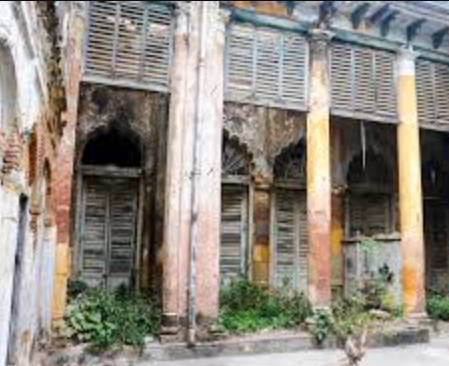
Shahji Ka Kothi was already in a dilapidated condition, made famous later as the residence of litterateur Amritlal Nagar.
Two years later, on 30 July, 1875, the decision for a site for the Native school was still in abeyance.
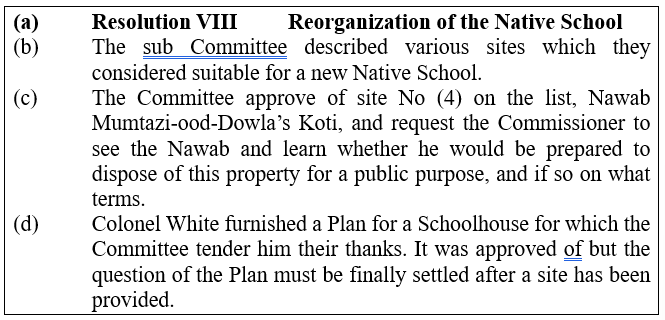
After almost twenty years of dragging their feet, the decision to abolish the Native School was taken in September, 1876. The school was to close at the end of that academic year, i.e. 30 November, 1876. A huge legacy was done away with, changing the demographics of La Martiniere, Lucknow for nearly 75 years, till the Independence of India in 1947.
Native School: Laid before the Committee the correspondence on the Native School as called for by Resolution IX of 8th July last with the opinions of the Members as to the real need of maintaining in the City of Lucknow a separate Institution for the education of Native youths through the medium of the English Language.
Resolution. As the Trustees find that a separate Institution in the city away from Constantia is opposed to the terms of General Martin’s Will and as the Oriental Department in Constantia which aimed at teaching Arabic and Persian proved a failure, the Members of the Committee agree with the Trustee “ that the Native School need not be settled down into a permanent annexure to the Martiniere Institution” and that “the money now expended on the establishment attached to that school should be utilised in improving the position of the Martiniere College”. They therefore vote for the abolition of the Native School to take effect from 30th November next, the end of the scholastic year.
Thomas Sykes
Officiating Secy, Local Committee
Minutes, 7 September 1876
The excuses and cover-up were immediate:
- It was promoted that the Oriental Department had been established with the aim of teaching Arabic and Persian and had proved a failure. This is furthest from the truth, as Claude Martin had willed that a school be established for young men and boys to learn the English language.
- The Native School was projected as being “opposed to the terms of General Martin’s Will”, though it was conveniently ignored that Martin had envisaged a single school in Constantia where all communities and sects would be admitted. This was the foundation of the Scheme of Administration set out by decree in 1840.
- The Native School “need not be settled down into a permanent annexure to the Martiniere Institution”; this dichotomy had in fact been artificially applied in dividing the Lucknow community into two separate departments – the European & Anglo-Indian and the Native.
- Finally, “the money now expended on the establishment attached to that school should be utilised in improving the position of the Martiniere College” was rather like robbing from one child to satisfy another.
It is observable that the Governors procrastinated and allowed the native School to die. A great disservice to the spirit of the Founder’s Will was conducted under the nose of the Court and the Trustees. In the meantime, the funds no longer required for the Native School were sought to be utilised for, ironically, ‘native’ female education that had not been envisioned by the Founder, for the Lucknow Martiniere.
An outcry was diverted when gratuity was paid to the Masters of the Native School.
Order: Masters who have served six (6) years or upwards are to have six (6) months half salary from1 December, 1876, payable monthly, and to cease should they obtain employment within the period. The other Masters are to be *** in like proportion according to length of service, 5 months ½ pay for 5 years’ service, etc.
Minutes, 26 October, 1876
The upshot of the closure of the Native School led to the increase in the number of boys to be admitted to the Foundation. In February, 1877, the number was set at 90.
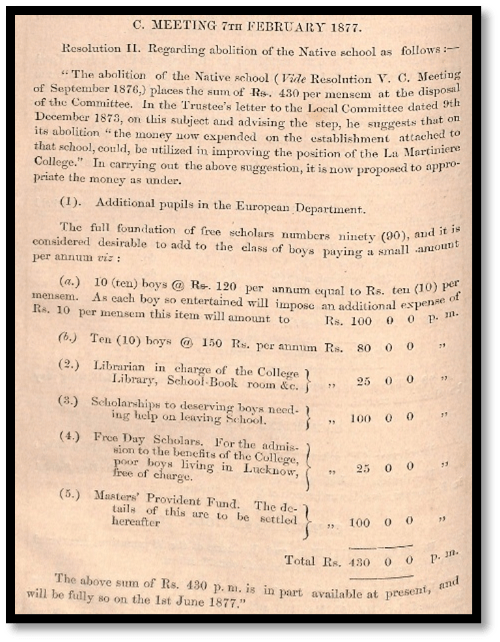
The demography of La Martiniere, Lucknow was moving towards a completely European school. There were no more native pupils. It would take decades for the first native boy to be admitted to the College.
There was no expenditure on the native foundation anymore; the funds being utilized for the foundationers in the European and Anglo-Indian establishment. La Martiniere had metamorphosed into a very European school.
 Macky's Mart
Leave a comment