
October 1 has been designated as Constantia Day since 2012. It is the date, in 1845, when classes were first conducted in the College. While this may be seen as the Foundation Day of the College in Constantia (therefore Constantia Day), it is not be confused with Founder’s Day, the 13th of September, which was specifically designated by the Founder to commemorate the date of his death.
For forty years after his death, Claude Martin’s Will was contested by persons connected with him from India and France. The matter found its way to the King’s Privy Council that issued directions to the Court in Calcutta to set out a Scheme of Administration for the establishment of the school in Lucknow. The said decree by which this was established was issued on 21 December, 1840. It took another five years for the basic infrastructure to be readied to receive the first boys of the College.
It was the intention of the first Trustees of the Institution for the College to be opened on 13 September, 1845, wherein Founder’s Day and Foundation Day would coincide. A series of circumstances prevented that from happening.
The Pro Tem Committee of Governors was made up of select individuals in Lucknow, with the British Resident serving as the ex-officio Visitor of the College. The officiating Honorary Secretary to the Committee was the medical doctor, James Spencer Login M. D. working in pro tem capacity, Dr Login was specially chosen for the task, being a member of the inner circle of the officiating Resident Mr T. R. Davidson. Login was the Resident Surgeon in Lucknow in 1838 as well as physician to the Court of Oudh. This 39 years old Scotsman was a man of several parts, well-suited for the task.
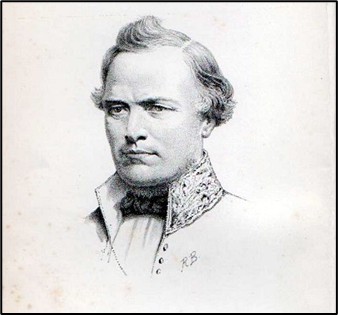
Sir James Spencer Login M. D.
Login was deeply influenced by the Scottish Enlightenment, a movement that emphasised education, rational thought and moral responsibility. These were the contributing factors for him to be appointed as the first Honorary Secretary of La Martiniere establishment. His most intense work was compiling the first Rules and Regulations of La Martiniere College. This contribution effectively set the foundation for the ethos of the College.
Dr Login’s contribution to the establishment of La Martiniere, Lucknow is overshadowed by his other achievements while in the service of the East India Company. Notable among these is his appointment as the Governor of Lahore in 1849. He will always be remembered by history for the most poignant aspect of his career, which was his guardianship of Maharaja Duleep Singh, the deposed child ruler of the Sikh Empire following the annexation of the Punjab in 1849. In addition, he was entrusted with the possession of the famous Koh-i-Noor diamond.
Dr Login and his wife Lena Campbell took care of the young impressionable boy, accompanying him to England where the child became a favourite of Queen Victoria. It is Login who conveyed the famous Koh-i-Noor to Governor General Lord Dalhousie, which later was presented to Queen Victoria, under circumstances that are controversial till today.
To understand the administrative foundation on which the College is built, it is significant to consider the members of the Committee of Governors throughout its history. The first members of the pro tem Committee included the following:

T. Reid Davidson served as the officiating British Resident in the court of the Nawab of Awadh in Lucknow from 1845 to 1847.
No information extant. The supposition is that as per his rank, he would have been effective as an officer of the Bengal Army of the East India Company, and stationed in Lucknow Residency, which was also known as Lucknow Cantonment.
Robert Merttins Bird, a British colonial administrator, known as the Father of Land Settlement in Northern India. He is recognized for developing the land revenue system in the North-Western Provinces of British India, which included the area that is now Lucknow. Between 1833 and 1841, he oversaw land settlement operations and implemented the “Mahalwari” tax reform. He held the honorary rank of Captain.
Lieutenant Colonel Richard Wilcox was a British astronomer who served as the Royal Astronomer in the court of Nasir-ud-Din Haidar, the King of Awadh, in Lucknow during the 1830s and 1840s. He took charge of the royal observatory, known as the Tare Wali Kothi or “Mansion of Stars,” in 1835. The building is still extant as immediate neighbour to La Martiniere Girls’ College and now houses the State Bank of India. The observatory maintained advanced astronomical equipment. Wilcox assisted with the publication of the Lucknow Almanac and supervised the translation of English books and journals on astronomy into Persian and Urdu.
In common with the chaplains of the Army Chaplains’ Department, his ministry would have chiefly entailed leading public services, visiting military hospitals and burying the dead. During his period in Rai Bareli and Lucknow, the chaplain’s duties to the military were subject to ongoing refinement. In 1857, J. J. Carshore published his Bengal Chaplain’s Vade-Mecum, a comprehensive guide to EIC chaplaincy. Significantly, Carshore emphasized the chaplain’s responsibility for inspecting regimental schools, experience of which he had received while serving on the Committee of Governors of La Martiniere, Lucknow.
Minute No I of the Local Committee of Governors was recorded by the Officiating Secretary, Dr J. S. Login. The struggles of practicability while following the letter of the law was evident at this tentative time. Much of the formality and anxiety was related to an interpretation of the fulfilment of the decretal orders of the Court regarding the date of establishment of the College. The Court had decreed that the College was to be opened on Founder’s Day, the 13th of September, which the Founder himself had determined should commemorate the date of his death. However, the first Principal who had been appointed could not be present in Lucknow until the 23rd of September, 1845. The opinions of the Members were solicited. This is on record as the very FIRST official Minute of the Local Committee of Governors, 180 years ago!
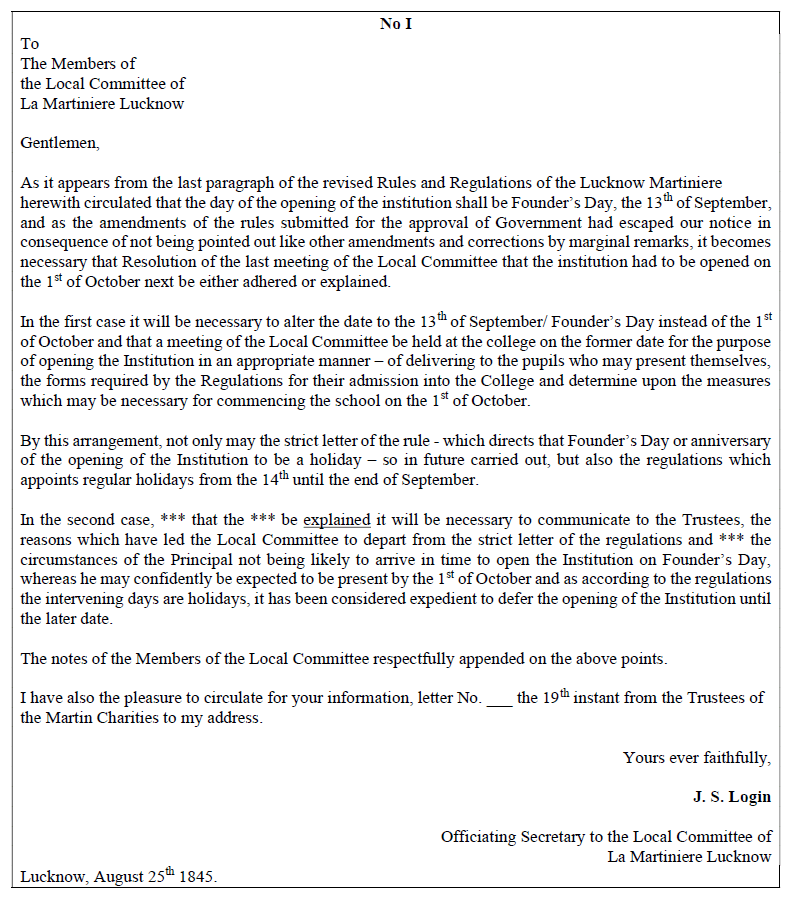
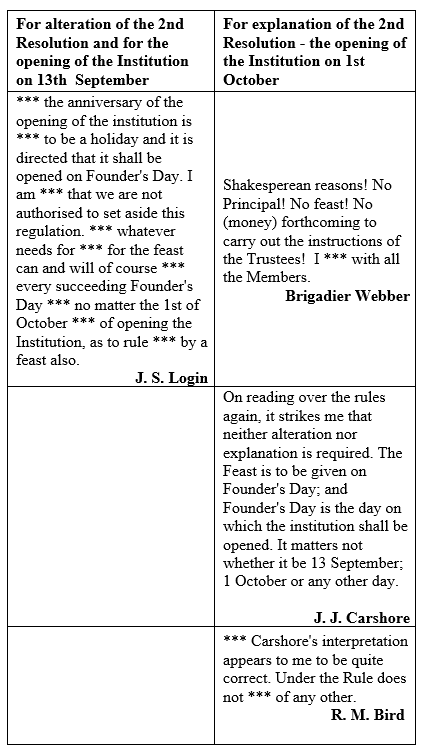
The first Principal, Mr John Newmarch, arrived in Lucknow on 23 September, 1845. The formality of taking charge as Principal and Secretary to the Local Committee of Governors was completed and recorded by Dr Login:
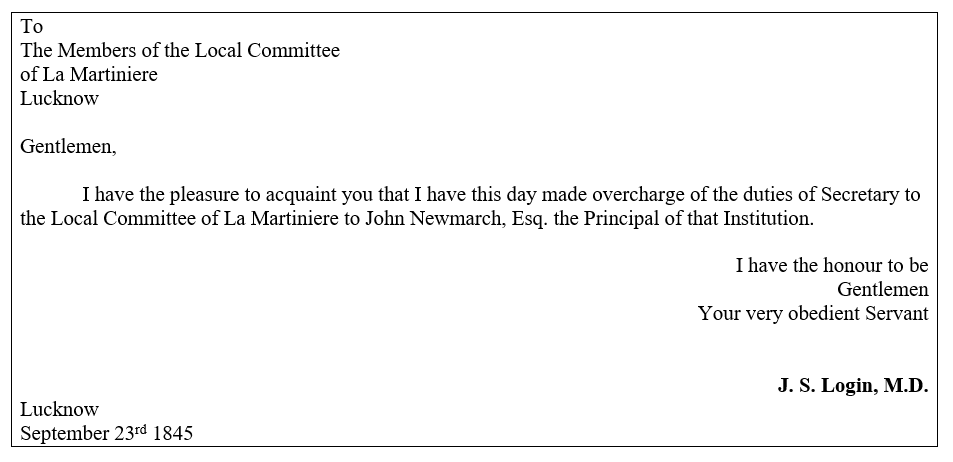
Classes began a week later on 1 October, 1845 – Foundation Day, today known as Constantia Day. This was recorded in the first monthly Report of the Principal to the Governors on 12 November, 1845 by a simple confirmation: “The College opened on the 1st of October last”.


 Macky's Mart
Leave a comment